Facts
The petitioner sought a writ of habeas corpus for production of his sister, Surekha, who went missing on 20 May 2026 after leaving for work at a garment company.
Source reference: para. 2He stated that he searched for her and later complained to the Home Minister on 5 July 2026. The University Police registered Crime No. 108/2026 as a missing-person case, and the investigation was ongoing.
Source reference: paras. 4–5The petitioner also relied on two letters said to have been written by his sister and alleged that she had been kidnapped and subjected to physical and mental torture.
Source reference: para. 7The State opposed the petition, contending that no person was alleged to have unlawfully confined her and that the police were investigating the missing-person case.
Source reference: para. 5Issues
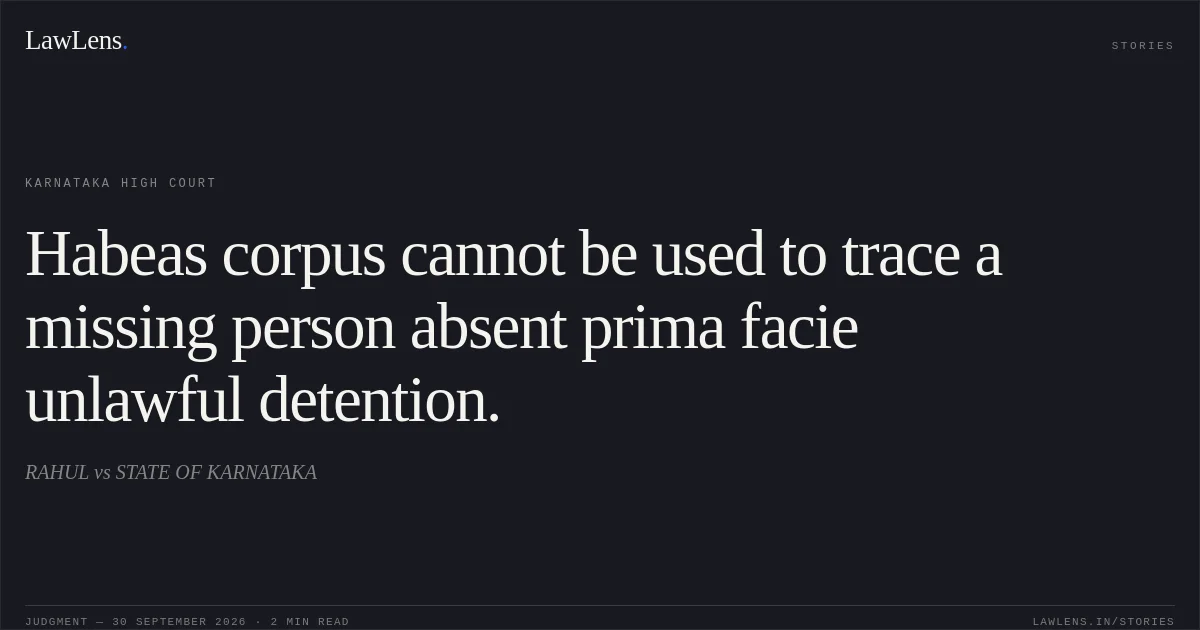
Whether a habeas corpus petition is maintainable to trace a missing person where no person is alleged to be responsible for her unlawful detention.
Source reference: paras. 5, 7–9Whether the petitioner established a prima facie case of unlawful detention warranting a direction for production of his sister.
Source reference: paras. 7–9Law Applied
Under Articles 226 and 227 of the Constitution, the extraordinary remedy of habeas corpus is directed at unlawful detention; it is not a general mechanism for tracing every missing person.
Source reference: para. 7The Court relied on Union of India v. Yumnam Anand M. alias Bocha alias Kora alias Suraj, (2007) 10 SCC 190, for the principle that habeas corpus powers are exercised in cases of illegal confinement and ex debito justitiae; Home Secretary (Prisons) v. H. Nilofer Nisha, (2020) 14 SCC 161, for the requirement to determine whether the person is under illegal detention; and Sulochana Bai v. State of M.P. and Others, 2008 (2) MPHT 223, for the principle that habeas corpus is not available merely because a person is missing, absent wrongful confinement by the police or a private person.
Source reference: para. 7Reasoning
The Court found that the petitioner’s case was that his sister was missing and that the police had already registered a missing-person case and were investigating it.
Source reference: paras. 7–9The petition did not identify any person alleged to have unlawfully detained her, nor did it otherwise establish a prima facie case of unlawful confinement.
Source reference: paras. 7–9The Court also noted that, although she went missing on 20 May 2026, the petitioner and his father did not lodge a complaint until 5 July 2026.
Source reference: paras. 7–9In these circumstances, the requested writ could not be used simply to trace her; the petitioner could pursue other effective remedies.
Source reference: paras. 7–9Holding
The Court held that the habeas corpus petition was not maintainable and dismissed it.
The dismissal did not prevent the State from taking appropriate steps in accordance with law.
Source reference: para. 10Original Court PDF
RAHULvsSTATE OF KARNATAKA
Click to open original judgment
Original judgment, available to read, download and summarize on LawLens.in