Facts
The petitioner filed a writ petition under Article 226 of the Constitution read with Section 528 of the Bharatiya Nagarik Suraksha Sanhita, 2023, seeking a writ of habeas corpus for production of his minor son, aged approximately eight years, alleged to be in the illegal custody of the petitioner’s wife and others.
Source reference: p.1, para.1The petitioner and respondent no. 3 married on 22 November 2015, and their son was born on 2 August 2018.
Source reference: p.2, para.2The petitioner admitted that the child had remained in the mother’s custody since birth and that the parties had been living separately since 2016, with the mother and child residing in Haridwar, Uttarakhand.
Source reference: p.2, paras.2–3He alleged that he had not seen the child for approximately two years and had made complaints to the police seeking assistance in meeting him.
Source reference: pp.2–3, paras.3, 5The petitioner had also initiated matrimonial and visitation-related proceedings before the Family Court at Haridwar.
Source reference: p.2, para.4; p.3, para.6Issues
1. Whether a writ of habeas corpus under Article 226 could be issued for production of a minor child who was admittedly residing with his mother, an ordinary resident of Uttarakhand, particularly when custody and visitation proceedings were pending before the competent Family Court.
Source reference: pp.3–4, paras.6–92. Whether the petitioner could invoke the writ jurisdiction of the Delhi High Court to determine a family custody/visitation dispute notwithstanding the availability of a specialised forum and the pendency of proceedings before the Family Court at Haridwar.
Source reference: p.4, paras.9–10Law Applied
The Court applied Article 226 of the Constitution and Section 528 of the Bharatiya Nagarik Suraksha Sanhita, 2023 as the legal bases for habeas corpus jurisdiction.
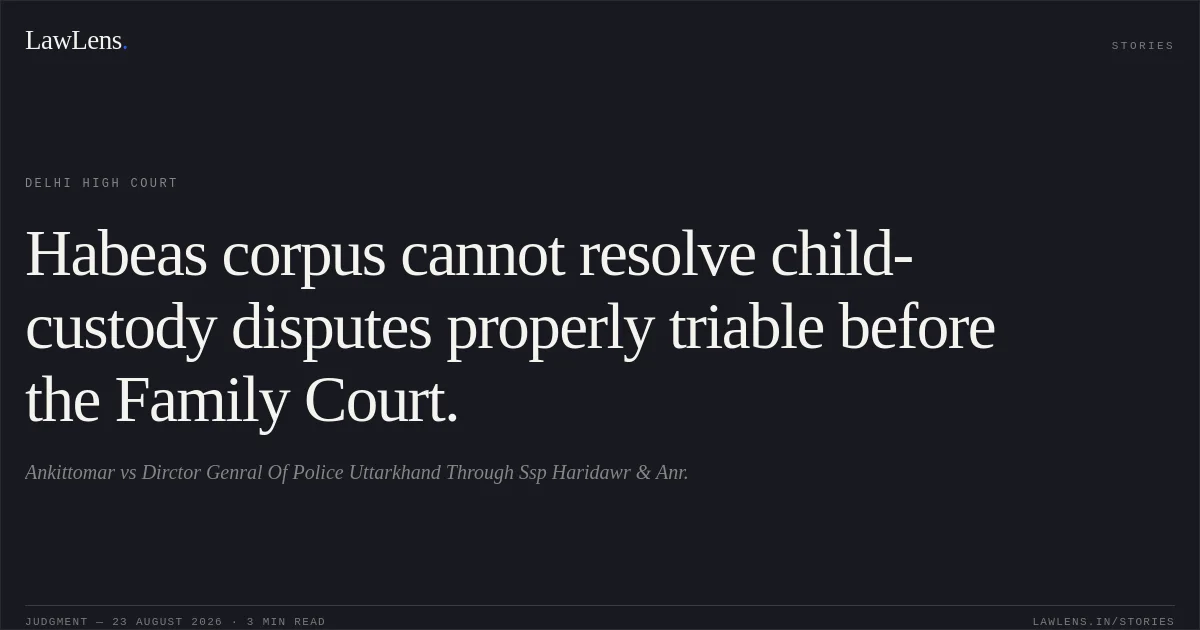
Source reference: p.1, para.1It held that the writ of habeas corpus is not an appropriate mechanism for adjudicating ordinary matrimonial, child-custody, or visitation disputes where the child is in the custody of a parent and the dispute can be determined by a competent specialised court.
Source reference: p.4, para.9The Court also relied on the existence of the Family Courts established under the Family Courts Act, 1984, observing that such family matters should ordinarily be pursued before that specialised forum.
Source reference: p.4, para.9Although the petitioner relied on Tejaswini Gaud v. Shekhar Jagdish Prasad Tewari, AIR 2019 SC 2318; Yashita Sahu v. State of Rajasthan, (2020) 3 SCC 67; and Gautam Kumar Das v. NCT of Delhi, 2024 INSC 610, the Court did not find those authorities applicable to justify issuance of habeas corpus on the facts presented.
Source reference: p.3, para.7; p.4, para.8Reasoning
The Court treated the petitioner’s own admissions as determinative: the child had ordinarily resided in Uttarakhand for several years and had remained in the custody of his mother, while the petitioner had already pursued legal proceedings concerning visitation before the Family Court at Haridwar.
Source reference: p.3, para.6In these circumstances, the custody was not shown to be prima facie illegal so as to warrant habeas corpus.
Source reference: no citationThe real dispute concerned matrimonial relations, custody, and visitation, matters requiring factual adjudication by the competent Family Court rather than summary determination in writ jurisdiction.
Source reference: p.4, para.9The Court therefore considered the petition an abuse of process intended to create multiplicity of litigation, notwithstanding the petitioner’s reliance on Supreme Court decisions concerning habeas corpus in child-custody matters.
Source reference: pp.3–4, paras.7–9Holding
The Delhi High Court dismissed the writ petition, holding that habeas corpus could not be used to determine the petitioner’s family and visitation dispute where the minor was residing with his mother in Uttarakhand and proceedings were pending before the competent Family Court.
The pending application was also disposed of.
Source reference: p.4, para.10The Court reserved liberty to the petitioner to approach the court of competent jurisdiction in an appropriate proceeding.
Source reference: p.4, para.10Acts & Sections Cited
4 provisions across 2 statutes referred to in this judgment. Linked provisions open on LawLens.
Bharatiya Nagarik Suraksha Sanhita, 20231
Hindu Marriage Act, 19553
Original Court PDF
AnkittomarvsDirctor Genral Of Police Uttarkhand Through Ssp Haridawr & Anr.
Click to open original judgment
Original judgment, available to read, download and summarize on LawLens.in