Facts
The petitioner filed a contempt petition alleging wilful disobedience of the Delhi High Court’s order dated 13 October 2023 in W.P.(C) 7373/2023.
Source reference: p.1–2, para.1In that order, the Court directed the petitioner to approach the Review Committee constituted by the Ministry of Home Affairs regarding his blacklisting and directed the respondents to provide him with the two addresses mentioned in his visa applications, which had formed the basis of the blacklisting.
Source reference: p.1–2, para.1The petitioner was permitted to submit a representation, and the Review Committee was requested to consider it expeditiously, preferably within six months.
Source reference: p.1–2, para.1During the contempt proceedings, the respondents filed a compliance affidavit dated 14 August 2026.
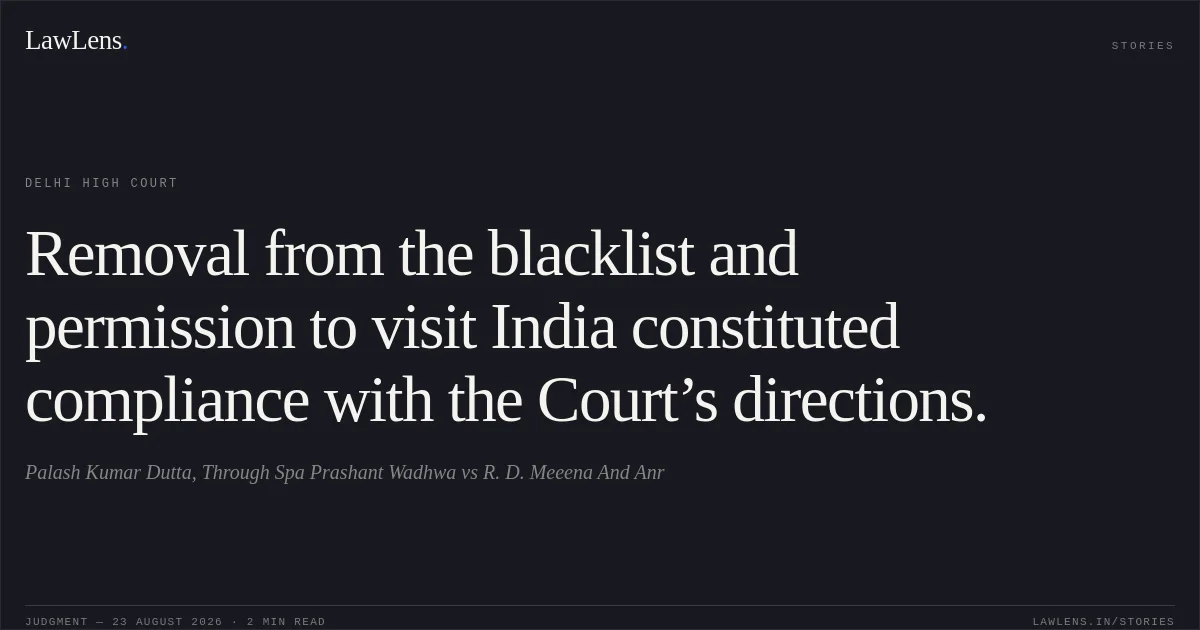
Source reference: p.3–4, paras.4–6The Court found that the petitioner had been permitted to visit India and that his name had been removed from the blacklist category.
Source reference: p.3–4, paras.4–6The petitioner nevertheless objected that the compliance affidavit described him as a Bangladeshi national, asserting that he held both Bangladeshi and Australian citizenship.
Source reference: p.4, paras.7–10The respondents stated that both passports were available with the Ministry of Home Affairs and that appropriate orders would be passed when the petitioner applied for a visa.
Source reference: p.4, paras.11–13Issues
1. Whether the respondents had wilfully disobeyed the directions issued by the Court in its order dated 13 October 2023 in W.P.(C) 7373/2023.
Source reference: p.1–3, paras.1–32. Whether the petitioner’s description as a Bangladeshi national in the compliance affidavit created an impediment to his obtaining a visa to visit India, despite the removal of his name from the blacklist.
Source reference: p.4, paras.7–13Law Applied
The Court applied the principle that contempt jurisdiction is concerned with determining whether a judicial direction has been complied with and whether any non-compliance is wilful.
Source reference: p.1–2, para.1The Court also applied the principle that contempt proceedings cannot be used to enlarge or modify the substantive relief granted in the original proceedings, particularly where the original order expressly recorded that no opinion had been expressed on the merits of the petitioner’s case.
Source reference: p.2, para.1Reasoning
The Court examined the original order and held that it had not directly permitted the petitioner to enter India or ordered automatic issuance of a visa; rather, it had directed him to pursue the remedy before the Review Committee concerning his blacklisting.
Source reference: p.2–3, paras.2–3On the basis of the respondents’ compliance affidavit, the Court found that the petitioner had in fact been permitted to visit India and that his name had been removed from the blacklist, thereby satisfying the material directions issued in the writ proceedings.
Source reference: p.3–4, paras.4–6The petitioner’s objection regarding his description as a Bangladeshi national did not establish disobedience of the original order.
Source reference: p.4, paras.7–13The respondents’ statement that both passports were before the Ministry and that appropriate orders would be passed upon a visa application was taken on record.
Source reference: p.4, paras.7–13Holding
The Court found no continuing wilful disobedience of its order dated 13 October 2023.
Since the petitioner had been permitted to visit India and had been removed from the blacklist, no further orders were considered necessary.
Source reference: p.4–5, paras.13–15The contempt petition and the pending application were accordingly disposed of.
Source reference: p.4–5, paras.13–15Original Court PDF
Palash Kumar Dutta, Through Spa Prashant WadhwavsR. D. Meeena And Anr
Click to open original judgment
Original judgment, available to read, download and summarize on LawLens.in