01Facts
The Petitioner (father) and Respondent No. 2 (mother) married in 2013 and relocated to North America, eventually settling in Canada as permanent residents.
p. 2Their son, Master ‘V’, was born in the USA in 2019.
p. 2In October 2023, the mother travelled to India with the child for a three-week vacation with the father’s consent but subsequently cancelled return tickets and remained in India, alleging matrimonial harassment.
p. 3She initiated criminal cases and a Guardianship Petition (GP No. 1/2024) under Section 25 of the Guardians and Wards Act in Delhi.
p. 3In March 2024, the Ontario Superior Court of Justice, Canada, granted the father interim sole parenting rights and ordered the child's immediate return, citing Canada as the habitual residence.
p. 3The father approached the Delhi High Court via a Writ of Habeas Corpus in August 2025 seeking the child’s return to Canada.
p. 402Issues
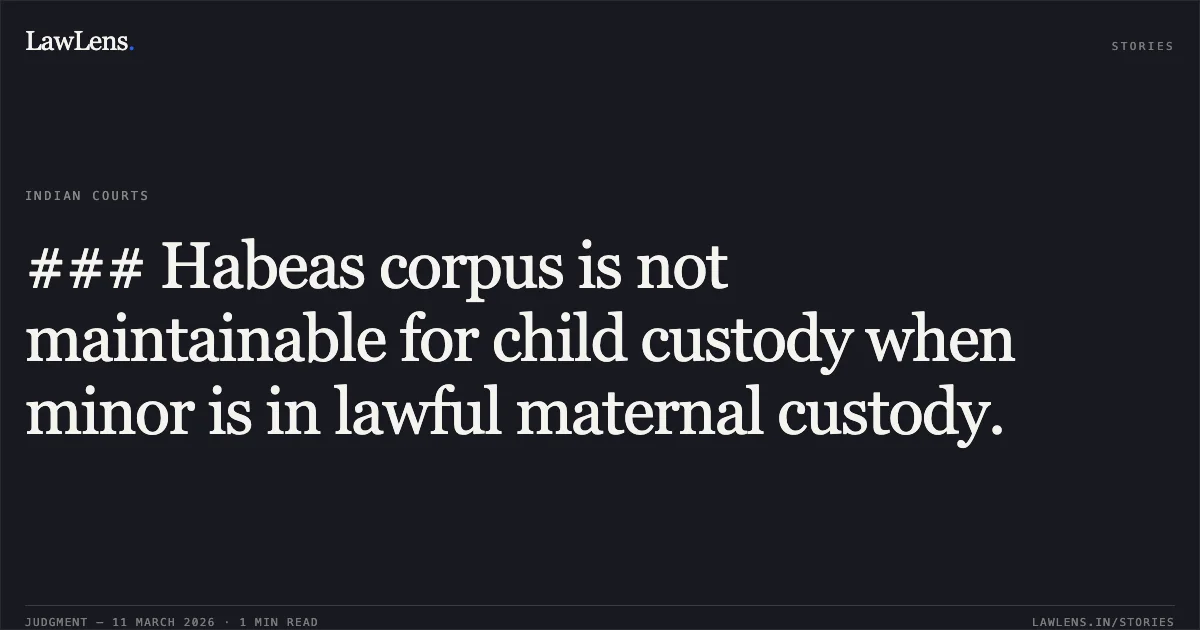
i.1. Whether a writ of Habeas Corpus is maintainable for the custody of a minor child when the child is in the custody of a biological parent.
p. 5/7ii.2. Whether an interim return order by a foreign court (Canada) must be summarily enforced by Indian courts via writ jurisdiction regardless of pending local guardianship proceedings.
p. 10/11iii.3. Whether the welfare of the child necessitates his immediate return to his habitual residence in Canada.
p. 1203Law Applied
The Court applied the principle that a writ of Habeas Corpus is an extraordinary remedy maintainable only if detention is "illegal or without authority of law".
¶ 20It relied on *Tejaswini Gaud v. Shekhar Jagdish Prasad Tewari*, holding that in custody matters, the ordinary remedy lies under the Hindu Minority and Guardianship Act or the Guardians and Wards Act.
¶ 23Following *Nithya Anand Raghavan v. State (NCT of Delhi)*, the Court established that the "welfare of the child is the paramount consideration" which overrides the "comity of courts" or "first strike" principles regarding foreign decrees.
¶ 24-25The Court further noted that foreign orders are merely one factor to be considered and do not convert the High Court into an executing court for foreign decrees.
¶ 24Provisions in the judgment · 3 · Linked ones open on LawLens
Indian Penal Code, 1860 Section 406Section 34
Guardians and Wards Act, 1890 Section 25
04Reasoning
The Court reasoned that since the child is with his biological mother, the custody cannot be termed "illegal".
¶ 20It observed that the Mother had already invoked the statutory jurisdiction of the Family Court in Delhi by filing a Guardianship Petition prior to the High Court being moved.
¶ 27The Court found that determining the child's welfare requires a "thorough examination of facts" and evidence, which is better suited for a Family Court rather than summary writ proceedings where rights are determined solely on affidavits.
¶ 23, 34Regarding the Ontario Court's order, the Bench held that the "welfare of the child must yield to the order of the foreign court" and noted the child had been settled in Delhi, attending school for over two years; thus, uprooting him abruptly without a detailed inquiry would be inappropriate.
¶ 32-33Finally, it ruled that the Petitioner’s pending challenge to the Family Court’s jurisdiction under Order VII Rule 11 CPC must be decided by that forum first.
¶ 29-3005Holding
The Court dismissed the writ petition, holding that no case was made out for the issuance of Habeas Corpus.
¶ 36-37The Court held that the existence of an efficacious alternate remedy (the pending Guardianship Petition) and the non-illegal nature of the mother's custody barred the exercise of extraordinary jurisdiction.
¶ 35The Family Court was directed to expeditiously decide the pending Guardianship Petition and the challenge to its maintainability on their own merits, uninfluenced by the High Court's observations.
¶ 38Original Court PDF
Varun Malhotra v. The State of NCT of Delhi and Ors. W.P.(CRL) 2808/2025
Click to open original judgment
Original judgment, available to read, download and summarize on LawLens.in