Facts
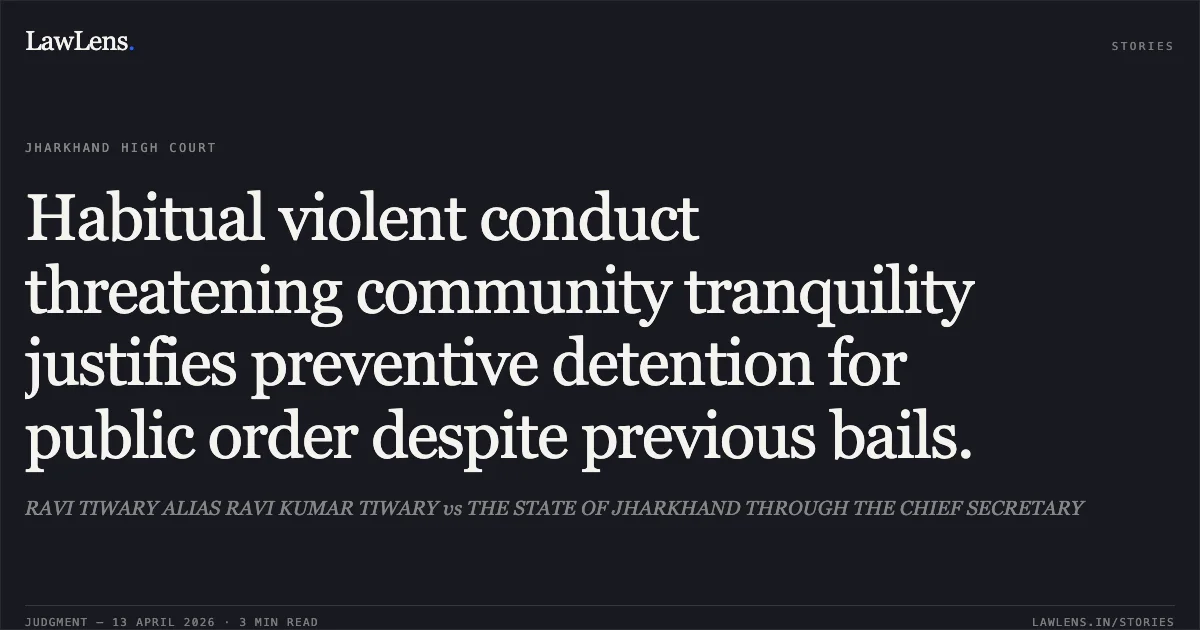
The petitioner, Ravi Tiwary, was placed under preventive detention by an order dated 07.11.2025 passed by the District Magistrate, Garhwa, under Sections 12(1) and 12(2) of the Jharkhand Control of Crimes Act, 2002
Source reference: para 4(v)The detention was based on the petitioner's involvement in 11 criminal cases and 6 sanha (station diary) entries, alleging that even while in judicial custody, he used henchmen to threaten the public and witnesses
Source reference: para 4(i)-(iv)The State Government confirmed the detention on 22.12.2025 and subsequently extended it on 30.01.2026 until 06.05.2026
Source reference: para 4(vi)-(vii)The petitioner challenged these orders via a writ of certiorari, contending that out of the 11 cases, he was acquitted in four and granted bail in six, leaving only one case where he remained in custody
Source reference: para 5(iv)He further argued that his actions constituted a "law and order" problem rather than a "public order" threat
Source reference: para 5(v)Issues
1. Whether the criminal activities of the petitioner fall within the definition of "Anti-social Element" under Section 2(d) of the Jharkhand Control of Crimes Act, 2002?
Source reference: para 10(i)2. Whether the acquittal and grant of bail to the petitioner in several cases preclude the passing of a preventive detention order under Section 12(2) of the Act?
Source reference: para 10(ii)3. Whether the petitioner’s criminal history and alleged activities threatened "public order" as stipulated in the Act or merely affected "law and order"?
Source reference: para 10(iii)Law Applied
The Court primarily applied Section 2(d) and Section 12 of the Jharkhand Control of Crimes Act, 2002, which authorize the detention of "anti-social elements" to maintain "public order"
Source reference: para 13, 18The Court relied on Vijay Narayan Singh v. State of Bihar (1984) to define "habitually" as a thread of continuity in repetitive acts
Source reference: para 16It further applied the "even tempo of life" test from Arun Ghosh v. State of W.B. (1970) and the "concentric circles" theory from Dr. Ram Manohar Lohia v. State of Bihar (1965) to distinguish between "law and order" and "public order"
Source reference: para 45-46Additionally, it cited D.M. Nagaraja v. Government of Karnataka (2011) to establish that subjective satisfaction for detention can be reached even if the detenu has been granted bail in individual cases
Source reference: para 36Reasoning
The Court found the petitioner to be a "habitual offender" under Section 2(d)(i) because his record displayed a persistent pattern of violent crimes, including attempt to murder, extortion, and multiple offenses under the Arms Act
Source reference: para 25-26Regarding the second issue, the Court held that the "subjective satisfaction" of the detaining authority is not vitiated by prior acquittals or bails; rather, the authority must determine if the detenu’s anticipated release poses a threat that ordinary law cannot suppress
Source reference: para 34-35The Court noted a "live and proximate link" between the petitioner’s past conduct and the need for detention
Source reference: para 39-40On the final issue, the Court determined that the petitioner’s use of henchmen to create panic and threaten witnesses while in jail moved the matter beyond a simple "law and order" issue into a "public order" disturbance, as it affected the community’s sense of safety and the "even tempo of life"
Source reference: para 54-56Holding
The High Court answered all issues in favor of the State, holding that the petitioner’s activities justified his classification as an anti-social element threatening public order
The Court upheld the initial detention order dated 07.11.2025, the confirmation order dated 22.12.2025, and the extension order dated 30.01.2026
Source reference: para 59The writ petition was dismissed, and all pending interlocutory applications were disposed of
Source reference: para 60-61Acts & Sections Cited
16 provisions across 3 statutes referred to in this judgment. Each provision opens on LawLens.
Indian Penal Code, 18605
Arms Act, 19596
Bharatiya Nyaya Sanhita, 20235
Original Court PDF
RAVI TIWARY ALIAS RAVI KUMAR TIWARYvsTHE STATE OF JHARKHAND THROUGH THE CHIEF SECRETARY
Click to open original judgment
Original judgment, available to read, download and summarize on LawLens.in