Facts
The petitioner, originally a Hindu woman, converted to Islam and married the Opposite Party No. 2 (OP2) according to Muslim rites on 12.08.2016
Source reference: p. 2A child was born in 2017
Source reference: p. 2The petitioner alleged desertion and torture, subsequently filing for maintenance under Section 125 Cr.P.C.
Source reference: p. 2The OP2, a Sub-Inspector, denied the marriage and paternity
Source reference: p. 3The Magistrate granted ad-interim maintenance of ₹5,000 for the petitioner and ₹4,000 for the child
Source reference: p. 3On a revisional application, the Additional Sessions Judge set aside this order, doubting the marriage because the petitioner used her Hindu name in the cause title and because the marriage's validity was disputed
Source reference: p. 5Issues
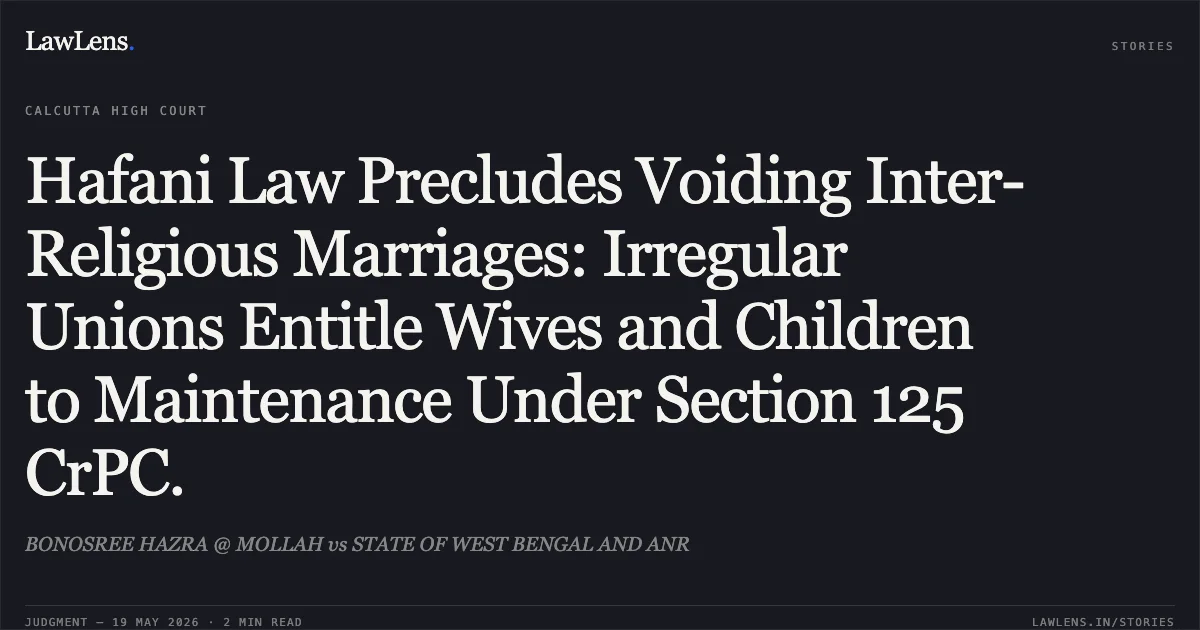
1. Whether a marriage between a Muslim man and a Hindu woman is "void" or "irregular" under Muslim Law, and whether it entitles the wife to maintenance under Section 125 Cr.P.C.
Source reference: p. 52. Whether the denial of marriage and paternity by the husband is sufficient to set aside an ad-interim maintenance order at a summary stage
Source reference: p. 10Law Applied
The Court applied Section 125 of the Cr.P.C., which provides a summary remedy for maintenance regardless of personal law
Source reference: p. 6It relied on Chand Patel vs. Bismilla Begum, establishing that under Hanafi Law, a marriage involving "unlawful conjunction" or religious differences (fasid) is merely irregular, not void (batil), and subsists until declared void by a competent court
Source reference: p. 5-7It further cited Mohammed Salim vs. Shamsudeen, holding that children of such irregular marriages are legitimate
Source reference: p. 7Finally, it applied Dwarika Prasad Satpathy vs. Bidyut Parava Dixit, which held that the standard of proof for marriage in Section 125 proceedings is not as strict as in criminal trials for bigamy; a prima facie showing of cohabitation as husband and wife suffices
Source reference: p. 10Reasoning
The High Court found that the Revisional Court erred by focusing on technicalities, such as the petitioner’s use of her Hindu name, while ignoring prima facie evidence like the marriage certificate and the child's birth certificate containing the OP2’s name
Source reference: p. 8, 10The Court reasoned that even if the petitioner had not converted, a marriage between a Muslim man and a Hindu woman is "irregular" (fasid), meaning it remains valid for the purpose of maintenance until a civil court declares it void
Source reference: p. 6, 9The Court noted that the OP2 only filed a civil suit to challenge the marriage long after the maintenance proceedings began
Source reference: p. 9Given the submission of a charge sheet under Section 498A IPC against the OP2, the Court held that the marital relationship was sufficiently established for a summary ad-interim stage
Source reference: p. 10-11Holding
The High Court allowed the revision, setting aside the order of the Learned Additional Sessions Judge and restoring the Magistrate's interim maintenance order
The Court held that the welfare of the child is paramount and that the OP2 is legally obligated to support the petitioner and the child pending the final disposal of the case
Source reference: p. 9, 11The OP2 was directed to pay the arrears and current maintenance as originally ordered by the Magistrate
Source reference: p. 11Acts & Sections Cited
8 provisions across 2 statutes referred to in this judgment. Each provision opens on LawLens.
Code of Criminal Procedure, 19734
Indian Penal Code, 18604
Original Court PDF
BONOSREE HAZRA @ MOLLAHvsSTATE OF WEST BENGAL AND ANR
Click to open original judgment
Original judgment, available to read, download and summarize on LawLens.in


