Facts
The respondent-complainant alleged that he lent the petitioner-accused Rs. 5,00,000 in January 2017 for the purchase of a site.
Source reference: para 3.2In June 2018, the petitioner issued a cheque for the said amount, which was subsequently dishonored due to "insufficient funds".
Source reference: para 3.3The petitioner’s defense was that she had only borrowed Rs. 1,00,000 in 2010, repaid Rs. 50,000 in cash, and issued the disputed cheque for the balance.
Source reference: paras 5-6She claimed the complainant falsely represented that the cheque was lost, obtained a second cheque (which was encashed), and later misused the "lost" cheque by filling in Rs. 5,00,000.
Source reference: paras 5-6The Trial Magistrate (XXII Addl. CMMS) convicted the petitioner under Section 138 of the Negotiable Instruments Act.
Source reference: para 2The First Appellate Court (LVIII Addl. City Civil and Sessions Judge) confirmed the conviction in October 2025.
Source reference: para 13Issues
1. Whether the petitioner-accused successfully rebutted the statutory presumption under Section 139 of the Negotiable Instruments Act.
Source reference: para 302. Whether the concurrent findings of the lower courts suffered from perversity or misunderstanding of evidence regarding the alleged misuse of the cheque.
Source reference: para 16, 36Law Applied
Sections 138, 118, and 139 of the Negotiable Instruments Act, 1881, which mandate a presumption in favor of the holder that a cheque is received for the discharge of a debt or liability.
Source reference: para 11, 30The court relied on the precedent set in Rangappa v. Mohan and Rohit Bhai Jeevanlal Patel v. State of Gujarat, affirming that once basic ingredients are met, the court must presume consideration and existing debt.
Source reference: para 11The principles from Rajesh Jain v. Ajay Singh (2023), which clarify that once a signature is admitted, the evidential burden shifts entirely to the accused to prove the non-existence of debt through a preponderance of probabilities.
Source reference: para 35Reasoning
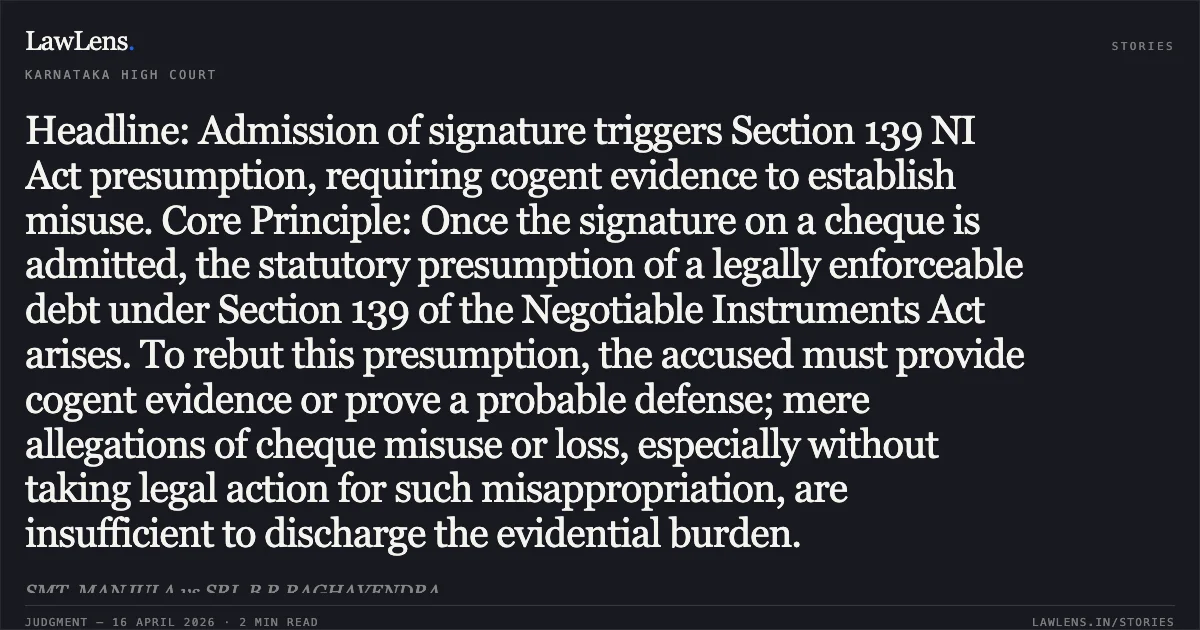
The High Court observed that since the petitioner admitted to the issuance of the cheque and her signature, the presumption under Section 139 of the NI Act was legally triggered.
Source reference: para 22, 30The court found the petitioner's defense of "misuse" lacked credibility because she failed to initiate any criminal action or police complaint regarding the allegedly "lost" and misused cheque, despite having family members in the legal profession.
Source reference: para 26-28The court noted that the Trial Court had scrutinized the bank passbooks (Ex.D-1), which proved that the disputed cheque series did not match the petitioner's bank transactions for the year 2013, contradicting her version of the timeline.
Source reference: para 11Following the Rajesh Jain doctrine, the court held that the petitioner's challenge to the complainant's lending capacity was a "feeble attempt" and failed because she did not provide cogent evidence to displace the presumption of a legally recoverable debt.
Source reference: para 35-36Holding
The court concluded that there was no miscarriage of justice or error in the findings of the lower courts.
The court held that the petitioner failed to establish a plausible defense to rebut the statutory presumption under Section 139 of the NI Act.
Source reference: para 30, 36The High Court dismissed the Criminal Revision Petition and upheld the conviction and sentence passed by the Trial Court and the First Appellate Court.
Source reference: para 38Acts & Sections Cited
13 provisions across 4 statutes referred to in this judgment. Each provision opens on LawLens.
Negotiable Instruments Act, 18813
Code of Criminal Procedure, 19734
Bharatiya Nagarik Suraksha Sanhita, 20231
Indian Penal Code, 18605
Original Court PDF
SMT. MANJULAvsSRI. B R RAGHAVENDRA
Click to open original judgment
Original judgment, available to read, download and summarize on LawLens.in


