Facts
The Appellant, a former Branch Manager at the Allahabad branch of IndusInd Bank (a private entity), was dismissed from service on 19.05.2014 following a disciplinary enquiry into a fraud amounting to ₹41 lakhs committed by a subordinate
Source reference: para. 2, 10, 15After his departmental appeal was rejected, the Appellant filed O.S. No. 180 of 2015 seeking a declaration that the termination was a nullity, a mandatory injunction for reinstatement, and back wages
Source reference: para. 19The Trial Court (Additional Civil Judge, Allahabad) dismissed the suit on 10.07.2023, ruling that it lacked inherent jurisdiction under Section 9 CPC read with the U.P. amendment to Order 39 Rule 2(2) CPC, which bars injunctions against dismissal orders
Source reference: para. 26The Appellant challenged this dismissal, arguing that as a private bank employee with no remedy under Article 226 or Service Tribunals, the Civil Court was his only forum
Source reference: para. 27, 28Issues
1. Whether the Civil Court lacked inherent jurisdiction to examine whether the plaintiff's termination from the service of the defendant Bank was illegal?
Source reference: para. 34 / 422. What relief could have been granted by the Court to the plaintiff in the suit?
Source reference: para. 34 / 49Law Applied
The Court relied on Section 9 of the CPC, which grants Civil Courts expansive jurisdiction unless expressly or impliedly barred
Source reference: para. 38It applied Section 14 of the Specific Relief Act, 1963, which prohibits specific performance of personal service contracts
Source reference: para. 40, 43The Court followed the "Three Exceptions" rule from State Bank of India v. S.N. Goyal, noting that reinstatement can only be granted to civil servants (Art. 311), workmen (Industrial Disputes Act), or employees of statutory bodies terminated in breach of mandatory statutes
Source reference: para. 40It also considered the U.P. amendment to Order 39 Rule 2(2) CPC (via Section 13 of U.P. Act 57 of 1976), which restricts injunctions against dismissal orders
Source reference: para. 47Finally, it applied Section 40 of the Specific Relief Act, allowing damages in lieu of or in addition to an injunction
Source reference: para. 50Reasoning
The High Court observed that IndusInd Bank is a non-statutory private body, making the Appellant’s employment purely contractual and not governed by statutory rules or Article 12 of the Constitution
Source reference: para. 42, 46Consequently, while the Appellant cannot seek reinstatement or a declaration of continued service due to the bar in Section 14 of the Specific Relief Act, he is entitled to sue for "wrongful dismissal"
Source reference: para. 43, 49The Court reasoned that the Trial Court misapplied the U.P. amendment to Order 39 Rule 2(2) CPC; while that provision prevents the stay of a dismissal order through an injunction, it does not oust the Civil Court’s jurisdiction to determine the legality of the termination and award damages
Source reference: para. 48, 49The Court noted that the Appellant had moved an amendment application to claim damages which the Trial Court carelessly left undisposed
Source reference: para. 50Since internal bank rules do not expressly bar civil suits and no other forum (like Art. 226 or Tribunals) is available to a private bank employee, the Civil Court remains the proper forum for a claim of damages
Source reference: para. 45, 46Holding
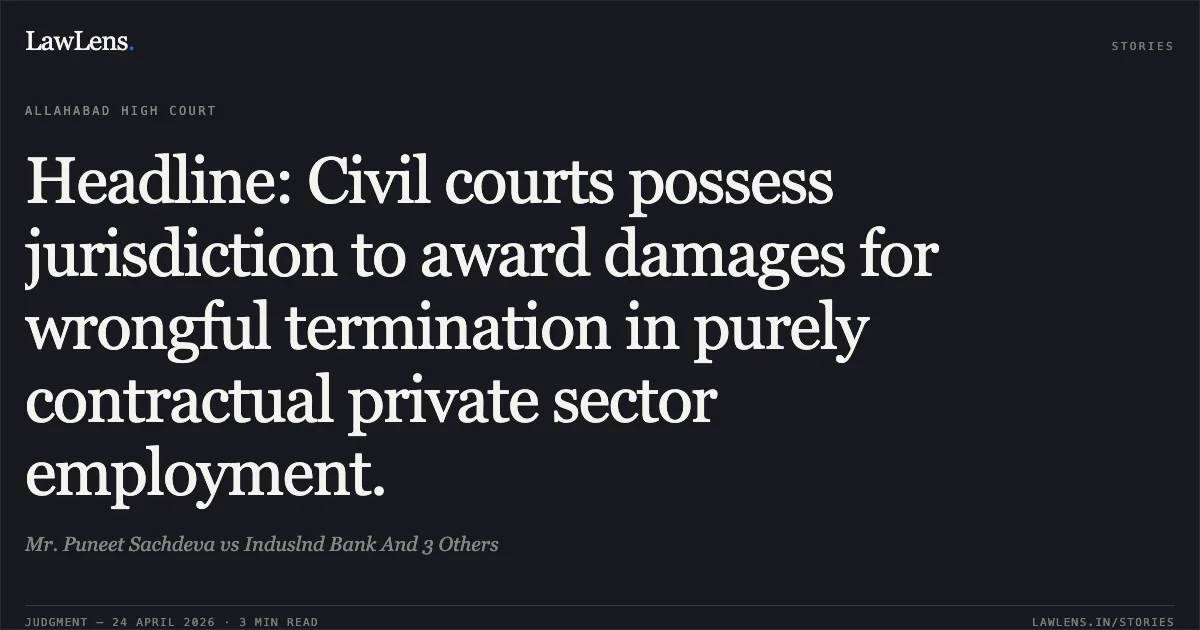
The Civil Court possesses the jurisdiction to try the suit, specifically for the purpose of examining the legality of the dismissal and awarding damages, even though reliefs like reinstatement or mandatory injunction are barred
The High Court allowed the appeal and set aside the Trial Court’s judgment. The suit (O.S. No. 180 of 2015) was restored, and the Trial Court was directed to decide the matter on merits within six months
Source reference: para. 51, 52, 53Acts & Sections Cited
12 provisions across 5 statutes referred to in this judgment. Each provision opens on LawLens.
Code of Civil Procedure, 19084
Specific Relief Act, 19635
Banking Regulation Act, 19491
State Bank of India Act, 19551
Administrative Tribunals Act, 19851
Original Court PDF
Mr. Puneet SachdevavsInduslnd Bank And 3 Others
Click to open original judgment
Original judgment, available to read, download and summarize on LawLens.in