Facts
The appellants owned agricultural land in Pune and sought to develop a group housing project under a government scheme allowing for regional plan modification
Source reference: para. 4On August 30, 2012, they paid a premium of ₹30,46,290 for additional Floor Space Index (FSI)
Source reference: para. 4Permission was granted on October 8, 2012; however, the appellants subsequently abandoned the housing plan in favor of plotting the land, which was permitted on April 19, 2014
Source reference: para. 4On August 13, 2015, the appellants applied for a refund of the premium since the extra FSI remained unutilized
Source reference: para. 5The Assistant Director of Town Planning rejected the request on February 15, 2020, citing a lack of statutory provision for such a refund in residential cases, though provisions existed for educational and medical institutions
Source reference: para. 7The Bombay High Court dismissed the subsequent writ petition on grounds of delay and lack of statutory provision for refund
Source reference: para. 3, 5Issues
1. Whether the denial of a refund for unutilized additional FSI premium is legally sustainable in the absence of a specific statutory provision for residential projects
Source reference: para. 2, 52. Whether the appellants were hit by the doctrine of laches or delay in seeking legal recourse
Source reference: para. 63. Whether the differential treatment regarding refunds between "institutional/hotel" projects and "residential" projects violates the principle of equality under Article 14
Source reference: para. 12-13Law Applied
The Court primarily applied the principle of non-arbitrariness and equality under Article 14 of the Constitution of India
Source reference: para. 13-14It relied on E.P. Royappa v. State of Tamil Nadu, establishing that equality is antithetical to arbitrariness
Source reference: para. 14Kumari Shrilekha Vidyarthi v. State of U.P., holding that all State actions, even in non-contractual spheres, must be fair and just
Source reference: para. 15The Court also referenced Ajay Hasia v. Khalid Mujib Sehravardi, asserting that Article 14 strikes down arbitrary legislative or executive actions
Source reference: para. 16Statutorily, the Court noted Section 154 and Section 37 of the Maharashtra Regional and Town Planning (MRTP) Act, 1966, regarding government directives and development regulations
Source reference: para. 8Reasoning
The Court rejected the High Court’s finding of delay, noting the appellants had consistently pursued the refund since 2015, within three years of payment
Source reference: para. 6On the merits, the Court found the State's refusal to refund the premium "ludicrous" and "whimsical"
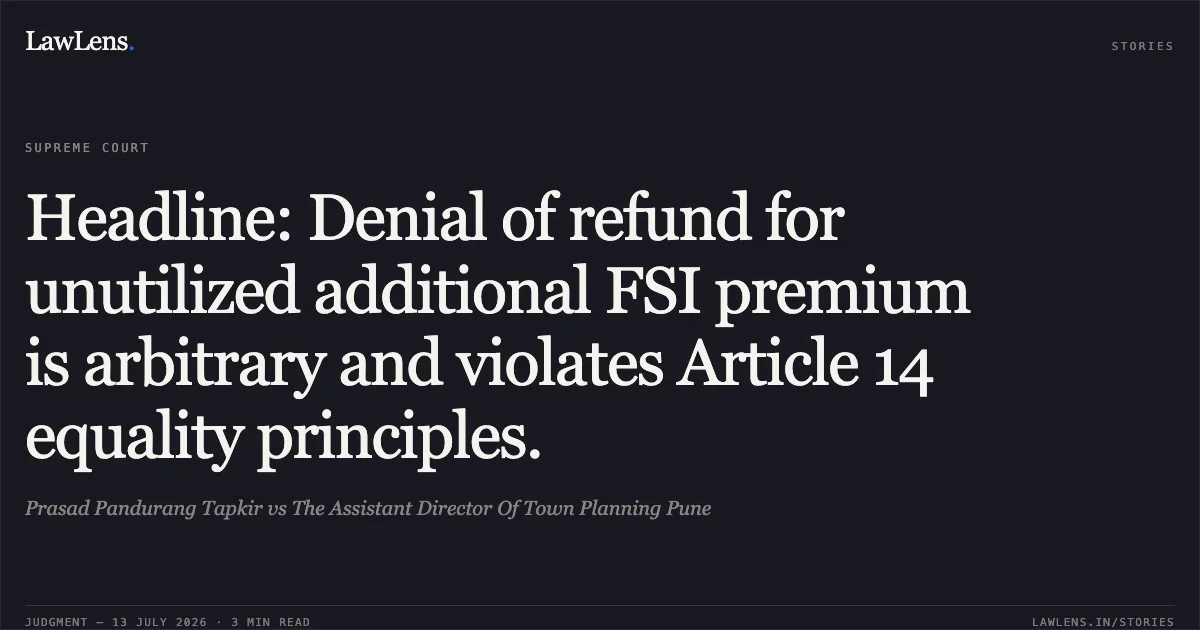
Source reference: para. 10, 18The Court reasoned that if the Government permitted refunds for unutilized FSI in Mumbai for specific sectors (educational, medical, or star hotels), denying the same to residential projects in Pune was "patently arbitrary and discriminatory"
Source reference: para. 12The Court emphasized that there is no logic in placing commercial/institutional buildings on a higher pedestal than residential projects, which impact individual homebuyers
Source reference: para. 17Since the appellants derived no tangible benefit from the premium and the State was not prejudiced, retaining the funds without a clear logic for the distinction across sectors violated the "fairness" facet of Article 14
Source reference: para. 11, 13, 17Holding
The Court allowed the appeal and set aside the High Court judgment and the rejection order dated February 15, 2020
The Court held that the appellants are entitled to a refund of the premium paid for unutilized FSI, subject to a 10% deduction for administrative charges
Source reference: para. 18, 20The Court ordered the respondents to refund ₹27,41,661 with simple interest at 7% per annum from the date of deposit until the date of actual payment, to be completed within two months
Source reference: para. 20Acts & Sections Cited
2 provisions across 1 statute referred to in this judgment. Each provision opens on LawLens.
Maharashtra Regional and Town Planning Act, 1966.2
Original Court PDF
Prasad Pandurang TapkirvsThe Assistant Director Of Town Planning Pune
Click to open original judgment
Original judgment, available to read, download and summarize on LawLens.in