Facts
The petitioner, an Assistant Engineer in the Water Resources Department, Bihar, was served a memorandum of charges in 2017 alleging financial irregularities related to excess payments.
Source reference: para. 3-4Following a departmental inquiry, the Enquiry Officer held the charges proved on 14.12.2018.
Source reference: para. 4The disciplinary authority issued a dismissal order via Notification No. 2627 on 19.12.2019, and a subsequent review petition filed by the petitioner was rejected on 05.03.2021.
Source reference: para. 5-6The petitioner challenged these orders on grounds of procedural lapses, vagueness of charges, and lack of oral evidence.
Source reference: para. 7-11He further claimed parity with a co-accused, Anil Kumar Pandey, whose dismissal was set aside by the High Court in a separate proceeding.
Source reference: para. 11Issues
1. Whether the departmental inquiry was vitiated by procedural unfairness, specifically regarding the non-examination of authors of the Technical Vigilance Cell report and the absence of oral evidence.
Source reference: para. 9, 132. Whether the disciplinary authority failed to apply its independent mind by issuing a non-speaking order that did not address the petitioner's specific defenses.
Source reference: para. 10, 133. Whether the petitioner is entitled to the benefit of parity with co-delinquents who were exonerated on identical facts.
Source reference: para. 11, 15Law Applied
The court primarily applied the Bihar Government Servants (Classification, Control and Appeal) Rules, 2005, specifically Rule 17 regarding the procedure for imposing major penalties.
Source reference: para. 8, 10It relied on the precedent set in Roop Singh Negi v. Punjab National Bank (2009), establishing that departmental findings must be based on evidence and that mere production of documents without proving them is insufficient.
Source reference: para. 9It also applied the principle from Barium Chemical Limited v. A.J. Rana (1972), holding that the word "consider" requires an authority to think over the matter deliberately and with care.
Source reference: para. 13/para. 26 of cited judgmentReasoning
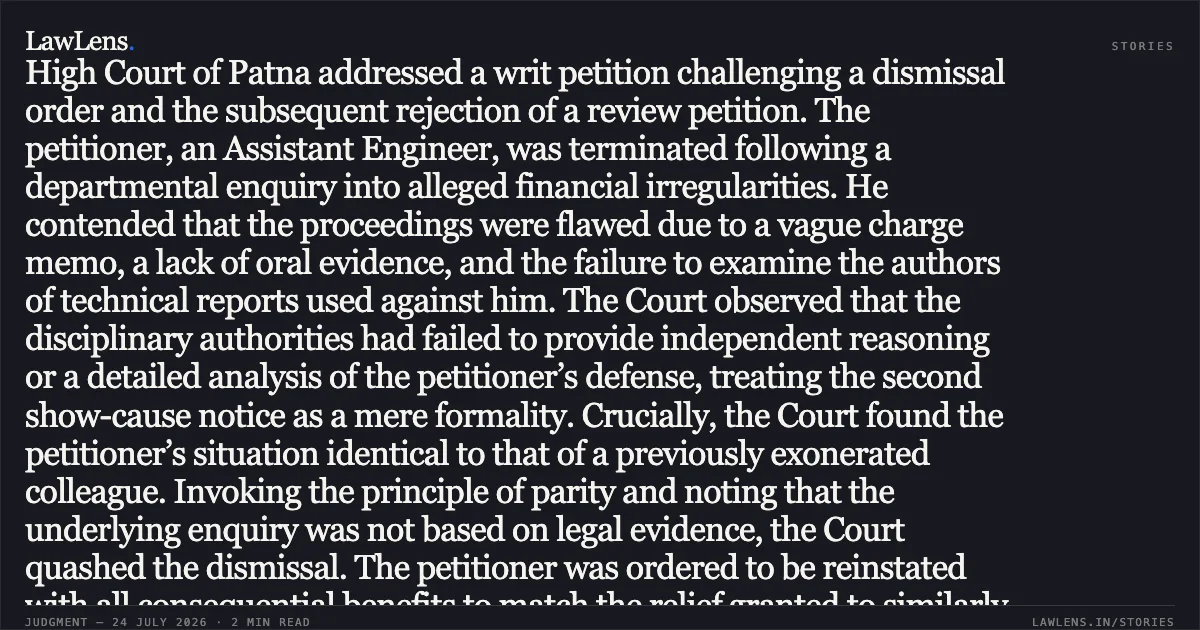
The court noted that the findings were based on a Technical Vigilance Cell report, yet the authors of that report were never examined, depriving the petitioner of his right to cross-examination.
Source reference: para. 13/para. 22 of cited judgmentApplying the Roop Singh Negi doctrine, the court held that documents alone, without legal proof, carry no evidentiary value.
Source reference: para. 9The court observed that the disciplinary authority’s order was mechanical and did not reflect an independent application of mind to the petitioner’s second show-cause reply, rendering the opportunity a "mere formality".
Source reference: para. 13/para. 23-25The court determined that the petitioner’s case was identical to Anil Kumar Pandey v. State of Bihar (CWJC 535/2021), where the dismissal was set aside on the same grounds; thus, the principle of parity necessitated the same relief.
Source reference: para. 13-15Holding
The court answered the issues in the affirmative, holding that the disciplinary proceedings were vitiated by technical and substantive illegalities.
The court quashed the dismissal order dated 19.12.2019 and the review order dated 05.03.2021.
Source reference: para. 16It directed the respondents to reinstate the petitioner with all consequential service benefits, including back wages, in parity with the treatment afforded to Anil Kumar Pandey.
Source reference: para. 17-18Original Court PDF
Ajit KumarvsThe State of Bihar
Click to open original judgment
Original judgment, available to read, download and summarize on LawLens.in