Facts
The Appellant (husband) and Respondent (wife) are Sunni Muslims married in 2022. Following matrimonial discord and separation in September 2023, the Respondent demanded a divorce during conciliation proceedings at Darul Kaza.
Source reference: para. 2–3The Appellant subsequently pronounced Talaq-e-hasan by sending three written notices via registered post at monthly intervals (22.07.2024, 22.08.2024, and 25.09.2024), which were duly received.
Source reference: para. 3After obtaining an opinion from Darul Uloom Nadwatul Ulema certifying the dissolution of marriage, the husband filed a declaratory suit under Section 7 of the Family Courts Act, 1984.
Source reference: para. 3, 23, 5Despite the Respondent’s written statement admitting the Talaq and expressing a desire for the decree, the Family Court dismissed the suit on 20.05.2025, holding it barred by Section 34 of the Specific Relief Act and Section 20 of the C.P.C. as the Talaq was undisputed.
Source reference: para. 5, 25-26, 6, 30Issues
1. Whether a Family Court has the jurisdiction to grant a declaratory decree of matrimonial status in cases of undisputed extra-judicial divorce.
Source reference: para. 20–212. Whether the absence of a challenge to a Talaq by the respondent or third parties bars a suit for declaration under Section 34 of the Specific Relief Act.
Source reference: para. 30, 32Law Applied
The Court applied Section 2 of the Muslim Personal Law (Shariat) Application Act, 1937, which mandates that Shariat is the "rule of decision" for dissolution of marriage, including talaq.
Source reference: para. 12–13Under the Muslim Women (Protection of Rights on Marriage) Act, 2019, only Talaq-e-bid’at is void, whereas Talaq-e-hasan remains a valid mode of dissolution.
Source reference: para. 15–16Section 7 of the Family Courts Act, 1984, particularly Explanation (b), grants Family Courts jurisdiction over suits for declaration of matrimonial status.
Source reference: para. 20The Court relied on the principles from Asbi K.N. v. Hashim M.U. (Kerala High Court), holding that a Family Court’s role in extra-judicial divorce is to endorse the status to maintain a public record.
Source reference: para. 21Reasoning
The High Court observed that the Family Court erred in applying Section 34 of the Specific Relief Act as a bar to the suit.
Source reference: para. 30, 32Every individual in a civilized society is entitled to a clear, legally recognized matrimonial status, and judicial endorsement of an extra-judicial divorce is imperative for public record.
Source reference: para. 31Since the Talaq-e-hasan procedure was strictly followed, Mehar was paid, and both parties admitted the dissolution in their pleadings and evidence, there was no factual or legal dispute to adjudicate through adversarial litigation.
Source reference: para. 24–28, 33When a party seeks a declaration of status under Section 7(b) of the Family Courts Act and the other party admits the claim, the Court should treat it as an uncontested matter and pass a formal order.
Source reference: para. 31, 34Holding
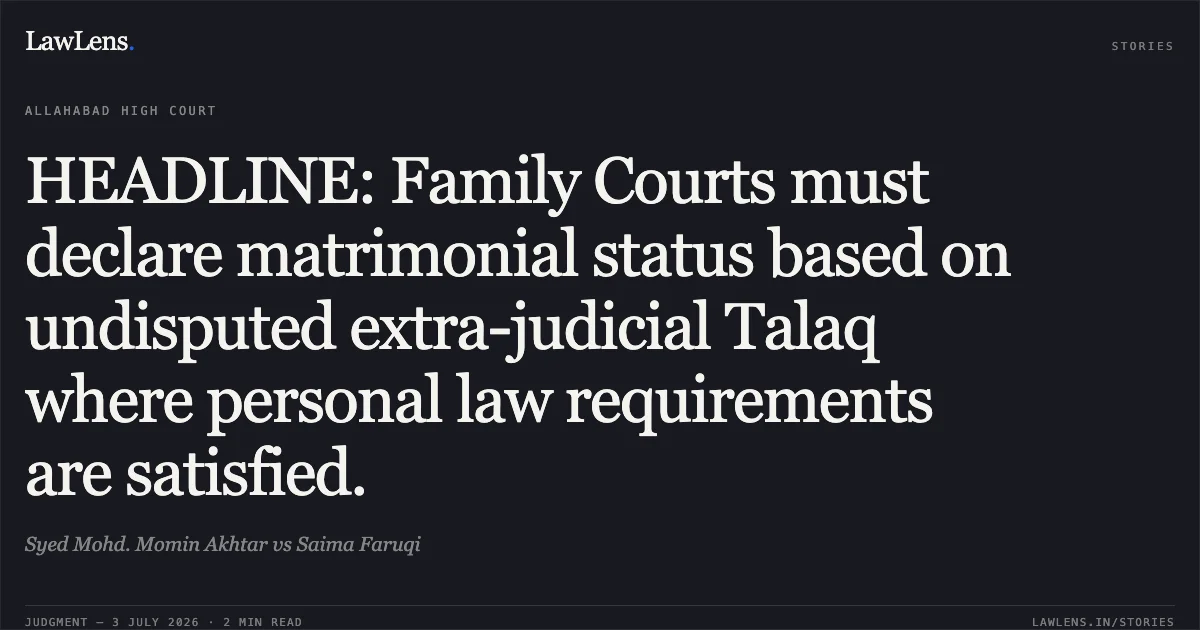
The suit was maintainable under Section 7 of the Family Courts Act regardless of whether the Talaq was contested.
The High Court allowed the appeal and set aside the Family Court’s order dated 20.05.2025; the Court decreed the suit, declaring the matrimonial status of the parties as "divorced".
Source reference: Order para. 1, 2–3Acts & Sections Cited
11 provisions across 6 statutes referred to in this judgment. Each provision opens on LawLens.
Family Courts Act, 19842
Specific Relief Act, 19631
Code of Civil Procedure, 19081
Information Technology Act, 20001
Original Court PDF
Syed Mohd. Momin AkhtarvsSaima Faruqi
Click to open original judgment
Original judgment, available to read, download and summarize on LawLens.in


