Facts
The applicant, Surjit Singh, joined the Chandigarh Police on December 12, 1983, and voluntarily retired as an ORP Inspector (Group – C) on November 1, 2019.
Source reference: p. 6Prior to his retirement, a 'No Due Certificate' (Annexure A-1) was issued, and his retiral dues, including pension, were released.
Source reference: p. 6In 2021, the Chandigarh Administration adopted the Punjab Civil Services (Revised Pay) Rules, 2021, effective from January 1, 2016.
Source reference: p. 6The applicant submitted an option form for revised pay.
Source reference: p. 6Subsequently, on November 16, 2022, Respondent No. 5 (Accountant General) revised his pay fixation and, via a revised certificate (Annexure A-4), directed the recovery of an overpayment of Rs. 1,02,468/- from his Death-cum-Retirement Gratuity (DCRG) without a show cause notice.
Source reference: p. 7This recovery was based on a rectification of an earlier step-up of pay granted to the applicant on October 19, 2016 (Annexure A-10), which had aligned his pay with his junior, Sh. Dalbir Singh.
Source reference: p. 7The applicant contends there was no misrepresentation or fraud on his part, and the pay fixation and step-up were departmental errors.
Source reference: p. 7The respondents argue that the recovery is justified as per Punjab Civil Services Rules due to an incorrect annual increment date after the step-up, and the applicant had given an undertaking regarding future recoveries.
Source reference: p. 9, 10These OAs were heard together due to similar facts and reliefs.
Source reference: p. 5Issues
Whether the recovery of overpaid amounts from a retired Group-C employee, without establishing misrepresentation or fraud, is permissible.
Source reference: p. 5, 12-13Whether such a recovery, particularly from DCRG, is prohibited under established legal principles and administrative instructions.
Source reference: p. 5, 13-14Whether the impugned recovery orders, issued without a show cause notice, violate principles of natural justice.
Source reference: p. 8, 14Law Applied
The court primarily applied the principles laid down by the Hon’ble Apex Court in State of Punjab & Ors. Vs. Rafiq Masih, SCT 2015 (1) 195, which summarized situations where recoveries by employers are impermissible in law, specifically from Class-III and Class-IV (or Group 'C' and Group 'D') service employees, and from retired employees or those due to retire within one year of the recovery order.
Source reference: p. 13It also considered Thomas Daniel Vs. State of Kerala, 2022 INSC 497, which held that belated recovery after a long lapse is inequitable and impermissible.
Source reference: p. 13-14The court further referenced DoPT OM dated 02.03.2016 (Annexure A-7), which prohibits recovery from retired employees, Group-C employees, and for excess payments due to administrative error.
Source reference: p. 8Reasoning
The court found that the applicants' claims were covered under categories (i) and (ii) of the Rafiq Masih judgment, as they are Group-C employees and the recovery orders were issued after their retirement.
Source reference: p. 13There was no allegation or establishment of fraud, misrepresentation, or fault on the part of the employees for the erroneous pay fixation; the stepping-up and increment alignment were administrative decisions and errors.
Source reference: p. 12The court noted that recovery from DCRG is prohibited unless misconduct is established, which was not the case here.
Source reference: p. 13Relying on Thomas Daniel (supra), the court emphasized that belated recovery after a long lapse is inequitable and impermissible.
Source reference: p. 13-14Furthermore, the court observed that the impugned recovery orders were issued without a copy being issued/marked to the applicants, violating natural justice principles.
Source reference: p. 14The argument that the applicants provided an undertaking was not deemed sufficient to override the principles established in Rafiq Masih especially considering the administrative nature of the error and the applicants' retired status.
Source reference: no citationHolding
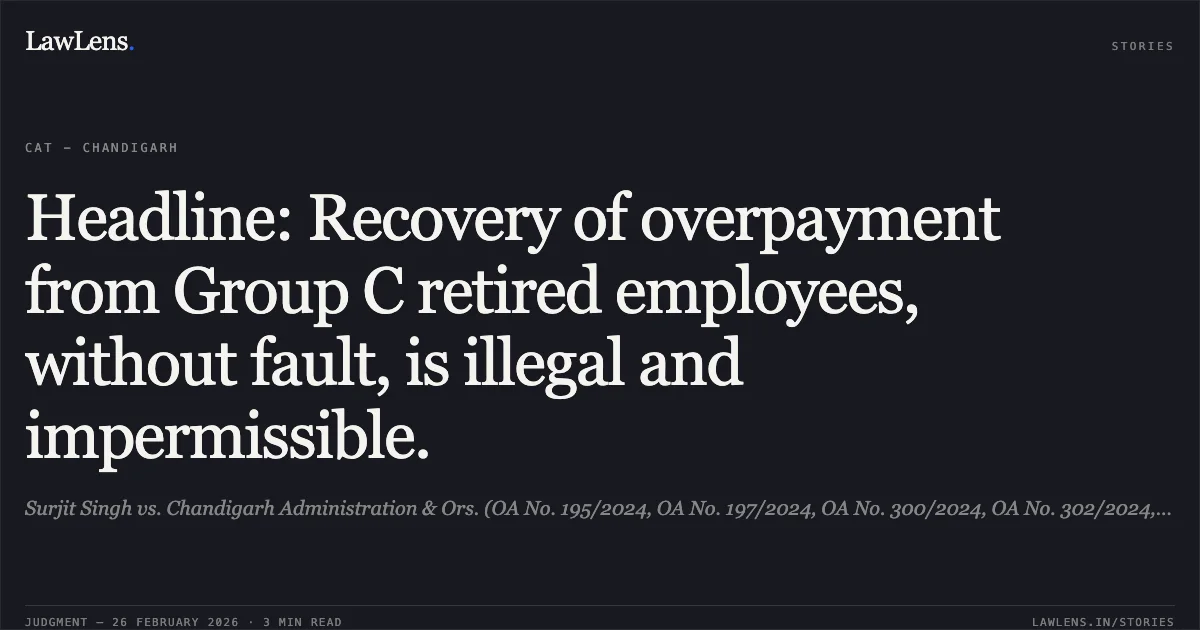
The court concluded that the recovery from the DCRG of the applicants is illegal, arbitrary, unjust, and unsustainable.
The Original Applications are allowed.
Source reference: p. 14The impugned recovery orders dated 05.04.2023 (in OA No. 195/2024), 15.12.2023 (in OA No. 197/2024), 22.03.2023 (in OA No. 300/2024), 29.06.2023 (in OA No. 302/2024), and 26.05.2023 (in OA No. 469/2024) are quashed and set aside to the extent they ordered recovery.
Source reference: p. 14The respondents are directed to refund the recovered amounts to the applicants, along with interest at the GPF rate from the date of recovery until the date of actual payment, within eight weeks from the receipt of the order.
Source reference: p. 14Original Court PDF
Surjit Singhvs.Chandigarh Administration & Ors. (OA No. 195/2024, OA No. 197/2024, OA No. 300/2024, OA No. 302/2024, and OA No. 469/2024)
Click to open original judgment
Original judgment, available to read, download and summarize on LawLens.in


