Facts
The Appellant (the Board) awarded rate contracts to the Respondent (the Company) for PVC pipes between 1998 and 2002. Following an audit alleging excess payments, the Board blacklisted the Company in 2003.
Source reference: para 2.3In 2012, the parties executed an Arbitration Agreement with a six-month mandate.
Source reference: para 2.4The proceedings were delayed primarily due to the Board’s failure to file replies and attend meetings.
Source reference: paras 3.9–3.15The Arbitrator unilaterally extended the mandate several times up to September 30, 2015, with the Board’s tacit participation.
Source reference: paras 15–17On October 27, 2015, the Arbitrator passed an Award for ₹1.01 Crores with simple interest at 21.675% for the pendente lite period and compound interest post-award.
Source reference: paras 3.29–3.30The Board challenged the Award under Section 34, while the Company sought a "correction" under Section 33 to change "simple interest" to "compound interest".
Source reference: para 4The Commercial Court modified the Award in a review proceeding, granting compound interest for the pendente lite period, which significantly increased the Board's liability.
Source reference: paras 7–8, 26The High Court of Gujarat dismissed the Board’s appeals.
Source reference: para 9Issues
1. Whether the arbitral mandate had validly subsisted at the time the Arbitral Award was passed.
Source reference: para 142. Whether the arbitral proceedings were conducted in accordance with principles of natural justice.
Source reference: para 143. Whether the Commercial Court possessed jurisdiction to modify the Award under Section 33(1)(a) of the Act to substitute simple interest with compound interest.
Source reference: para 14Law Applied
The Court applied the principle of acquiescence and estoppel regarding the extension of an arbitrator's mandate in cases not governed by the 2015 Amendment.
Source reference: para 21Section 33(1)(a) of the Arbitration and Conciliation Act, 1996, which limits the Tribunal's power to "computational, clerical, or typographical errors".
Source reference: para 30Precedents including State of Arunachal Pradesh v. Damani Construction Co. and Gyan Prakash Arya v. Titan Industries Ltd. were cited to establish that Section 33 does not permit a substantive review or modification of the merits of an Award.
Source reference: para 30Reasoning
The Court found that while the initial mandate was for six months, the Board never objected to the Arbitrator’s unilateral extensions and continued to participate, thereby tacitly consenting to the extension.
Source reference: para 19Regarding natural justice, the Court noted that the Board’s own dilatory tactics and failure to attend the final hearing after three and a half years of proceedings precluded it from claiming a lack of opportunity.
Source reference: paras 23–25On the substantive modification of interest, the Court held that the choice between "simple" and "compound" interest is a deliberate merit-based decision by the Arbitrator.
Source reference: para 31Changing the interest type is not a clerical or typographical correction under Section 33(1)(a). The Commercial Court’s modification, which increased liability from ₹30.38 crores to ₹144.93 crores, was held to be an impermissible exercise of review jurisdiction.
Source reference: paras 26, 32Holding
The Arbitrator had a valid mandate and followed natural justice.
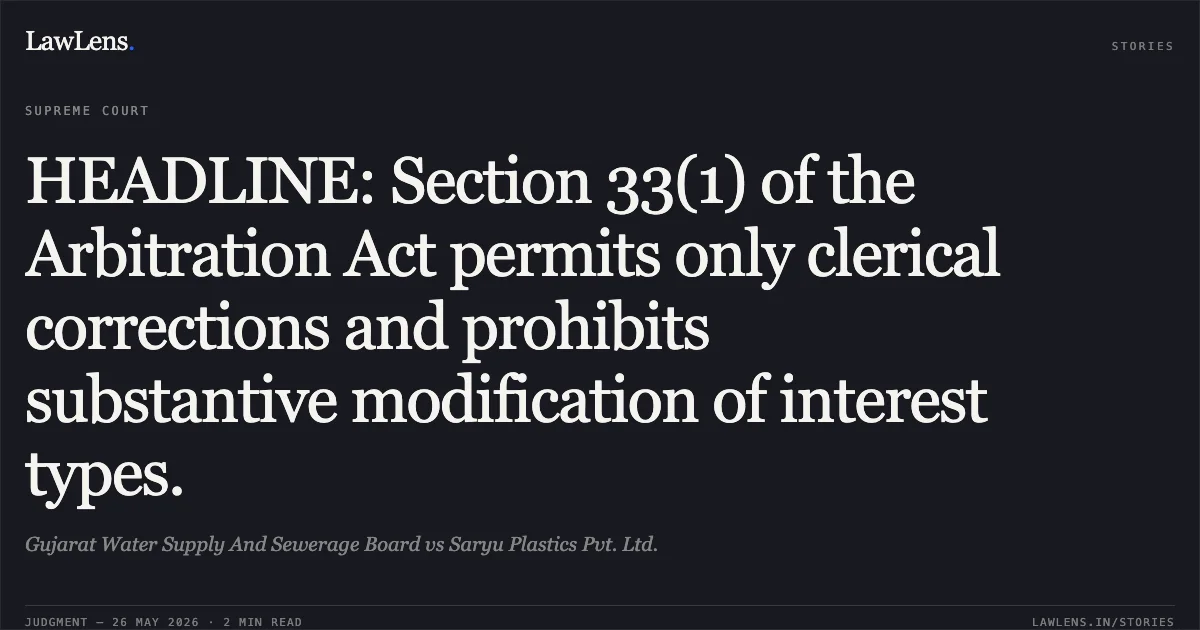
A court or tribunal cannot use Section 33(1)(a) to substantively alter the nature of interest awarded.
Source reference: para 32The Supreme Court allowed the appeals in part. It set aside the Commercial Court’s order modifying the interest. The Company is entitled only to "simple interest" at 21.675% for the pendente lite period as originally awarded.
Source reference: para 34Acts & Sections Cited
4 provisions across 2 statutes referred to in this judgment. Each provision opens on LawLens.
Gujarat Water Supply and Sewerage Board Act, 1979.1
Arbitration and Conciliation Act, 19963
Original Court PDF
Gujarat Water Supply And Sewerage BoardvsSaryu Plastics Pvt. Ltd.
Click to open original judgment
Original judgment, available to read, download and summarize on LawLens.in