Facts
The Appellants (husband, mother-in-law, sister-in-law, and brother-in-law of the Complainant) were embroiled in over ten civil and criminal litigations with Respondent No. 2 following a matrimonial separation in 2011.
Source reference: para. 3.1In September 2024, fourteen years after the separation and while the children were in the Appellants' custody, the Complainant filed a complaint alleging that Appellant No. 1 (father) and Appellant No. 4 (uncle) had raped the minor prosecutrix, and Appellants No. 2 and 3 had assaulted and intimidated her.
Source reference: para. 3.2The Trial Court took cognizance and issued summons.
Source reference: para. 3.3The Allahabad High Court refused to quash the proceedings, holding the allegations triable.
Source reference: para. 3.5The Appellants challenged this refusal, contending the case was a malicious counterblast to ongoing matrimonial disputes.
Source reference: para. 4.1Issues
1. Whether the allegations in the complaint and the statements recorded under Sections 223 and 225 of the BNSS prima facie constitute the alleged offences under the BNS and POCSO Act.
Source reference: para. 7.12. Whether the criminal proceedings were instituted with a mala fide ulterior motive to wreak vengeance, warranting quashment under the principles of State of Haryana v. Bhajan Lal.
Source reference: para. 8.2Law Applied
The Court applied the definition of "penetrative sexual assault" under Section 3 of the POCSO Act and "rape" under Section 63/65 of the BNS, requiring specific acts of penetration or insertion.
Source reference: paras. 6.5, 6.6It invoked Sections 74 (outraging modesty), 115 (voluntarily causing hurt), 351 (criminal intimidation), and 352 (intentional insult) of the BNS.
Source reference: paras. 6.1–6.4Crucially, the Court relied on the Seven Categories for quashing criminal proceedings established in State of Haryana v. Bhajan Lal, specifically regarding inherently improbable allegations and proceedings attended with mala fides.
Source reference: para. 8.2It also referenced the Justice J.S. Verma Committee Report regarding the necessity of medical examinations in sexual offence cases.
Source reference: para. 8Reasoning
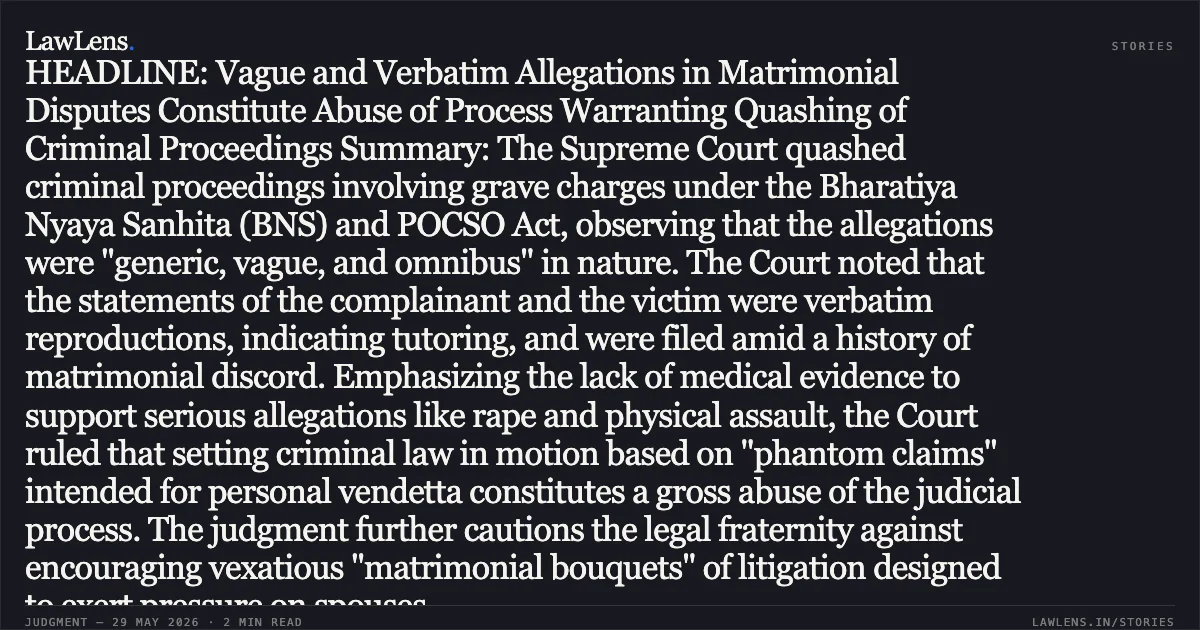
The Court found the allegations of rape to be vague, generic "blanket statements" lacking specific dates or factual details of the acts.
Source reference: para. 7.2It noted that the statements of the Complainant and the prosecutrix were "verbatim reproductions" and "parrot-like," suggesting tutoring during the four-month window after the daughter moved to the Complainant’s house.
Source reference: paras. 7.5, 7.6The Court observed that despite allegations of grave physical injury (insertion of a hammer handle), no medical report or evidence of treatment was produced, which was deemed "fatal to the case of the prosecution".
Source reference: paras. 7.11, 8The Court highlighed the "worrying trend" of "matrimonial bouquets"—multiple frivolous filings—noting that the 14-year delay in making these allegations, coupled with the existing 10+ cases between the parties, indicated the complaint was a tool for "personal vendetta" and "arm-twisting".
Source reference: paras. 7.4, 9.3Holding
The Court answered the issues in the affirmative for the Appellants, holding that the allegations were inherently improbable and maliciously instituted.
The Court allowed the appeal and quashed Complaint Case No. 05 of 2025, the cognizance order dated 07.02.2025, and the summoning order dated 18.08.2025.
Source reference: para. 11It held that permitting the trial to continue would constitute an abuse of the process of law, as the charges lacked any "kernel of truth" and were designed to settle personal scores.
Source reference: paras. 7.10, 9.7Acts & Sections Cited
29 provisions across 6 statutes referred to in this judgment. Each provision opens on LawLens.
Bharatiya Nyaya Sanhita, 20237
Bharatiya Nagarik Suraksha Sanhita, 20233
Indian Penal Code, 1860
Hindu Marriage Act, 19551
Code of Criminal Procedure, 19733
Original Court PDF
Ishwar Chand SharmavsState Of U.P.
Click to open original judgment
Original judgment, available to read, download and summarize on LawLens.in