Facts
The appellant (plaintiff), daughter of Respondent No. 1 (Defendant No. 1), filed a suit for partition and separate possession of Schedule ‘A’, ‘B’, ‘C’, and ‘D’ properties
Source reference: p. 3-4She claimed the properties were ancestral/joint family properties inherited by her father from her grandfather, Muniyappa, and that she became a coparcener by birth
Source reference: p. 4, para. 3The defendants contended the properties were the absolute/self-acquired properties of Respondent No. 1, having been acquired through a family settlement/partition of the grandfather's self-acquired assets
Source reference: p. 5-6, para. 5The Trial Court dismissed the suit, holding that the properties were the absolute properties of the father and not available for partition
Source reference: p. 9, para. 9The appellant challenged this, arguing that once the court found the father "inherited" the property in Issue No. 1, it must be treated as ancestral
Source reference: p. 12, para. 14Issues
1. Whether schedule 'A', 'C' and 'D' are self-acquired properties of her father/defendant No.1 or he had inherited those properties from his ancestors and therefore, they were the joint Hindu family properties?
Source reference: p. 11, para. 122. Whether the Trial Court's failure to frame a specific issue on the character/nature of the property led to a miscarriage of justice?
Source reference: p. 32, para. 453. Whether an adverse inference should be drawn against the defendants for failing to lead oral or documentary evidence?
Source reference: p. 33, para. 46Law Applied
The Court applied Section 6 of the Hindu Succession Act, 1956 (as amended in 2005), which grants daughters status as coparceners in joint family property
Source reference: p. 23, para. 30It relied on the principle from C.L. Arunachala Mudaliar v. C.A. Murugatha Mudaliar, establishing that property received by a son via gift or testament from a father for his exclusive benefit remains self-acquired, even if it came from a paternal ancestor
Source reference: p. 21, para. 28The Court further applied Section 8 regarding rules of succession and Section 101 of the Indian Evidence Act, affirming that the plaintiff must prove her case on her own merits and cannot rely on the defendant's lack of evidence
Source reference: p. 22, para. 29; p. 37, para. 53, 55Reasoning
The Court determined that the suit properties were originally the self-acquired assets of the plaintiff’s grandfather, Muniyappa
Source reference: p. 26-27, para. 36-38Witness PW-2 (the father's brother) admitted that the properties were purchased by the grandfather and later divided among the children
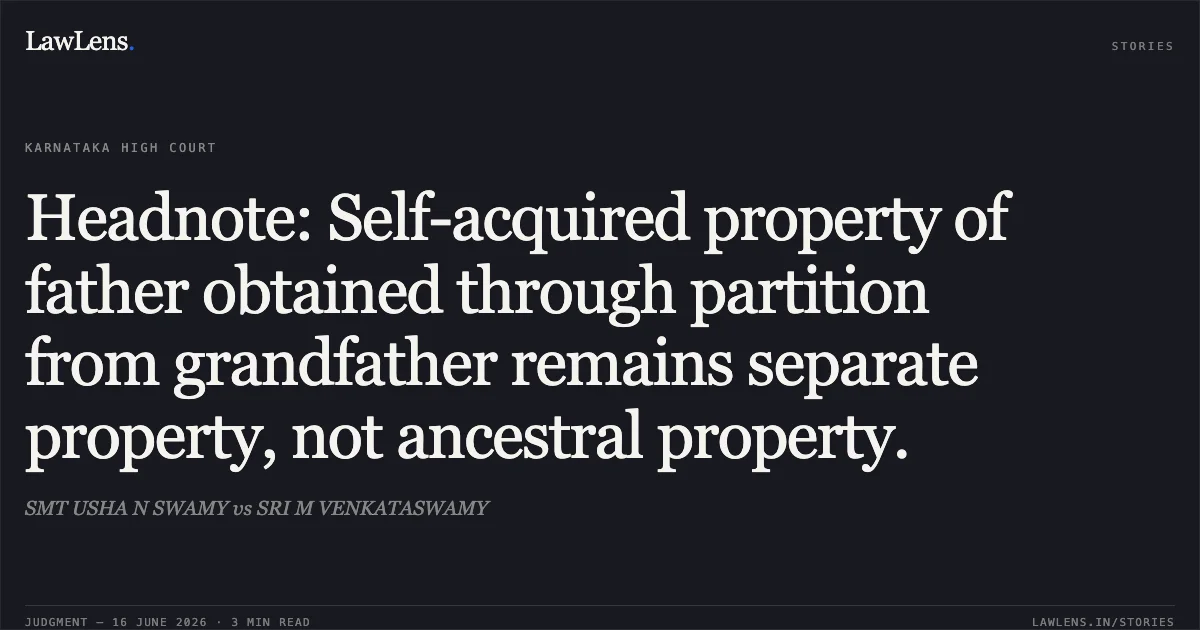
Source reference: p. 18, para. 23; p. 24, para. 34The Court reasoned that under Mitakshara law, a father has absolute power over self-acquired property; when such property is divided among children, it becomes their separate/individual property, not ancestral property in which their own children (the plaintiff) acquire a right by birth
Source reference: p. 28, para. 39; p. 31, para. 42Regarding the procedural issues, the Court found that Issue No. 3 (entitlement as a member of a Hindu Undivided Family) sufficiently covered the character of the property
Source reference: p. 34, para. 48Finally, the Court rejected the "adverse inference" argument, noting that since the plaintiff failed to discharge the initial burden of proving the property was ancestral, the burden never shifted to the defendants to prove otherwise
Source reference: p. 38, para. 54Holding
The Court held that the properties were the separate/absolute properties of Respondent No. 1, as they were derived from the grandfather’s self-acquired holdings and not through the inheritance of ancestral nucleus
Consequently, the plaintiff was not a coparcener in these specific assets and had no right to seek partition during her father's lifetime
Source reference: p. 27, para. 38The High Court dismissed the appeal and upheld the Trial Court’s judgment
Source reference: p. 39, para. 56Acts & Sections Cited
1 provisions across 1 statute referred to in this judgment. Each provision opens on LawLens.
Code of Civil Procedure, 19081
Original Court PDF
SMT USHA N SWAMYvsSRI M VENKATASWAMY
Click to open original judgment
Original judgment, available to read, download and summarize on LawLens.in