Facts
The Petitioner was a director of Osian’s Connoisseurs of Art Pvt Ltd, which floated the Osian’s Art Fund (OAF)
Source reference: para 3.1-3.2SEBI determined OAF was an unregistered collective investment scheme and ordered a refund of investor monies
Source reference: para 3.3-3.4Following defaults and the initiation of Corporate Insolvency Resolution Process against the company, SEBI filed a complaint against the Petitioner for offences under Section 24(2) of the SEBI Act, 1992
Source reference: para 3.6-3.7On taking cognizance, the Special Court (SEBI) issued process against the Petitioner without affording him a prior hearing
Source reference: para 3.8The Petitioner challenged this order, alleging a violation of the mandatory pre-cognizance hearing requirement under the first proviso to Section 223 of the Bharatiya Nagarik Suraksha Sanhita (BNSS), 2023
Source reference: para 4-5Issues
1. Whether it is incumbent upon a Special Court under the SEBI Act, 1992 to provide an opportunity of hearing to an accused under the first proviso to Section 223 of the BNSS, 2023 before taking cognizance of offences
Source reference: para 2Law Applied
The Court applied Section 4(2) of the BNSS, 2023, which mandates that all offences under other laws be investigated and tried according to BNSS unless a special enactment regulates the manner otherwise
Source reference: para 17-18It prioritized the first proviso to Section 223(1) of the BNSS, 2023, which requires a Magistrate to hear the accused before taking cognizance on a complaint
Source reference: para 20The Court also interpreted Section 26-D of the SEBI Act, 1992, which applies the Code of Criminal Procedure (now BNSS) to Special Court proceedings
Source reference: para 28, 31Key precedents included Kushal Kumar Agarwal v. Directorate of Enforcement and Parvinder Singh v. Directorate of Enforcement, which established that pre-cognizance hearings are mandatory for complaints under the PMLA and similar special statutes unless expressly excluded.
Source reference: para 10, 44, 48, 49Reasoning
The Court reasoned that Section 4(2) of the BNSS creates a default procedural application unless the SEBI Act provides a contrary mechanism
Source reference: para 18While SEBI argued that the Special Court is a Deemed Court of Session under Section 26-D and thus exempt from Section 223 (which refers to "Magistrates"), the Court held that the SEBI Act lacks a specific provision overriding the BNSS's requirement for a pre-cognizance hearing
Source reference: para 31-33The Court contrasted the SEBI Act with the Negotiable Instruments Act, noting the latter contains a non-obstante clause in Section 142 that excludes general procedural rules, whereas the SEBI Act does not
Source reference: para 42-43Drawing a parallel to the PMLA—where the Supreme Court held the right to a hearing is a substantive part of a fair trial under Article 21—the Court concluded that the word "shall" in the proviso to Section 223(1) is mandatory and applies to the Special Court when taking cognizance of SEBI complaints
Source reference: para 49-51Holding
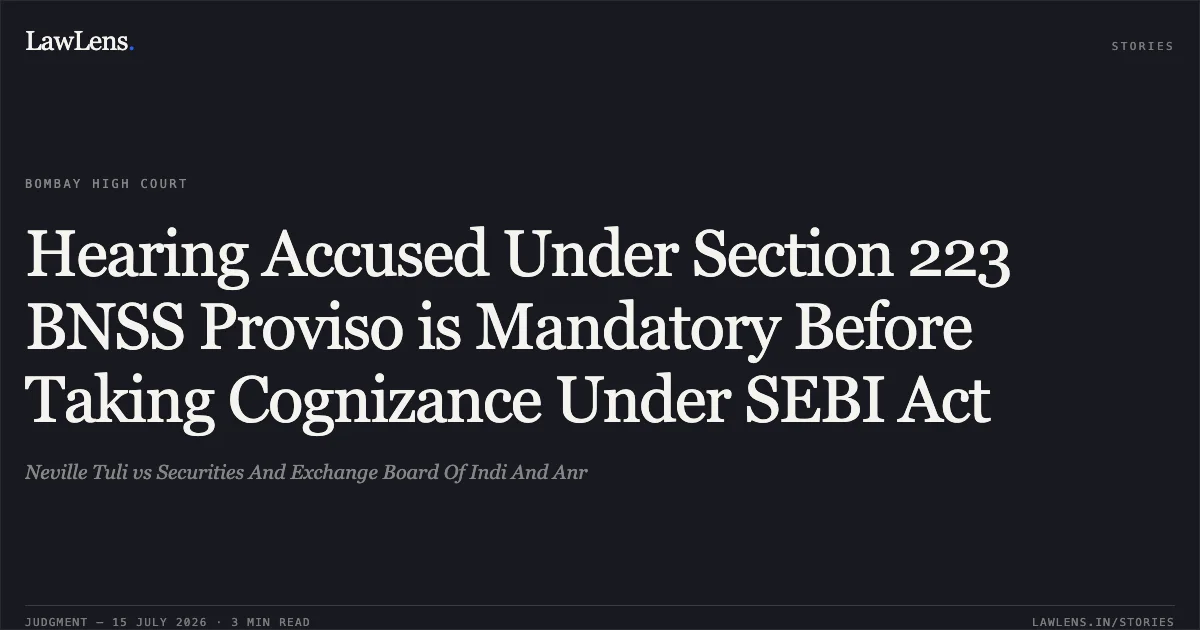
The Court answered the issue in the affirmative, holding that a Special Court cannot take cognizance under the SEBI Act without affording the accused a hearing under the first proviso to Section 223(1) of the BNSS
The order taking cognizance and issuing process was quashed as being void ab initio for lack of compliance with this peremptory requirement. The Court directed the Special Court to provide the Petitioner an opportunity to be heard on August 3, 2026, before passing a fresh order on cognizance
Source reference: para 53-54Acts & Sections Cited
35 provisions across 6 statutes referred to in this judgment. Each provision opens on LawLens.
Bharatiya Nagarik Suraksha Sanhita, 2023
Securities and Exchange Board of India Act, 19926
Insolvency and Bankruptcy Code, 2016.1
Prevention of Money-Laundering Act, 20026
Negotiable Instruments Act, 18812
Code of Criminal Procedure, 1973
Original Court PDF
Neville TulivsSecurities And Exchange Board Of Indi And Anr
Click to open original judgment
Original judgment, available to read, download and summarize on LawLens.in