Facts
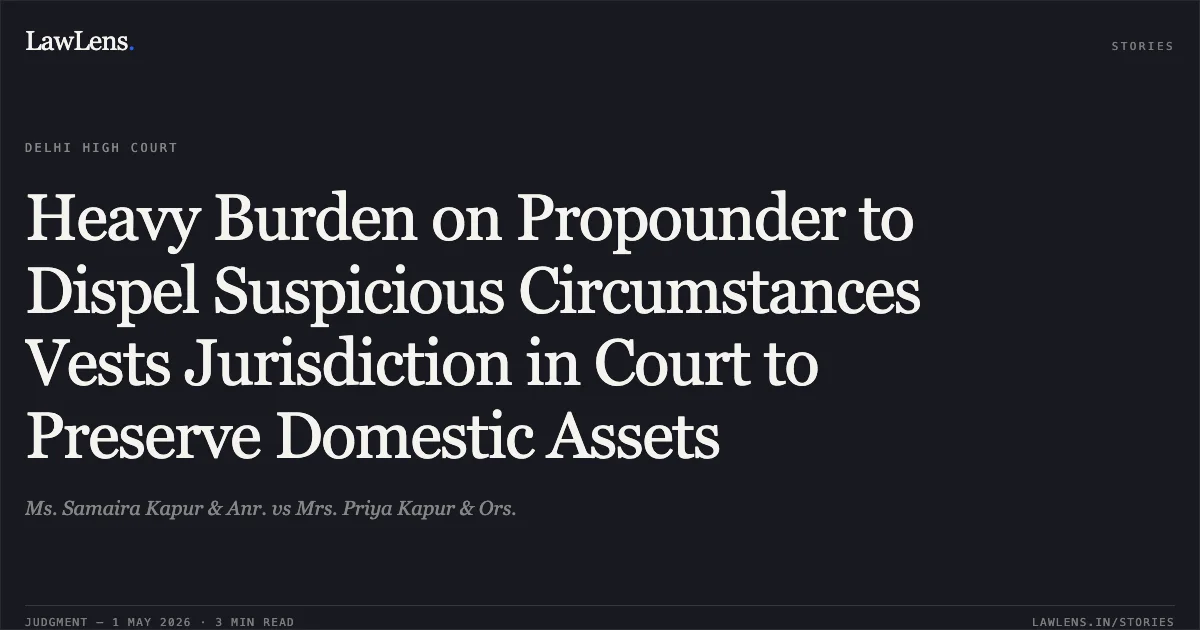
The Plaintiffs, daughter and minor son of Late Sunjay Kapur from his marriage to Karisma Kapoor, filed a suit for partition of their father’s estate, claiming a 1/5th share as Class-I heirs under the Hindu Succession Act, 1956
Source reference: p. 2, 6, 15Upon Sunjay’s sudden death in June 2025, Defendant No. 1 (Priya Kapur, Sunjay’s second wife) propounded an unregistered Will dated 21.03.2025, naming herself the sole beneficiary of his personal assets to the exclusion of Sunjay’s children and mother (Defendant No. 3)
Source reference: p. 5, 25The Plaintiffs and Defendant No. 3 alleged the Will was forged and shrouded in suspicious circumstances, including glaring typographical errors (misspelling Sunjay’s son's name, referring to the male Testator as "Testatrix"), the active role of the beneficiary, and a questionable digital trail
Source reference: p. 10–13, 17–18Defendant No. 1 moved the court to dismiss the application regarding foreign assets, citing lack of jurisdiction under Section 16 CPC
Source reference: p. 23–24Issues
1. Whether the estate of the deceased needs to be preserved via interim injunction pending the trial on the genuineness of the propounded Will
Source reference: para. 712. Whether the High Court of Delhi has jurisdiction to pass interlocutory orders/injunctions regarding the immovable property of the deceased situated in foreign jurisdictions
Source reference: para. 72, 75Law Applied
The court applied the principles of Order XXXIX Rules 1 and 2 of the CPC for grant of interim injunction
Source reference: p. 2Regarding the proof of Wills, it relied on H. Venkatachala Iyengar v. B.N. Thimmajamma, which requires the propounder to dispel "suspicious circumstances" surrounding a Will to satisfy the "judicial conscience"
Source reference: para. 62It further applied Section 16 of the CPC, specifically its Explanation, which clarifies that "property" for jurisdictional purposes means property situate in India
Source reference: para. 73, 77The court also invoked the principle of equity acts in personam from Harshad Chiman Lal Modi v. DLF Universal Ltd., though noting its limitations regarding foreign immovable property
Source reference: para. 35, 76Reasoning
The Court observed that since the Plaintiffs and Defendant No. 3 raised several "real and germane" suspicious circumstances—such as the exclusion of natural heirs despite a close bond, technical errors in the document, and the questionable chain of custody—the onus on Priya Kapur to prove the Will is "substantially heavier" and requires a full trial
Source reference: para. 67, 71To prevent the dissipation of assets and a fait accompli before the Will is proved, preservation of the corpus is necessary
Source reference: para. 71Regarding jurisdiction, the Court reasoned that under the Explanation to Section 16 CPC and Private International Law, Indian courts generally cannot adjudicate title or partition for immovable property situate abroad as they cannot provide an effective judgment
Source reference: para. 74–75However, the Court distinguished between immovable and movable assets, finding that the jurisdictional bar under Section 16 does not extend to movables, such as foreign bank accounts or cryptocurrency, which can be controlled through orders against the person (Priya)
Source reference: para. 77Holding
The Court partially allowed the application for interim injunction
The Court held that while it lacked jurisdiction to grant injunctions over foreign immovable property, it was necessary to protect the remainder of the estate.
Source reference: para. 77The Court ordered Priya Kapur to be restrained from: (a) alienating shares in Indian companies (AIPL, BRS Finance, JTEKT); (b) withdrawing Provident Fund amounts; (c) selling personal effects (watches, jewelry, art); and (d) withdrawing or encumbering funds in both Indian and specified foreign bank accounts (JP Morgan, HSBC UK) or cryptocurrency, except for discharging specific legal liabilities towards the Plaintiffs
Source reference: para. 79Acts & Sections Cited
13 provisions across 4 statutes referred to in this judgment. Each provision opens on LawLens.
Code of Civil Procedure, 19084
Indian Succession Act, 19256
Bharatiya Sakshya Adhiniyam, 20231
Companies Act, 20132
Original Court PDF
Ms. Samaira Kapur & Anr.vsMrs. Priya Kapur & Ors.
Click to open original judgment
Original judgment, available to read, download and summarize on LawLens.in