Facts
The plaintiffs filed a suit for eviction against the appellants (defendant no. 5 series).
Source reference: no citationIn their written statement, the appellants claimed they were bona fide monthly tenants under the West Bengal Premises Tenancy Act, 1997.
Source reference: para. 16The original tenant (appellants' father) died on December 24, 2008.
Source reference: para. 17Five years after the death, the plaintiffs moved an application for a decree of eviction based on the admissions made in the written statement.
Source reference: para. 18The Trial Judge passed a decree for eviction, which the appellants challenged on the grounds of lack of jurisdiction and improper valuation.
Source reference: para. 7-8Issues
1. Whether a decree on admission can be passed under the West Bengal Premises Tenancy Act, 1997, after the expiry of the five-year statutory protection for heirs.
Source reference: para. 212. Whether the High Court lacked jurisdiction under Section 18(2) of the Presidency Small Cause Courts Act, 1882, due to the plaintiffs' characterization of the deceased as a "rank trespasser".
Source reference: para. 8, 233. Whether the heirs of a deceased tenant are entitled to a right of pre-emption under Section 2(g) of the 1997 Act after the statutory protection period.
Source reference: para. 22Law Applied
West Bengal Premises Tenancy Act, 1997, specifically Section 2(h) regarding the definition of a tenant and the five-year limitation on the right of succession for heirs.
Source reference: para. 21Section 2(g) of the West Bengal Premises Tenancy Act, 1997 regarding pre-emption.
Source reference: para. 22Section 18(2) of the Presidency Small Cause Courts Act, 1882 (as amended in 1999) concerning the jurisdictional limits of Small Cause Courts based on property valuation.
Source reference: para. 8, 23The principle of "judgment on admissions" whereby a plaintiff can seek a decree based on statements made in the defendant's pleadings.
Source reference: para. 20Reasoning
The court reasoned that since the appellants admitted in their written statement that they were governed by the Act of 1997, the plaintiffs were entitled to rely on that admission.
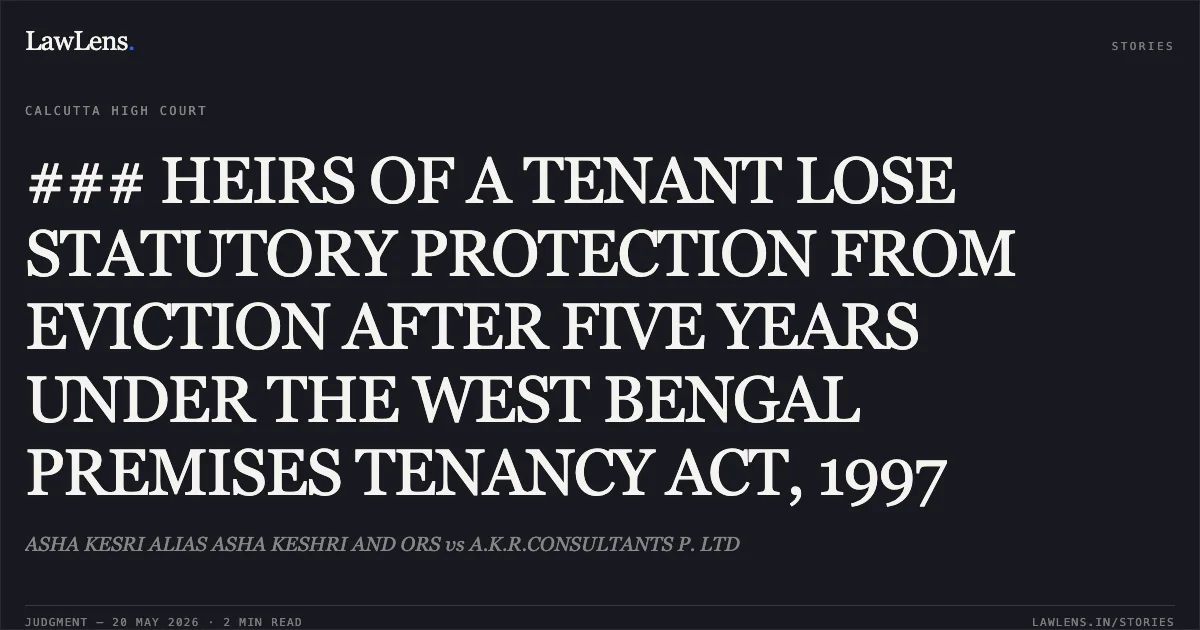
Source reference: para. 20Under the 1997 Act, heirs of a deceased tenant only enjoy immunity from eviction for five years from the date of the tenant's death. Since the original tenant died in 2008 and the application was filed after 2013, the appellants had lost their statutory protection regardless of their dependency status.
Source reference: para. 21On the issue of jurisdiction, the court noted that the suit was valued based on the property's market value, and the appellants failed to provide evidence that this valuation fell within the pecuniary limits of the Small Cause Court.
Source reference: para. 23The court rejected the pre-emption argument, holding that such a right does not vest in heirs once the five-year protection period under the Act expires.
Source reference: para. 22Holding
After the expiry of five years from the death of the original tenant, heirs cannot claim immunity from eviction under the Act of 1997.
The suit was properly valued and correctly filed within the High Court's jurisdiction as the specific criteria for Small Cause Court jurisdiction under Section 18(2) were not met.
Source reference: para. 23The High Court dismissed the appeal and the connected applications, upholding the Trial Judge’s decree. No order as to costs was made.
Source reference: para. 24-25Acts & Sections Cited
3 provisions across 3 statutes referred to in this judgment. Each provision opens on LawLens.
Specific Relief Act, 19631
Presidency Small Cause Courts Act, 18821
West Bengal Premises Tenancy Act, 19971
Original Court PDF
ASHA KESRI ALIAS ASHA KESHRI AND ORSvsA.K.R.CONSULTANTS P. LTD
Click to open original judgment
Original judgment, available to read, download and summarize on LawLens.in


