Facts
The dispute involves a step-mother (Appellant/Defendant) and four daughters (Respondents/Plaintiffs) over the separate property of the late Dajiba, who died intestate.
Source reference: para. 2-3The properties include land and two houses in village Sapti.
Source reference: para. 3The Plaintiffs filed a suit for partition and separate possession claiming 4/5th share as successors-in-interest.
Source reference: para. 3The Defendant resisted, claiming she sold part of the property as ‘karta’ of the family to meet the "legal necessity" of a daughter's marriage.
Source reference: para. 4The Civil Court decreed the suit; the First Appellate Court partially reversed it by accepting the "legal necessity" argument; however, the High Court restored the Civil Court's decree in Second Appeal.
Source reference: para. 2-4Issues
1. Whether the Defendant could avail the ground of "legal necessity" as a karta of the family to alienate property inherited under Section 8 of the Hindu Succession Act, 1956.
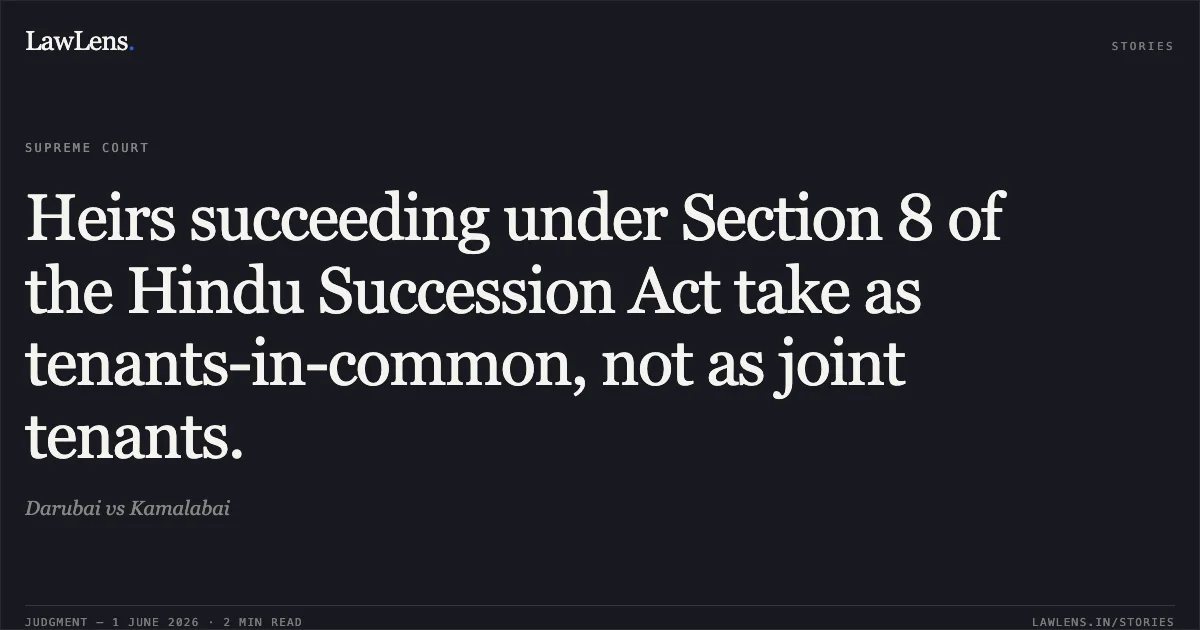
Source reference: para. 52. Whether heirs succeeding to property under Section 8 of the Hindu Succession Act, 1956, hold the property as tenants-in-common or joint tenants.
Source reference: para. 5Law Applied
Section 8 of the Hindu Succession Act (HSA), which governs the general rules of succession for male Hindus dying intestate.
Source reference: para. 6Section 19 of the HSA, which mandates that two or more heirs succeeding together take property as "tenants-in-common" and not as "joint tenants".
Source reference: para. 6The doctrine from CWT v. Chander Sen, which established that property inherited under Section 8 is the individual property of the heir and not HUF property.
Source reference: para. 7/9The principle in M. Arumugam v. Ammaniammal affirming that such inheritance is individual and statutory, precluding the birthright of descendants under Mitakshara coparcenary.
Source reference: para. 7/10-11Reasoning
The Court analyzed the distinction between joint tenancy (governed by survivorship) and tenancy-in-common (notional separate ownership).
Source reference: para. 6-7It observed that under Section 19(b) of the HSA, statutory succession creates a tenancy-in-common.
Source reference: para. 6-7The Court reasoned that since the property devolved under Section 8, it lost its character as coparcenary property; hence, the concepts of karta and "legal necessity"—which are central to managing joint family/coparcenary property—were inapplicable.
Source reference: para. 7-8The Defendant only had the right to alienate her specific 1/5th share and lacked the legal authority to bind the other heirs' shares under the guise of family management.
Source reference: para. 8Holding
The Court held that heirs succeeding under Section 8 of the HSA take the property as tenants-in-common with separate shares.
The Defendant could not act as a karta to sell the property for "legal necessity" as the property was not a joint family asset.
Source reference: para. 8The Supreme Court dismissed the appeal, affirming the High Court’s judgment which restored the partition decree in favor of the daughters.
Source reference: para. 9No order as to costs was made.
Source reference: para. 9Acts & Sections Cited
5 provisions across 1 statute referred to in this judgment. Each provision opens on LawLens.
Hindu Succession Act, 19565
Original Court PDF
DarubaivsKamalabai
Click to open original judgment
Original judgment, available to read, download and summarize on LawLens.in