Facts
The Petitioner, an IRS officer, was denied promotion to Commissioner of Income Tax by a DPC held on 23.01.2009 because two of his ACRs (2003-04 and 2005-06) were below the "Very Good" benchmark. These ACRs had not been communicated to him.
Source reference: para. 1The Central Administrative Tribunal (CAT) in 2009 directed a review DPC to ignore these ACRs and consider preceding ones.
Source reference: para. 1The Delhi High Court upheld this in 2010.
Source reference: para. 2The Petitioner filed the present writ petition alleging that a subsequent review DPC in December 2010 again erroneously considered those same ACRs in violation of the previous court orders.
Source reference: paras. 3-4Issues
1. Whether the High Court can entertain a writ petition as a court of first instance in a service matter falling under the jurisdiction of the Central Administrative Tribunal
Source reference: para. 82. Whether the decision of the review DPC dated 27.12.2010 was in compliance with the court’s earlier directions
Source reference: para. 7Law Applied
The court primarily applied the constitutional principle established by the seven-judge bench of the Supreme Court in L. Chandra Kumar v. Union of India (1997) 3 SCC 261.
Source reference: para. 5This precedent dictates that the Tribunals created under Articles 323-A and 323-B act as the "only courts of first instance" for matters within their jurisdiction. Consequently, litigants are proscribed from directly approaching High Courts under Article 226, overlooking the Tribunal’s jurisdiction, except when the parent statute of the Tribunal itself is challenged.
Source reference: para. 6Reasoning
The court reasoned that since the grievance involves the correctness of a DPC meeting (a service matter regulated by Section 19 of the Administrative Tribunals Act, 1985), the Petitioner must first approach the CAT.
Source reference: paras. 6-7The court noted that the validity of the December 2010 DPC had never been examined by the Tribunal. If the High Court were to adjudicate the merits of the DPC's decision now, it would impermissibly act as a court of first instance, violating the mandate in L. Chandra Kumar.
Source reference: para. 8While acknowledging the petition had been pending since 2021, the court invoked the principle of actus curiae neminem gravabit (an act of the court shall prejudice no one) to avoid further procedural delays.
Source reference: para. 14Holding
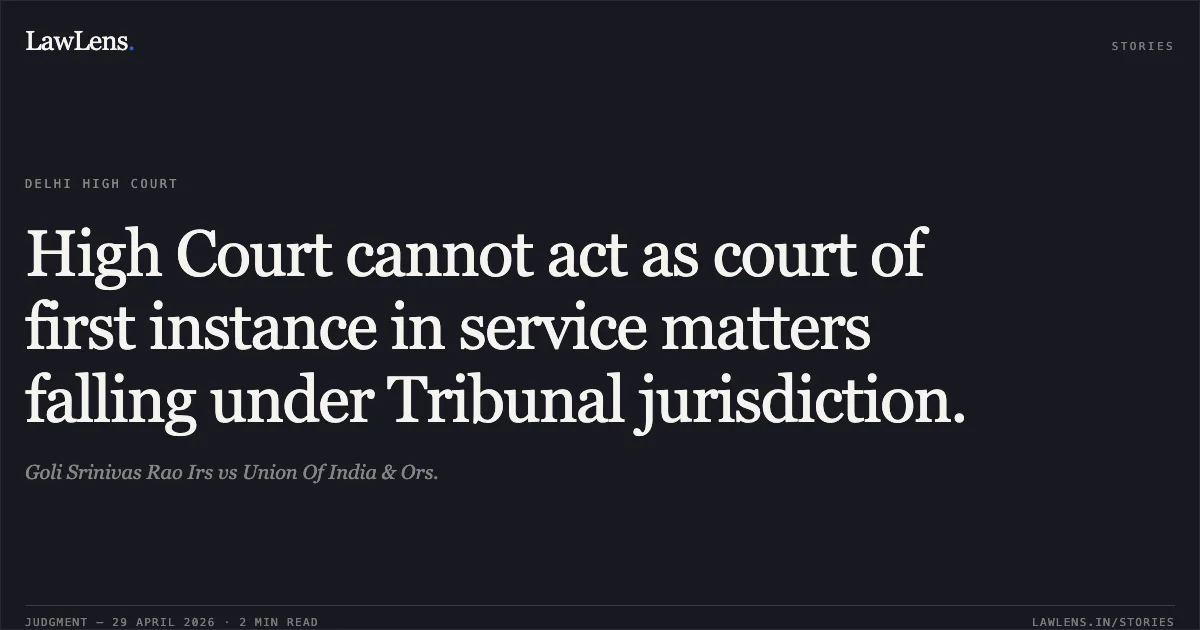
The court held that it was coram non judice (not the proper forum) and could not entertain the petition directly.
The court declined to express an opinion on the merits but directed the Registry to transmit the record of the writ petition to the Tribunal to be registered as a "Transferred Application". The Tribunal was requested to dispose of the matter within six months, treating the existing record as the official record to avoid fresh pleadings. The writ petition was disposed of with a direction for the parties to appear before the CAT on 05.05.2026.
Source reference: paras. 14, 16-18, 19Acts & Sections Cited
3 provisions across 1 statute referred to in this judgment. Each provision opens on LawLens.
Administrative Tribunals Act, 19853
Original Court PDF
Goli Srinivas Rao IrsvsUnion Of India & Ors.
Click to open original judgment
Original judgment, available to read, download and summarize on LawLens.in