Facts
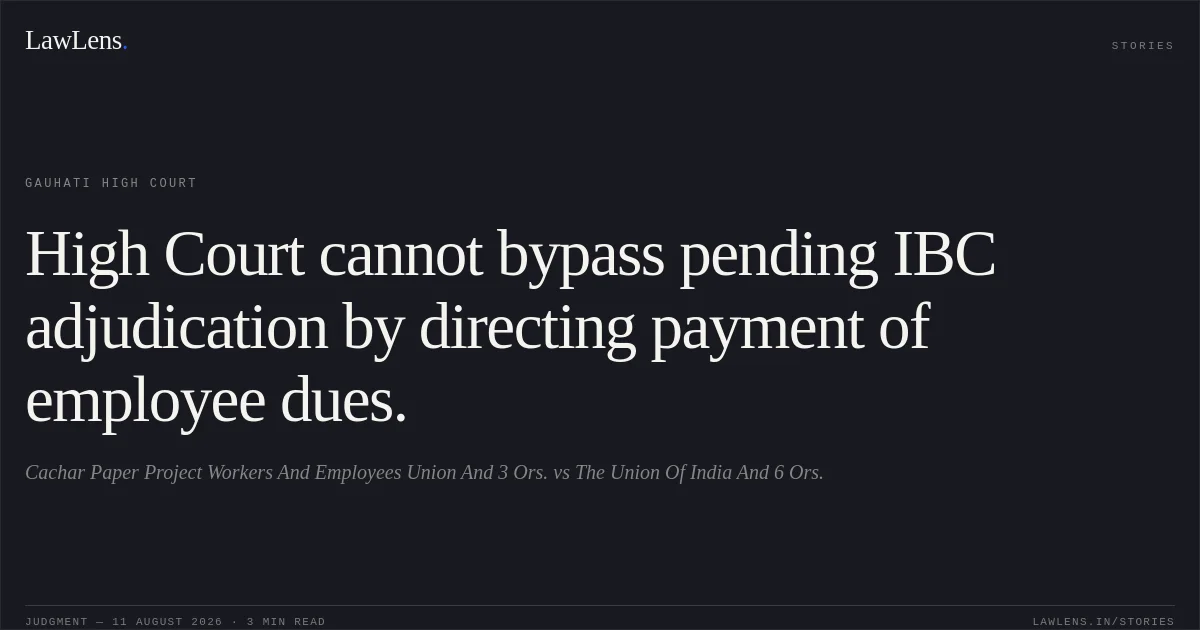
The petitioners, claiming to represent workers and employees of Cachar Paper Mill, a unit of Hindustan Paper Corporation Ltd. (“HPCL”), sought directions to the Union of India to ensure payment of provident fund, gratuity, wages and other employee dues, invoking the humanitarian crisis and Article 21 of the Constitution.
Source reference: pp. 4–5, paras. 2–3HPCL was under liquidation, and the Official Liquidator disclosed that the same issues were pending in WP(C) No. 1062/2020 before the Delhi High Court and were also being adjudicated by the NCLT, New Delhi under the Insolvency and Bankruptcy Code, 2016 (“IBC”).
Source reference: p. 6, paras. 4–5By the date of the affidavit, ₹213,18,14,728 had been disbursed to the EPFO, ₹79,51,60,919 towards wage arrears, and ₹359,13,97,613 to employees through the State of Assam/AIDC—totalling ₹651,83,73,260; this was not disputed by the petitioners.
Source reference: p. 6, para. 4Issues
Whether the High Court should direct the Union of India to make immediate payment of provident fund and other employee dues pending adjudication before the authorities under the IBC.
Source reference: pp. 5–7, paras. 3, 5–9Whether such a direction would impermissibly interfere with the liquidation and claim-adjudication proceedings pending before the NCLT, New Delhi under the IBC.
Source reference: pp. 6–8, paras. 5–10Whether dismissal of the writ petition would prejudice the petitioners’ right to pursue their outstanding claims before the competent insolvency forum.
Source reference: p. 8, para. 11Law Applied
The Court applied Article 21 of the Constitution as the constitutional basis invoked by the petitioners in seeking protection against the alleged humanitarian consequences of non-payment of employee dues.
Source reference: p. 5, para. 3It held that the Insolvency and Bankruptcy Code, 2016 is a self-contained statutory framework governing liquidation, claims and distribution of the assets of a corporate debtor, including employee claims.
Source reference: p. 7, para. 6The Court also took note of Section 53 of the IBC, which regulates the statutory priority and distribution of liquidation proceeds, as reflected in the payments made towards wage arrears.
Source reference: p. 6, para. 4Where the relevant claims are already pending before the NCLT, the High Court should not issue directions that interfere with or circumvent the insolvency process.
Source reference: pp. 7–8, paras. 6 and 9Reasoning
The Court declined to order fresh payment by the Union of India because the employees had already received substantial disbursements and the petitioners did not dispute the aggregate payment of ₹651,83,73,260.
Source reference: p. 6, para. 4The Court observed that it might have considered interim intervention if no payment had been made, but that was not the factual position.
Source reference: p. 7, para. 8Since the EPFO’s additional claims and the employees’ dues were already under consideration by the NCLT pursuant to orders of the NCLT and NCLAT, directing the Union of India to pay the claimed amount—with liberty to recover it later—would interfere with the pending insolvency proceedings and conflict with the IBC’s self-contained mechanism.
Source reference: pp. 6–8, paras. 5–9The Court also noted that the petitioners had not produced material establishing that petitioner organisations Nos. 1 and 3 were registered trade unions.
Source reference: p. 5, para. 2Holding
The High Court dismissed the writ petition, holding that it was not inclined to entertain the prayer for direct payment while the claims were pending adjudication under the IBC and substantial amounts had already been disbursed.
The dismissal was expressly confined to the Court’s refusal to entertain the writ petition on those grounds and did not affect the petitioners’ substantive right to pursue their dues before the NCLT, New Delhi.
Source reference: p. 8, para. 11Acts & Sections Cited
1 provisions across 1 statute referred to in this judgment. Each provision opens on LawLens.
Insolvency and Bankruptcy Code, 2016.1
Original Court PDF
Cachar Paper Project Workers And Employees Union And 3 Ors.vsThe Union Of India And 6 Ors.
Click to open original judgment
Original judgment, available to read, download and summarize on LawLens.in