Facts
The respondents (borrowers) availed credit facilities from Canara Bank and created security interest over their property.
Source reference: para. 2Upon default, the Bank classified the account as a Non-Performing Asset (NPA) on 30.05.2019 and initiated recovery under the SARFAESI Act, 2002.
Source reference: para. 2The Chief Judicial Magistrate, Bengaluru, passed an order dated 13.03.2020 under Section 14 of the Act for taking physical possession.
Source reference: para. 3The respondents challenged this order via a writ petition, claiming they had entered into a One-Time Settlement (OTS) for ₹58,00,000/- on 02.08.2021.
Source reference: para. 4The Bank disputed the validity of the OTS, stating it was merely an unauthorized acknowledgment.
Source reference: para. 10A Single Judge of the High Court entertained the petition, modified the OTS terms by allowing delayed payments with 12% interest, and restrained the Bank from proceeding.
Source reference: para. 12Issues
1. Whether the Writ Petition was maintainable under Article 226 given the availability of an alternate efficacious remedy under Section 17 of the SARFAESI Act.
Source reference: para. 132. Whether the Court can modify the terms of a One-Time Settlement (OTS) and compel a bank to accept delayed payments.
Source reference: para. 153. Whether the Single Judge erred in granting relief beyond the scope of the prayers sought in the writ petition.
Source reference: para. 14Law Applied
The Court applied Sections 34 and 35 of the SARFAESI Act, 2002, which bar the jurisdiction of civil courts and give the Act overriding effect over other laws.
Source reference: para. 17It relied on the principle of self-restraint in writ jurisdiction established in United Bank of India v. Satyawati Tondon (2010), which dictates that High Courts should not entertain petitions where an effective statutory remedy (Section 17) exists.
Source reference: para. 19It further applied PHR Invent Educational Society v. UCO Bank (2024), which mandates that Article 226 should only be invoked under specific exceptions like violation of natural justice or lack of jurisdiction.
Source reference: para. 22Reasoning
The Court reasoned that Section 17 of the SARFAESI Act provides a comprehensive mechanism for "any person" aggrieved by measures under Section 13(4) or Section 14, making the respondents' writ petition improper.
Source reference: para. 18-20The Court found that the Single Judge overlooked that recovery of public dues requires strict adherence to statutory codes.
Source reference: para. 19On the merits of the OTS, the Court noted that the "acceptance" was recorded on an incomplete form, and the Single Judge failed to verify the authority of the bank official or the Bank’s Master Circular conditions.
Source reference: para. 27-29The Court held that a Writ Court cannot "impose a contract" or compel a lender to accept a settlement on terms (such as interest for delay) that were never agreed upon by the parties.
Source reference: para. 31Holding
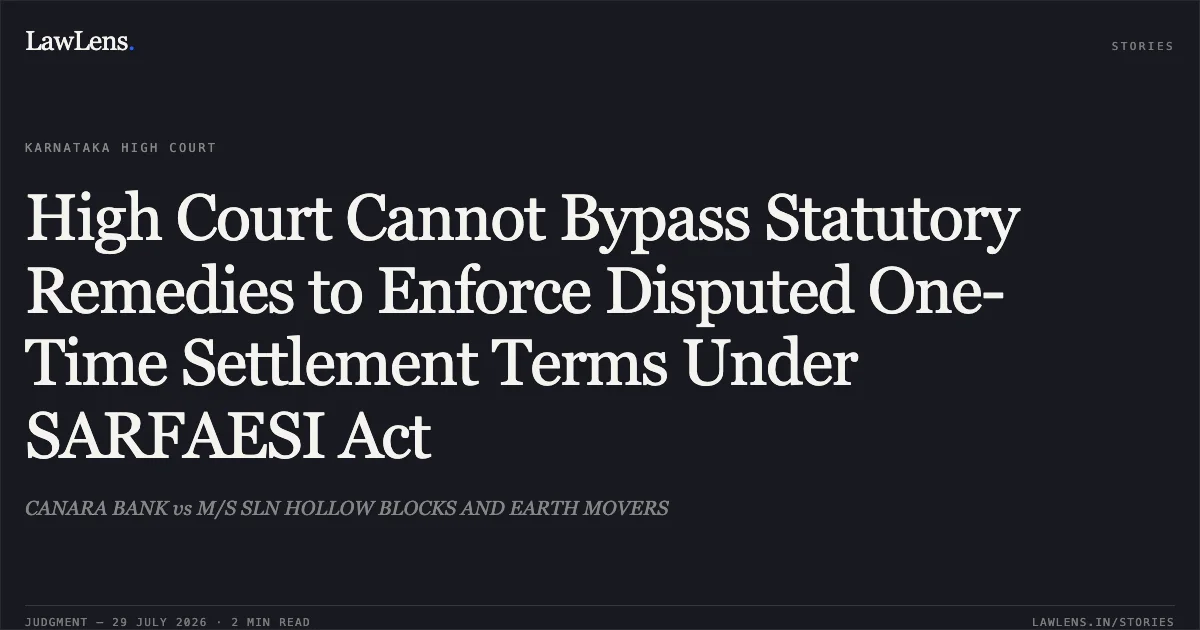
The Division Bench set aside the judgment of the Single Judge, holding that the writ petition was not maintainable due to the alternate remedy.
The Court concluded that the Single Judge exceeded jurisdiction by adjudicating factual disputes regarding the OTS and modifying its terms.
Source reference: para. 31The Writ Appeal was allowed, the impugned order was quashed, and the parties were granted liberty to pursue appropriate statutory remedies.
Source reference: para. 33-34Acts & Sections Cited
7 provisions across 2 statutes referred to in this judgment. Each provision opens on LawLens.
KARNATAKA HIGH COURT ACT, 19611
Securitisation and Reconstruction of Financial Assets and Enforcement of Security Interest Act, 20026
Original Court PDF
CANARA BANKvsM/S SLN HOLLOW BLOCKS AND EARTH MOVERS
Click to open original judgment
Original judgment, available to read, download and summarize on LawLens.in