Facts
The respondent-tenants instituted suits under the Gujarat Rents, Hotel and Lodging House Rates Control Act, 1947, alleging that, although portions of their rented shops were demolished during road-widening works undertaken by the Ahmedabad Municipal Corporation (“AMC”), some portions of the rented premises remained and were retained by the landlord instead of being restored to the tenants.
Source reference: para. 5.1The Trial Court decreed the suits and directed the landlord to hand over the remaining portions of the shops to the tenants. The Appellate Bench of the Small Cause Court affirmed the decrees.
Source reference: paras. 5.1–5.2The landlord challenged the concurrent decisions under Section 29(2) of the 1947 Act, contending that the plaints did not sufficiently identify the immovable properties as required by Order VII Rule 3 of the Code of Civil Procedure, and that no portion of the rented premises remained after demolition.
Source reference: paras. 3, 7–7.2In CRA No. 301 of 2005, the landlord also relied on discrepancies in the Court Commissioner’s panchnama concerning the identity and use of the shop.
Source reference: para. 7.2The tenants relied on the AMC Inspector’s evidence, the Commissioner’s report, municipal records, notices, tax bills and electricity bills to establish that portions of Shop Nos. 26 and 28 remained after road widening and were occupied by the landlord.
Source reference: paras. 8–8.4, 11, 13–14Issues
Whether the plaints failed to comply with Order VII Rule 3 CPC because the rented shops were not sufficiently described and identified?
Source reference: paras. 7, 16–16.2Whether the evidence established that portions of the tenants’ rented premises remained after AMC’s road-widening works and were wrongfully retained by the landlord?
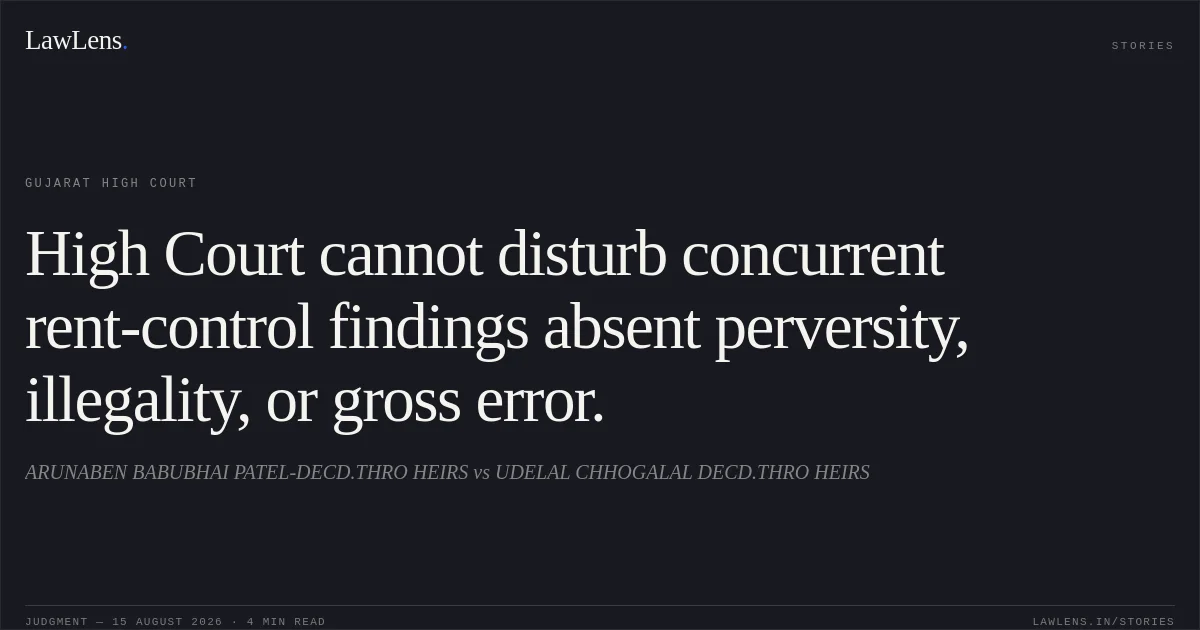
Source reference: paras. 5.1, 10–14Whether the High Court, in exercise of revisional jurisdiction under Section 29(2) of the 1947 Act, could interfere with the concurrent findings of fact recorded by the Courts below?
Source reference: paras. 7.3, 15–15.1Whether the landlord’s failure to enter the witness box and lead rebuttal evidence warranted an adverse inference?
Source reference: paras. 11–12.1Law Applied
The Court applied Section 29(2) of the Gujarat Rents, Hotel and Lodging House Rates Control Act, 1947, under which the High Court’s revisional jurisdiction is confined to examining the legality, correctness and propriety of the impugned decision and does not permit routine reappreciation of evidence.
Source reference: paras. 3, 15–15.1Order VII Rule 3 CPC requires sufficient identification of immovable property in the plaint; however, relying on Pratibha Singh v. Shanti Devi Prasad, (2003) 2 SCC 330, and Hindustan Petroleum Corporation Ltd. v. Ajay Bhatia, (2022) 17 SCC 289, the Court held that an identification defect is curable where the property can otherwise be ascertained.
Source reference: paras. 8.4–8.5, 16–16.1Under Vidhyadhar v. Manikrao, (1999) 3 SCC 573, a party who abstains from entering the witness box may face an adverse presumption under Section 114 of the Evidence Act.
Source reference: para. 12.1Following Hindustan Petroleum Corporation Ltd. v. Dilbahar Singh, (2014) 9 SCC 78, the Court reiterated that concurrent findings may be disturbed in revision only where they are perverse, unsupported by evidence, based on misreading of evidence, or grossly erroneous so as to occasion a miscarriage of justice.
Source reference: para. 15.1Reasoning
The Court found that the tenants had sufficiently identified the rented shops through the municipal final plot number, municipal census number and supporting municipal tax and electricity records. Therefore, any deficiency in the description was curable and did not invalidate the suits or the decrees.
Source reference: paras. 16–16.2On the substantive dispute, the AMC Inspector’s testimony, the Commissioner’s report, the AMC notices and the applications submitted by the parties established that portions of Shop Nos. 26 and 28 remained after road widening and were in the landlord’s possession.
Source reference: paras. 11, 13–14The landlord did not enter the witness box or produce rebuttal evidence to displace this material, justifying an adverse inference under Vidhyadhar.
Source reference: paras. 11–12.1The findings of the Trial Court and the Appellate Court were concurrent, evidence-based and neither perverse nor grossly erroneous. Accordingly, the High Court held that the statutory limits of Section 29(2) did not permit interference merely because the landlord sought a different appreciation of the evidence.
Source reference: para. 15.1Holding
The High Court answered all issues against the landlord. It held that the plaints adequately identified the suit premises, that portions of the tenants’ rented shops remained after AMC’s road widening, and that the concurrent findings of the Courts below disclosed no revisable error.
Both Civil Revision Applications were dismissed with costs quantified at ₹20,000 in each matter, payable by the landlord to the concerned tenant.
Source reference: para. 20The request to suspend the order for eight weeks was refused; the interim relief stood vacated forthwith, and the judgments and decrees of the Courts below were confirmed.
Source reference: paras. 19, 21Acts & Sections Cited
1 provisions across 1 statute referred to in this judgment. Each provision opens on LawLens.
Gujarat Rents, Hotel and Lodging House Rates Control Act, 19471
Original Court PDF
ARUNABEN BABUBHAI PATEL-DECD.THRO HEIRSvsUDELAL CHHOGALAL DECD.THRO HEIRS
Click to open original judgment
Original judgment, available to read, download and summarize on LawLens.in