Facts
The petitioners filed a petition under Section 528 of the Bharatiya Nagarik Suraksha Sanhita (BNSS), 2023, seeking the quashing of an FIR registered at Police Station Torwa, Bilaspur.
Source reference: para. 2The FIR, lodged on March 4, 2026, alleged that Petitioner No. 1 surreptitiously recorded a video of the complainant’s daughter while she was changing clothes.
Source reference: para. 3It further alleged that when the complainant’s son later went to a shop, the petitioners threatened him, with Petitioner No. 2 assaulting him with a sharp object while Petitioners Nos. 1 and 3 used physical force.
Source reference: para. 3The petitioners contended the FIR was a retaliatory and motivated proceeding, citing a counter-complaint filed earlier that day by the mother of Petitioner No. 1 against the complainant’s son for intoxication and harassment.
Source reference: para. 4They argued the allegations were "omnibus" and that the immediate deletion of the alleged video rendered the prosecution's narrative improbable.
Source reference: para. 4Issues
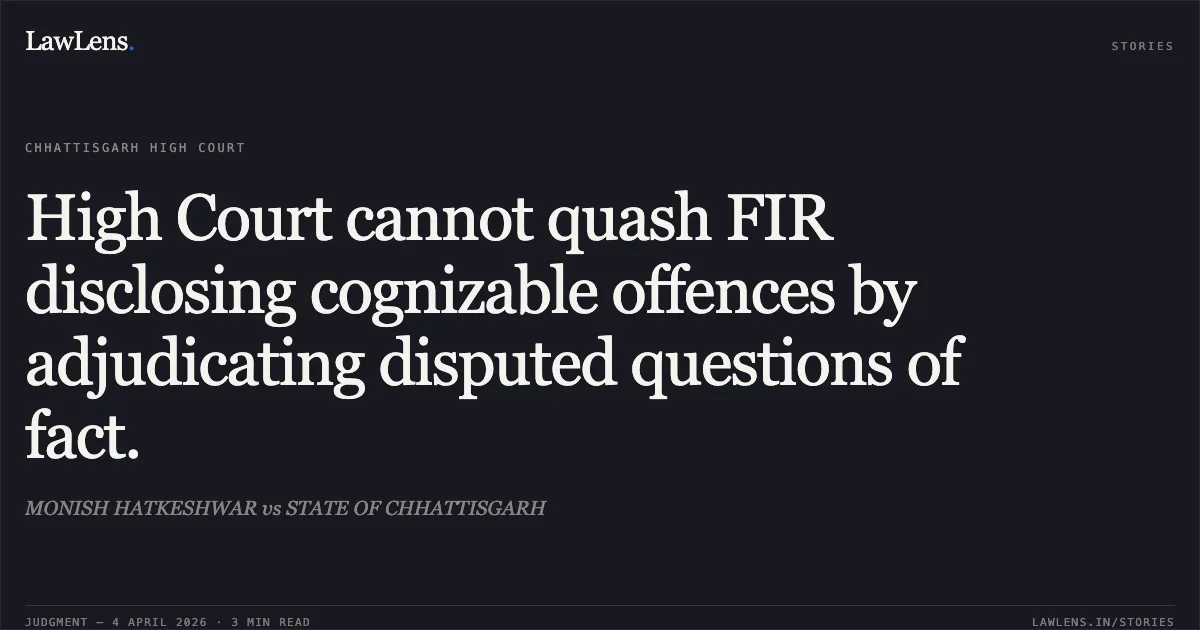
Whether the High Court should exercise its inherent power under Section 528 of the BNSS to quash an FIR that prima facie discloses the commission of cognizable offences.
Source reference: para. 8Whether the existence of a counter-report and disputed questions of fact regarding the motive of the complainant are sufficient grounds to scuttle a criminal investigation at the initial stage.
Source reference: para. 5, 8Law Applied
The court primarily applied Section 528 of the BNSS, 2023 (analogous to Section 482 of the CrPC), regarding the inherent powers of the High Court to prevent abuse of the process of law.
Source reference: para. 2It heavily relied on the principles established in M/s. Neeharika Infrastructure Pvt. Ltd. v. State of Maharashtra (2021), which held that the power of quashing should be exercised sparingly and only in the "rarest of rare cases".
Source reference: para. 7The court underscored that police have a statutory right to investigate cognizable offences and that courts should not thwart such investigations unless no offence of any kind is disclosed.
Source reference: para. 7Furthermore, the court applied the principle that it cannot embark upon an inquiry into the reliability or genuineness of allegations at the quashing stage.
Source reference: para. 7Reasoning
The court observed that the impugned FIR prima facie disclosed the commission of several cognizable offences under the Bharatiya Nyaya Sanhita (BNS), including Sections 115(2), 296, 3(5), 351(3), and 77.
Source reference: para. 8Applying the Neeharika Infrastructure doctrine, the court reasoned that since the allegations—voyeurism and physical assault in the presence of witnesses—constitute cognizable offences, the judicial process should not interfere with the police's statutory duty to investigate.
Source reference: para. 7-8Regarding the petitioners' defense of false implication and the existence of a counter-complaint, the court held that these constitute "disputed questions of fact".
Source reference: para. 8Such matters require the appreciation of evidence by a trial court and cannot be adjudicated in a summary proceeding under inherent jurisdiction.
Source reference: para. 8The court concluded that the petition failed to demonstrate any exceptional circumstances where non-interference would result in a miscarriage of justice.
Source reference: para. 9Holding
The High Court of Chhattisgarh answered the issues in the negative and dismissed the petition.
The court held that the FIR clearly reflected cognizable offences requiring investigation and that the defense's claims of retaliation or improbable facts were matters for trial.
Source reference: para. 8Consequently, the prayer to quash the FIR and stay the arrest of the petitioners was denied.
Source reference: para. 9Acts & Sections Cited
10 provisions across 3 statutes referred to in this judgment. Each provision opens on LawLens.
Bharatiya Nagarik Suraksha Sanhita, 20232
Bharatiya Nyaya Sanhita, 20235
Code of Criminal Procedure, 19733
Original Court PDF
MONISH HATKESHWARvsSTATE OF CHHATTISGARH
Click to open original judgment
Original judgment, available to read, download and summarize on LawLens.in


