01Facts
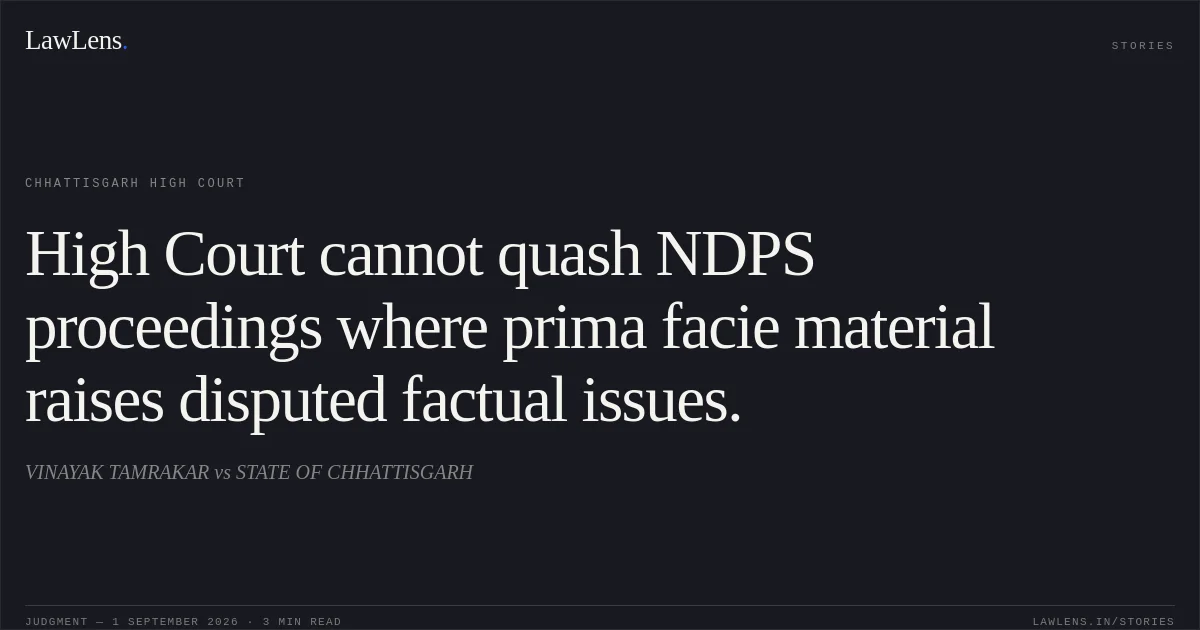
The petitioner challenged FIR Crime No. 247/2026, the consequential charge-sheet, the order taking cognizance, and the order framing charges for offences under Sections 8, 18, 29 and 27-A of the Narcotic Drugs and Psychotropic Substances Act, 1985 (“NDPS Act”).
¶ 2The prosecution alleged that, pursuant to secret information received on 6 March 2026, a police party discovered illegal opium cultivation in fields near the Shivnath River at Village Jhejhri. Co-accused Vikas Bishnoi was found at the spot, and on 7 March 2026 approximately 1,430,100 opium plants weighing 62,424.4 kilograms were allegedly seized.
¶ 3During investigation, Vikas Bishnoi allegedly disclosed the involvement of the petitioner and other accused persons. The petitioner contended that he was not named in the secret information, did not own the land where the crop was found, was not present at the spot, and that no narcotic substance was recovered from him.
¶ 4He further argued that the alleged seizure of agricultural and electrical equipment did not establish conscious possession, conspiracy, financing, or intentional participation. The State opposed the petition and supported continuation of the prosecution.
¶ 5–602Issues
i.Whether the FIR, charge-sheet and consequential proceedings against the petitioner under Sections 8, 18, 29 and 27-A of the NDPS Act disclosed a prima facie case warranting interference under Section 528 of the Bharatiya Nagarik Suraksha Sanhita, 2023 (“BNSS”).
¶ 7, 11–12ii.Whether the High Court could, at the stage of a petition seeking quashing of cognizance and framing of charges, assess the reliability of the prosecution material, resolve disputed questions concerning land ownership and possession, or determine the petitioner’s conscious participation, knowledge, conspiracy or financing.
¶ 9–1103Law Applied
The Court applied the settled principle that the inherent jurisdiction to quash an FIR, charge-sheet or criminal proceedings must be exercised sparingly and only in exceptional cases; proceedings may be quashed where, even accepting the allegations at face value, no offence is disclosed, but not where a prima facie case exists.
¶ 7–8Relying on Rupan Deol Bajaj v. K.P.S. Gill, Rajesh Bajaj v. State of NCT of Delhi and Medchl Chemicals & Pharma (P) Ltd. v. Biological E Ltd., the Court reiterated that patently absurd or inherently improbable allegations may be quashed, whereas a prima facie case should ordinarily proceed.
¶ 8Under Neeharika Infrastructure Pvt. Ltd. v. State of Maharashtra, the High Court cannot conduct a mini-trial, evaluate the reliability or genuineness of evidence, or ordinarily obstruct investigation and prosecution of cognizable offences.
¶ 9The same principle was reaffirmed in Pradeep Kumar Kesharwani v. State of Uttar Pradesh, namely, that disputed questions of fact and the evidentiary worth of investigation material cannot ordinarily be adjudicated under the inherent jurisdiction.
¶ 10Provisions in the judgment · 5 · Linked ones open on LawLens
Narcotic Drugs and Psychotropic Substances Act, 1985 Section 8Section 18Section 29
Code of Criminal Procedure, 1973 Section 482
Bharatiya Nagarik Suraksha Sanhita, 2023 Section 528
04Reasoning
The Court held that the petitioner’s objections principally concerned the sufficiency and credibility of the prosecution evidence, including the alleged discrepancies regarding ownership and possession of the land, the evidentiary value of memorandum statements and seizure proceedings, and whether the petitioner possessed the requisite knowledge or consciously participated in the alleged opium cultivation.
¶ 11These matters required appreciation of evidence and determination of disputed facts, which could not be undertaken in proceedings under Section 528 BNSS. At the preliminary stage, the Court was required only to determine whether the material, taken at face value, disclosed a prima facie case—not whether the prosecution would ultimately prove the charges beyond reasonable doubt.
¶ 11The Court therefore declined to discard or meticulously examine the investigation material and left the petitioner’s defences to be raised before the trial court.
¶ 11–1205Holding
The Court answered the issues against the petitioner. It held that the prosecution material was not patently absurd, inherently improbable or wholly insufficient to justify quashing, and that the orders taking cognizance and framing charges did not suffer from manifest illegality or perversity.
¶ 12The petition seeking quashing of the FIR, charge-sheet, cognizance order, charge-framing order and consequential proceedings was accordingly dismissed, with no order as to costs.
¶ 12The petitioner was permitted to raise all permissible defences before the trial court, which was directed to consider the matter independently and uninfluenced by the High Court’s observations.
¶ 12–13Original Court PDF
VINAYAK TAMRAKARvsSTATE OF CHHATTISGARH
Click to open original judgment
Original judgment, available to read, download and summarize on LawLens.in