01Facts
The marriage between Petitioner No. 1 and Respondent No. 2 was solemnized on July 2, 2021.
pp. 1-2Due to matrimonial discord, the parties began living separately, leading Respondent No. 2 to file a complaint alleging cruelty.
p. 2Consequently, FIR No. 210/2023 was registered under Sections 498A, 406, and 34 of the Indian Penal Code (IPC) at Police Station Kotwali.
pp. 1-2Subsequently, the parties settled all disputes via a Memorandum of Understanding dated December 6, 2023, and obtained a decree of divorce by mutual consent.
p. 2A total settlement amount of ₹8,00,000/- was agreed upon, the final installment of which was paid in court.
p. 2The Petitioners sought quashing of the FIR based on this settlement.
02Issues
i.Whether the High Court should exercise its inherent power to quash criminal proceedings for non-compoundable matrimonial offences when the parties have reached an amicable settlement.
p. 3 · ¶ 903Law Applied
The court primarily applied Section 528 of the Bharatiya Nagarik Suraksha Sanhita, 2023 (BNSS), which preserves the inherent powers of the High Court previously held under Section 482 of the Code of Criminal Procedure, 1973.
p. 3 · ¶ 9It relied on the principles established in Narinder Singh & Ors. v. State of Punjab & Anr. (2014), which mandates quashing cases of a predominantly civil or matrimonial character to secure the ends of justice when settlement is reached.
pp. 3-4 · ¶ 9Furthermore, it cited Parbatbhai Aahir & Ors. v. State of Gujarat & Anr. (2017), affirming that while heinous crimes cannot be quashed, matrimonial disputes where the possibility of conviction is remote should be terminated to prevent abuse of the process of law.
pp. 4-6 · ¶ 10Provisions in the judgment · 5 · Linked ones open on LawLens
Indian Penal Code, 1860 Section 406Section 34
Code of Criminal Procedure, 1973 Section 482Section 320
Bharatiya Nagarik Suraksha Sanhita, 2023 Section 528
04Reasoning
The court observed that the dispute was essentially matrimonial in nature, lacking the "mental depravity" associated with heinous crimes that impact society at large.
pp. 3-4Since the parties had already dissolved their marriage by mutual consent and the complainant (Respondent No. 2) stated in person that she did not wish to pursue the proceedings, the court determined that the possibility of conviction had become "remote and bleak".
p. 4 · ¶ 9.5 · p. 5 · ¶ 16.9Applying the guidelines from Narinder Singh, the court reasoned that continuing the criminal trial would result in unnecessary oppression of the accused and would not serve the ends of justice.
p. 6 · ¶ 1105Holding
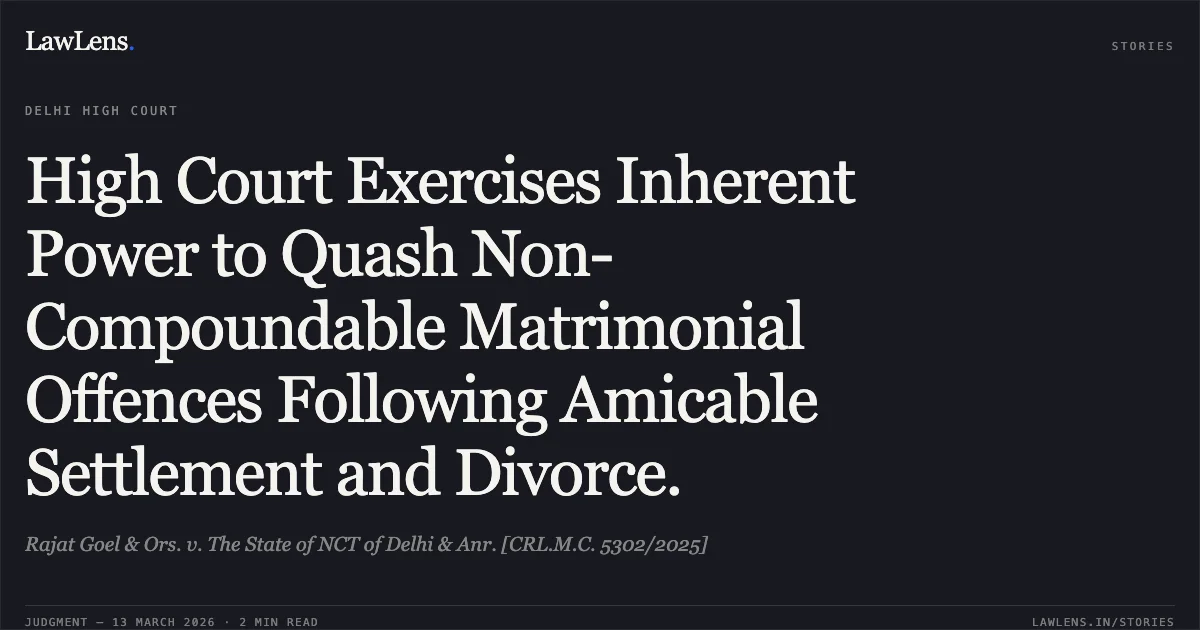
The court answered the issue in the affirmative, holding that this was a fit case to exercise discretionary jurisdiction under Section 528 of the BNSS.
p. 6 · ¶ 11The court ordered that FIR No. 210/2023, registered at Police Station Kotwali, and all consequential proceedings arising therefrom, stand quashed.
p. 6 · ¶ 12The petition was allowed accordingly.
p. 6 · ¶ 13Original Court PDF
Rajat Goel & Ors. v. The State of NCT of Delhi & Anr. [CRL.M.C. 5302/2025]
Click to open original judgment
Original judgment, available to read, download and summarize on LawLens.in