Facts
The marriage between Petitioner No. 1 and Respondent No. 2 was solemnized on June 23, 2023.
Source reference: no citationFollowing allegations of dowry-related harassment and cruelty, an FIR was registered on February 2, 2025, under Section 498-A/34 of the IPC.
Source reference: p. 3After investigation, a charge-sheet was filed and the Judicial Magistrate First Class, Raipur, took cognizance on September 18, 2025, in Criminal Case No. 40841/2025.
Source reference: p. 3During the pendency of these proceedings, the parties entered into an amicable settlement, filed for divorce by mutual consent under Section 13(B) of the Hindu Marriage Act, 1955, and agreed upon a permanent alimony of Rs. 5,00,000/-.
Source reference: p. 4-5Consequently, the petitioners moved the High Court to quash the criminal proceedings based on this compromise.
Source reference: p. 2Issues
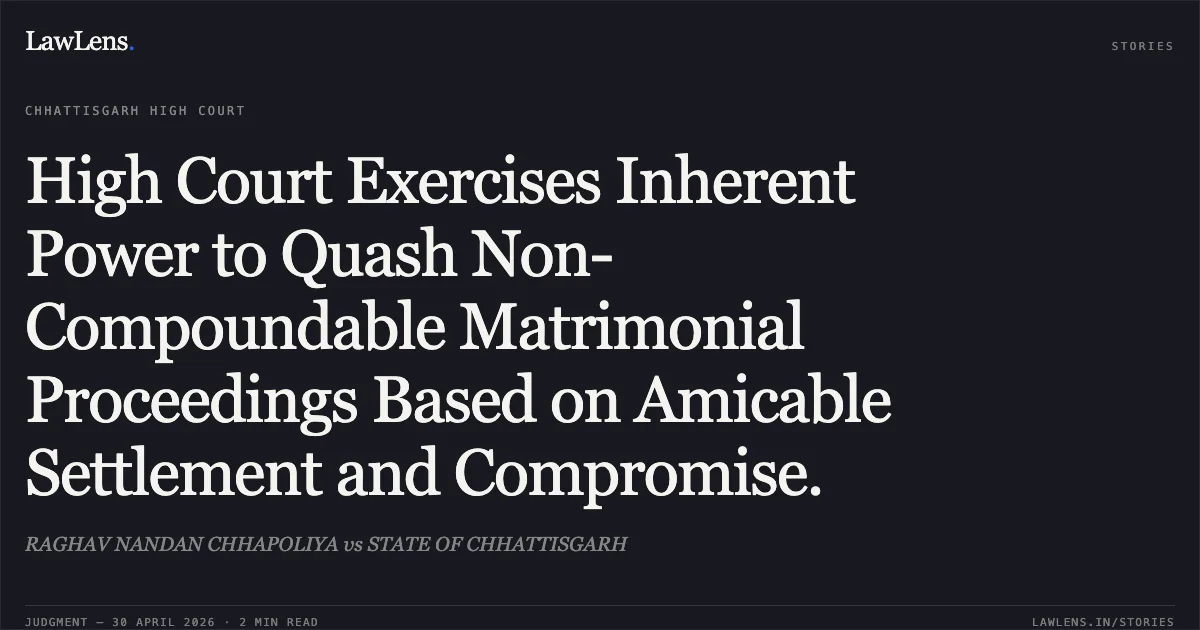
Whether the High Court, in the exercise of its inherent powers under Section 528 of the Bharatiya Nagarik Suraksha Sanhita (BNSS), can quash criminal proceedings involving non-compoundable matrimonial offences when the parties have reached an amicable settlement.
Source reference: p. 7 / para. 11Law Applied
The Court primarily applied Section 528 of the Bharatiya Nagarik Suraksha Sanhita (BNSS), which preserves the inherent powers of the High Court to prevent abuse of process or secure the ends of justice.
Source reference: p. 10It relied on the landmark precedents of Gian Singh v. State of Punjab (2012) and Jitendra Raghuvanshi v. Babita Raghuwanshi (2013), which established that matrimonial disputes are personal in nature and, even if non-compoundable under Section 320 of the Code, may be quashed if a genuine settlement is reached to encourage marital harmony or facilitate the parties' move toward separate lives.
Source reference: p. 7-9The Court also noted the principle that quashing is appropriate when the possibility of conviction is remote due to compromise, making continued prosecution oppressive.
Source reference: para. 12Reasoning
The Court observed that the dispute between the parties was "purely matrimonial in nature" and had been resolved voluntarily through mediation.
Source reference: para. 13Applying the ratio from Jitendra Raghuvanshi, the Bench reasoned that it is the duty of the courts to encourage genuine settlements in matrimonial matters.
Source reference: para. 10The Court found that since the parties had already initiated divorce by mutual consent and reached a financial settlement, the continuation of the criminal trial for the offence under Section 498-A would be an "exercise in futility" and would adversely impact the reconciliation process.
Source reference: para. 13-14The Bench concluded that because the wrong was essentially private and personal, and the parties had resolved their entire dispute, the ends of justice would be better served by terminating the proceedings rather than allowing a bleak prosecution to continue.
Source reference: para. 12-14Holding
The Court answered the issue in the affirmative, holding that the inherent power to quash is not limited by the compounding provisions of the Code in matrimonial settlements.
The High Court allowed the petition and quashed FIR No. 09/2025 dated February 2, 2025, and the resulting proceedings in Criminal Case No. 40841/2025 pending before the Judicial Magistrate First Class, Raipur.
Source reference: para. 14The quashment is subject to the fulfillment of the terms and conditions of the compromise agreement entered into by the parties.
Source reference: para. 14-15Acts & Sections Cited
13 provisions across 5 statutes referred to in this judgment. Each provision opens on LawLens.
Bharatiya Nagarik Suraksha Sanhita, 20231
Indian Penal Code, 18602
Bharatiya Nyaya Sanhita, 20235
Hindu Marriage Act, 19551
Protection of Women from Domestic Violence Act, 20054
Original Court PDF
RAGHAV NANDAN CHHAPOLIYAvsSTATE OF CHHATTISGARH
Click to open original judgment
Original judgment, available to read, download and summarize on LawLens.in