Facts
The marriage of respondent No. 2/complainant Rajshree Potphode with petitioner No. 1 Manish Dhote was solemnized on 04.05.2018 as per Hindu rites and customs; petitioners Nos. 2, 3 and 4 are the mother-in-law, sister-in-law (Jethani) and brother-in-law (Jeth) of the complainant respectively.
Source reference: para. 3The complainant lodged FIR Crime No. 06/2025 at P.S. Mahila Thana, District Betul, alleging torture and harassment in connection with demand of dowry, for offences punishable under Sections 498-A r/w 34 IPC and Sections 3/4 of the Dowry Prohibition Act.
Source reference: para. 1, 3, 4The petitioners sought quashment of the FIR and consequential proceedings under Section 482 CrPC.
Source reference: para. 1During pendency, both parties filed I.A. No. 9501/2026 under Section 320 CrPC seeking to place on record a compromise.
Source reference: para. 2, 4Pursuant to the Court's direction dated 29.04.2026, the parties appeared before the Registrar (J-II) on 08.05.2026, who recorded their statements; both parties affirmed that the settlement was entered into without any threat, inducement or pressure, and the Registrar reported the compromise to be genuine and authentic, with the parties duly identified by counsel.
Source reference: para. 5, 6Issues
1. Whether the High Court, in exercise of its inherent powers under Section 482 CrPC, may quash an FIR and consequential criminal proceedings arising out of a matrimonial dispute where the parties have amicably settled their differences.
Source reference: para. 8, 92. Whether Section 320 CrPC operates as a bar to quashment of proceedings for non-compoundable offences—namely Sections 498-A r/w 34 IPC and Sections 3/4 of the Dowry Prohibition Act—on the basis of a genuine compromise between the parties.
Source reference: para. 10, 12Law Applied
The Court exercised its inherent jurisdiction under Section 482 of the CrPC.
Source reference: no citationGian Singh v. State of Punjab, (2012) 10 SCC 303, which holds that the inherent power to quash is distinct from the power of compounding under Section 320 CrPC; while heinous offences (murder, rape, dacoity) cannot be quashed despite settlement, offences "arising out of matrimony relating to dowry" or family disputes—being private and personal in nature—may be quashed where the compromise renders conviction remote and continuation of proceedings would cause oppression.
Source reference: para. 11Jitendra Raghuvanshi v. Babita Raghuvanshi (Crl. Appeal No. 447/2013, decided 15.03.2013), which, following B.S. Joshi v. State of Haryana, (2003) 4 SCC 675, held that Section 320 CrPC is not a bar to quashment of matrimonial disputes and that courts must encourage genuine settlements.
Source reference: para. 10Principles culled out in Narinder Singh v. State of Punjab, (2014) 6 SCC 466, were also noted as the governing framework for settlement-based quashment, with supporting reliance on Jagdish Channa v. State of Haryana, AIR 2008 SC 1968, Madan Mohan Abbot v. State of Punjab, AIR 2008 SC 1969, and Shiji v. Radhika, (2011) 10 SCC 705.
Source reference: para. 8, 11Reasoning
The Court found the dispute squarely within the category identified in Gian Singh—offences arising out of matrimony relating to dowry, where the wrong is "basically private or personal in nature".
Source reference: para. 11, 12The voluntariness of the settlement was independently verified: the complainant stated before the Registrar (J-II) that she had entered into the compromise, did not wish to pursue the criminal proceedings, and fully supported the compromise application; the Registrar reported the compromise as genuine and authentic.
Source reference: para. 6, 9Applying Jitendra Raghuvanshi, the Court held that non-compoundability is no impediment since the petition sought quashment, not compounding, and Section 320 does not fetter Section 482 powers.
Source reference: para. 10The Court reasoned that the object of law is not merely punishment but maintenance of "peace, tranquility and harmony in society," and that matrimonial settlements deserve encouragement lest parties lose "precious years" litigating in courts.
Source reference: para. 12Given the genuine settlement, the possibility of conviction was rendered remote, and continuation of the proceedings would amount to abuse of process and cause prejudice to the petitioners.
Source reference: para. 11, 12Holding
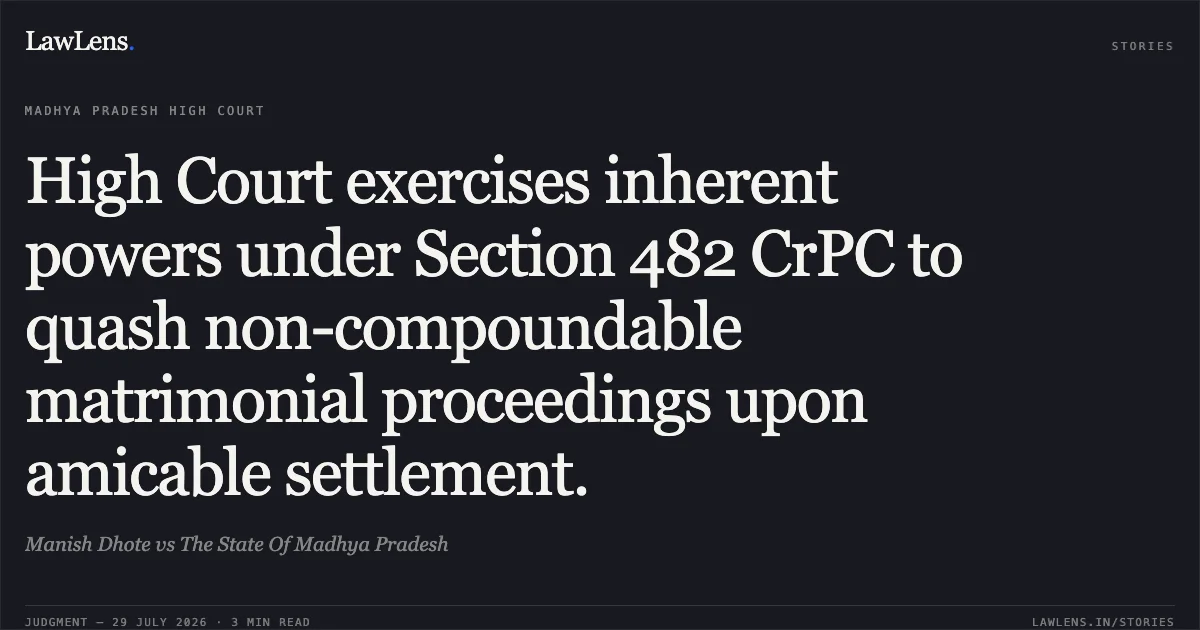
The Court answered both issues in favour of the petitioners: the High Court's Section 482 powers extend to quashing non-compoundable matrimonial offences upon genuine compromise, and Section 320 CrPC is no bar thereto.
Reliance on Jitendra Raghuvanshi, Gian Singh and the consistent view of the Court, the petition was allowed; FIR Crime No. 06/2025 registered at P.S. Mahila Thana, District Betul, and all consequential criminal proceedings for offences under Sections 498-A r/w 34 IPC and Sections 3/4 of the Dowry Prohibition Act were quashed on the basis of the compromise. The petition was disposed of accordingly.
Source reference: para. 13Acts & Sections Cited
6 provisions across 3 statutes referred to in this judgment. Each provision opens on LawLens.
Code of Criminal Procedure, 19732
Indian Penal Code, 18602
Original Court PDF
Manish DhotevsThe State Of Madhya Pradesh
Click to open original judgment
Original judgment, available to read, download and summarize on LawLens.in