Facts
The State of Meghalaya (Petitioner) and Marbaniang Projects Pvt. Ltd. (Contemnors) are involved in proceedings before an Arbitral Tribunal.
Source reference: para 1-2On 08.11.2023 and 10.11.2023, the Tribunal directed the Contemnors to pay lease rentals and furnish a bank guarantee of ₹2 crores
Source reference: para 1-2Upon the Contemnors' failure to comply, the State sought contempt proceedings.
Source reference: para 3On 19.02.2024, the Tribunal observed that while it lacked jurisdiction under the Contempt of Courts Act, the matter required strict action; it referred the matter to the High Court Registry to be placed before the Chief Justice
Source reference: para 3Simultaneously, the State filed a petition under Section 12 of the Contempt of Courts Act, 1971
Source reference: para 4The Contemnors challenged the maintainability of the petition, arguing that no formal reference was made by the Tribunal and that the State could not pursue parallel proceedings
Source reference: para 12-14Issues
1. Whether a contempt petition filed by an aggrieved party is maintainable for the violation of an Arbitral Tribunal's interim orders in the absence of a formal administrative reference
Source reference: para 152. Whether the High Court has the jurisdiction to punish for contempt of an Arbitral Tribunal under the Arbitration and Conciliation Act, 1996
Source reference: para 6-7Law Applied
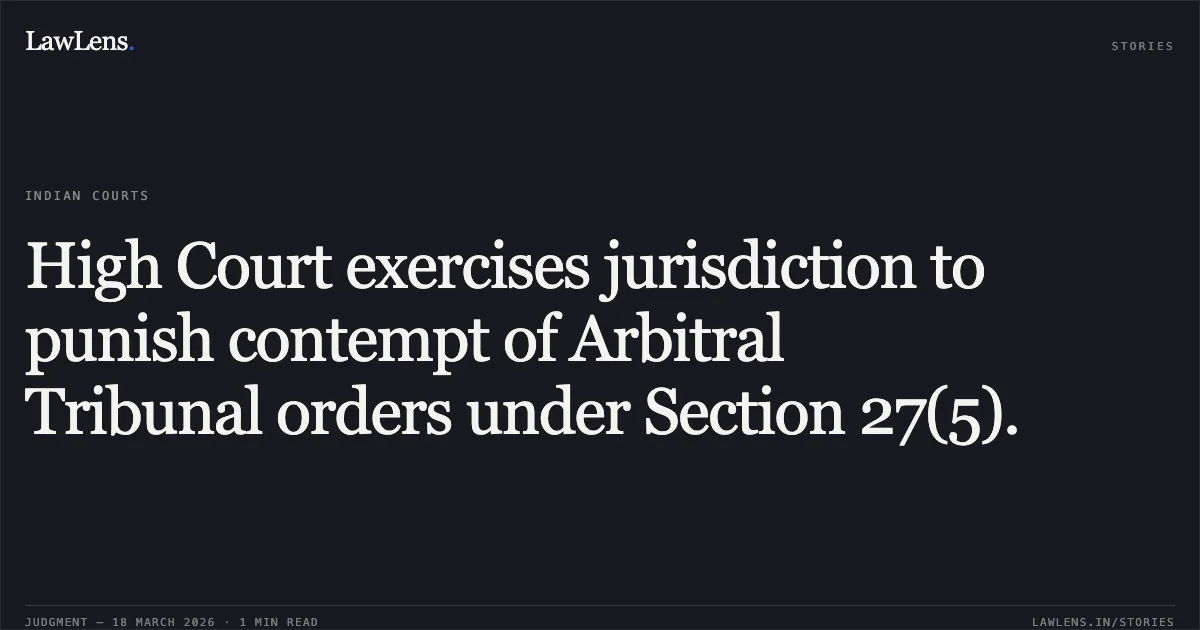
The Court relied on Section 27(5) of the Arbitration and Conciliation Act, 1996, which provides that persons failing to comply with orders of an Arbitral Tribunal are subject to the same penalties and punishments by the Court as they would be for similar offenses in suits before the Court
Source reference: para 6It further applied Section 17(2) of the same Act, which deems interim orders of a Tribunal to be orders of the Court for enforcement purposes
Source reference: para 7The Court followed the precedents of Sri Krishan v. Anand (2009) and Alka Chandewar v. Shamshul Ishrar Khan (2017), affirming that disobedience of Tribunal orders triggers contempt jurisdiction
Source reference: para 6-7Additionally, it applied Rules 6(2) and 9 of the Contempt of Courts (High Court of Meghalaya) Rules, 2013, which permit contempt actions via suo motu motion, petition by an aggrieved party, or reference by a subordinate court
Source reference: para 9-10Reasoning
The Court analyzed the Contemnors' objection regarding the lack of a "formal reference." It noted that the Arbitral Tribunal’s order dated 19.02.2024 explicitly found the Contemnors in violation of its directions and requested High Court intervention
Source reference: para 16Although the Tribunal’s administrative process for the reference was initially incomplete, the Petitioner exercised its right under Rule 9(b) of the High Court Rules to file a petition as an "aggrieved party"
Source reference: para 10, 18The Court observed that once the Single Judge and the Chief Justice directed the matter to be placed before the Division Bench, the "process of reference" was effectively completed and acknowledged by the Court
Source reference: para 19-21The Court rejected the argument that Section 27(5) had not been complied with, holding that the Tribunal’s intent to seek contempt action was clear from its order
Source reference: para 21-22Holding
The High Court held that the contempt petition is maintainable
It ruled that the combination of the Tribunal’s referral order and the State’s petition as an aggrieved party sufficiently invoked the Court's jurisdiction under the Contempt of Courts Act and the Arbitration and Conciliation Act
Source reference: para 21-22The Court dismissed the Contemnors' objections and directed them to file a show cause notice within two weeks
Source reference: para 24Acts & Sections Cited
3 provisions across 2 statutes referred to in this judgment. Each provision opens on LawLens.
Contempt of Courts Act, 19711
Arbitration and Conciliation Act, 19962
Original Court PDF
STATE OF MEGHALAYAvsMAYVEN T MARBANIANG AND ANR.
Click to open original judgment
Original judgment, available to read, download and summarize on LawLens.in