Facts
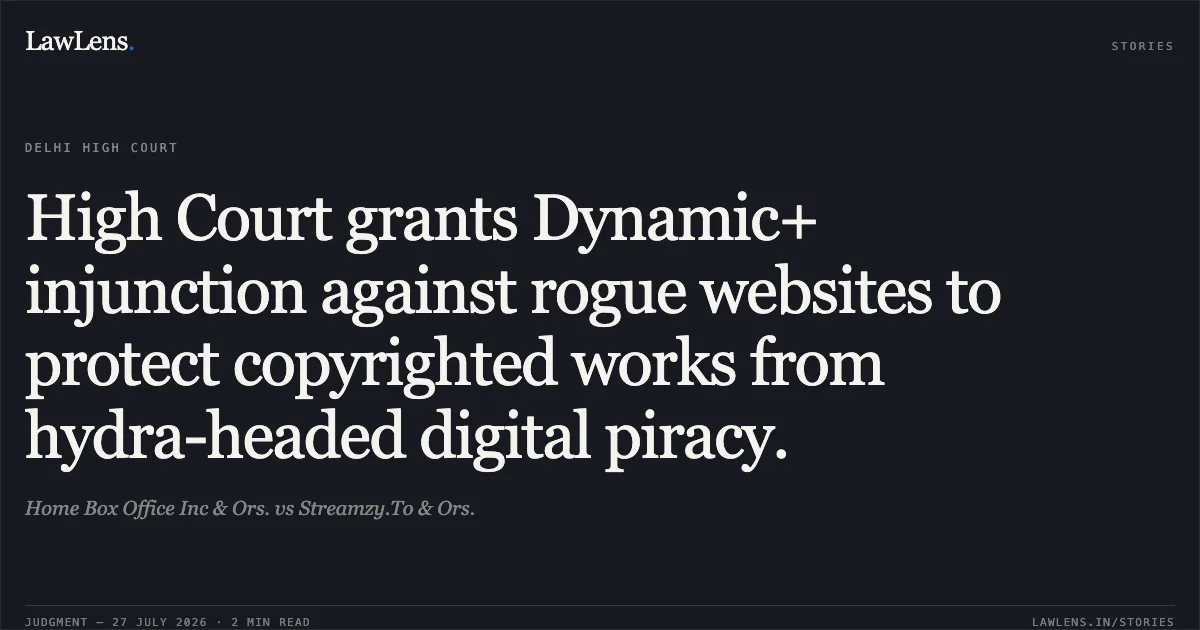
The Plaintiffs, major motion picture production houses, filed a suit for permanent injunction against 30 "rogue websites" (Defendants 1-30) for unauthorized streaming and distribution of their copyrighted cinematographic films and shows
Source reference: p. 1-3The identities of the website operators are masked behind privacy policies of Domain Name Registrars (DNRs)
Source reference: p. 7The Plaintiffs sought an ex-parte ad-interim "Dynamic+ Injunction" to not only block the identified websites but also to enable the blocking of future mirror, redirect, or alphanumeric variations of these websites that may emerge during the proceedings to circumvent court orders
Source reference: p. 1-2, 14Issues
1. Whether the Defendant websites qualify as "rogue websites" or "flagrantly infringing online locations" (FIOLs) warranting a blocking order
Source reference: p. 7 / para. 72. Whether the court should grant a "Dynamic+ Injunction" allowing for the blocking of future mirror/redirect websites without the Plaintiffs having to file a fresh suit for each iteration
Source reference: p. 14-15 / para. 14-173. What mechanism should be adopted to balance the protection of copyright with the legal status of intermediaries (ISPs/DNRs) to avoid granting a "carte blanche" power to block websites without judicial oversight
Source reference: p. 15 / para. 15-20Law Applied
The Court applied the principles regarding ‘rogue websites’ established in UTV Software Communication Ltd. v. 1337X.To, defining them as sites whose primary purpose is to facilitate copyright infringement, often characterized by masked registrant details and disregard for take-down notices
Source reference: p. 3-7The concept of "Dynamic+ Injunctions" was drawn from Universal City Studios Productions LLLP v. Movies123.LA and Home Box Office Inc v. Moviebox.ph, which allow interim relief to extend to future works and mirror sites
Source reference: p. 10-12The court also considered the "safe harbour" protections for intermediaries under Section 79 of the Information Technology Act, 2000, as interpreted in Shreya Singhal v. Union of India, which mandates that blocking must generally occur via a judicial or administrative order
Source reference: p. 17 / para. 22Reasoning
The Court determined that Defendants 1-30 are FIOLs because their primary purpose is the unlicensed dissemination of content and their contact details are obscured
Source reference: p. 7The Justice noted a procedural tension: while mirror sites frustration injunctions (the "moving target" problem), allowing Plaintiffs to block websites unilaterally via mere affidavits to ISPs would bypass judicial scrutiny and cast an illegal "adjudicatory responsibility" upon neutral intermediaries
Source reference: p. 15To resolve this, the court fashioned a hybrid mechanism... this court permitted a "pro-tem" (temporary) blocking by ISPs/DNRs upon the Plaintiffs' affidavit, provided the intermediary "technically verifies" that the new site is indeed a mirror or redirect of the originally injuncted site. This restricts the intermediary's role to technical verification rather than legal adjudication
Source reference: p. 16-17Holding
The Court granted an ex-parte ad-interim injunction restraining Defendants 1-30 from hosting or streaming the Plaintiffs' copyrighted works
Regarding future sites, the Court held that Plaintiffs are at liberty to notify ISPs/DNRs of mirror/alphanumeric/redirect websites via affidavit. Intermediaries are directed to enforce the injunction as a "pro-tem measure" after technical verification. Simultaneously, Plaintiffs must file an application under Order I Rule 10 CPC to implead these new websites for formal judicial consideration
Source reference: p. 16-17Acts & Sections Cited
3 provisions across 3 statutes referred to in this judgment. Each provision opens on LawLens.
Code of Civil Procedure, 19081
Copyright Act, 19571
Information Technology Act, 20001
Original Court PDF
Home Box Office Inc & Ors.vsStreamzy.To & Ors.
Click to open original judgment
Original judgment, available to read, download and summarize on LawLens.in