Facts
The petitioner originally registered her marriage with the respondent No. 2 (Registrar of Marriages) citing the date of marriage as 11.03.2024.
Source reference: p. 3On that date, due to the husband’s ill health, only a limited ceremony (exchange of garlands and mangalsutra) was performed in a temple.
Source reference: p. 3Vital Hindu rituals, specifically "datta homa" and "Saptapadi," were deferred until the husband recovered.
Source reference: p. 3These ceremonies were subsequently performed on 15.12.2025 in a larger social gathering.
Source reference: p. 3The petitioner sought to rectify the marriage certificate to reflect 15.12.2025 as the correct legal date of marriage, but the respondent authority claimed a lack of statutory power to amend the certificate, leading to a rejection of the request on 24.12.2025.
Source reference: p. 2Issues
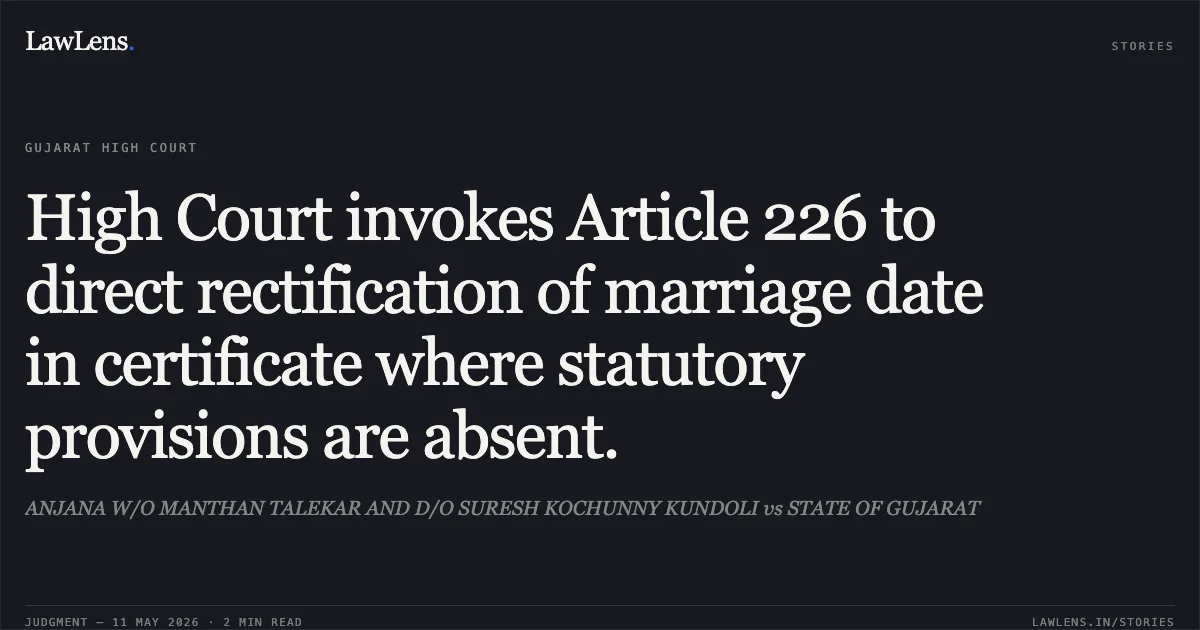
1. Whether the High Court can exercise its extraordinary jurisdiction under Article 226 to direct the Registrar of Marriages to correct the marriage date in the absence of specific statutory provisions for such rectification
Source reference: p. 5Law Applied
The court primarily applied Article 226 of the Constitution of India, which grants High Courts wide powers to issue writs for the enforcement of rights and to achieve justice where no other adequate remedy exists.
Source reference: p. 5The court also relied on the judicial precedent established in Special Civil Application No. 19647 of 2019 (Order dated 09.01.2020), which held that if a Registrar is powerless under the Gujarat Public Trust Act/Marriage Rules to rectify a certificate, the High Court may intervene to remedy a situation that prevents a party from cohabiting with their spouse or exercising their legal rights.
Source reference: p. 4Reasoning
The court observed that while the respondent authority (Registrar) did not technically err in refusing the amendment because the law provided no specific mechanism for such a change, the petitioner was left without a remedy.
Source reference: para. 14, p. 4Drawing from the cited precedent, the court noted that the factual circumstances—where traditional rites like Saptapadi (essential for a valid Hindu marriage) were completed only at a later date—justified a correction to reflect the true legal solemnization.
Source reference: p. 3The court reasoned that constitutional powers under Article 226 are meant to overcome such technical hurdles to ensure the official record reflects the actual date of the complete ceremonial marriage (15.12.2025) rather than the preliminary exchange of garlands (11.03.2024).
Source reference: p. 5Holding
The Court allowed the petition and directed the respondent No. 2 to accept a fresh application from the petitioner seeking to change the marriage date from 11.03.2024 to 15.12.2025.
The Court ordered the Registrar to issue a fresh marriage certificate reflecting the updated date and declared that the earlier certificate (dated 18.03.2024) shall stand quashed and cancelled upon the issuance of the new one.
Source reference: p. 5-6The exercise was directed to be completed within two weeks.
Source reference: p. 6Original Court PDF
ANJANA W/O MANTHAN TALEKAR AND D/O SURESH KOCHUNNY KUNDOLIvsSTATE OF GUJARAT
Click to open original judgment
Original judgment, available to read, download and summarize on LawLens.in