Facts
The Petitioners owned land in Mumbai, possession of which was taken by the Respondent Municipal Corporation in 1960 for public purposes.
Source reference: para. 1, 6While some portions were acquired via agreements, 9,295.25 sq. mtrs. remained unacquired despite being utilized for public utilities.
Source reference: para. 9Following several rounds of litigation, the SLAO issued a Section 4 notification on 08.12.1999 and a Section 6 declaration on 05.01.2001 (published 18.01.2001).
Source reference: para. 14An award passed in 2001 was set aside by the High Court in 2008 due to incorrect valuation principles.
Source reference: para. 18The Supreme Court, in 2011, directed the SLAO to reconsider all issues, including the Petitioners' claim that the acquisition had lapsed because the Section 6 declaration was issued more than one year after the Section 4 notification.
Source reference: para. 19, 39On 19.07.2011, the SLAO rejected the Petitioners' application, claiming the "lapsing" issue had already been decided by higher courts.
Source reference: para. 19, 42Issues
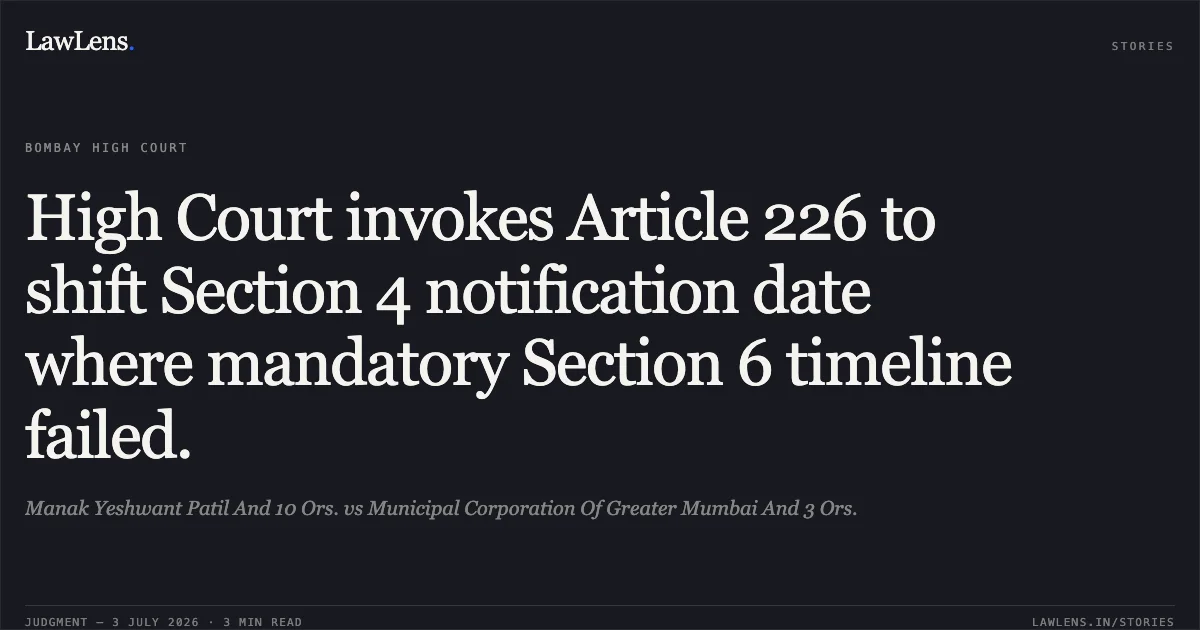
1. Whether the land acquisition proceedings lapsed by operation of law under the proviso to Section 6 of the Land Acquisition Act, 1894, due to the declaration being issued beyond one year of the Section 4 notification?
Source reference: para. 442. Whether the High Court can exercise its jurisdiction under Article 226 to shift the date of the Section 4 notification to balance the owners' rights with public interest?
Source reference: para. 54Law Applied
The court applied Section 6 of the Land Acquisition Act, 1894, which mandatorily requires that a declaration be made within one year of the Section 4 notification.
Source reference: para. 46-47It relied on the Constitution Bench in Padma Sundara Rao v. State of Tamil Nadu, which held that the time limit in the proviso to Section 6 is mandatory and bears no exceptions.
Source reference: para. 45, 48The court applied principles from Competent Authority v. Barangore Jute Factory and Bernard Francis Joseph Vaz v. Government of Karnataka, which establish that when an acquisition is technically invalid but the land is already in public use, the High Court under Article 226 has the inherent power to "shift" the Section 4 notification date to a later date to ensure fair market value compensation without requiring the return of the land.
Source reference: para. 55, 57Reasoning
The court found it undisputed that the Section 4 notification was published on 23.12.1999, while the Section 6 declaration was only issued on 05.01.2001 and published on 18.01.2001.
Source reference: para. 49This delay beyond the mandatory one-year period rendered the declaration a nullity by operation of law.
Source reference: para. 50The court rejected the Respondent’s argument that Section 126 of the MRTP Act applied, noting that the possession was taken in 1960 (pre-dating the Act) and the State had specifically proceeded under the 1894 Act.
Source reference: para. 51-52Recognizing that the Petitioners’ Article 300-A rights were violated by 60 years of non-payment, but also noting the land now housed schools and roads, the court determined that returning the land was impractical.
Source reference: para. 53, 54, 59Applying the doctrine of "shifting dates," the court determined that the only way to do "complete justice" was to treat the date of the filing of the present Writ Petition as the new deemed date for the Section 4 notification.
Source reference: para. 60-61Holding
The court allowed the petition, quashing the SLAO’s order dated 19.07.2011 and held that the original acquisition proceedings had lapsed.
The court shifted the date of the Section 4 notification to 26.08.2011 (the date the petition was lodged), directed the SLAO to pass a fresh award based on that market value within three months, and ordered the disbursement of deposited amounts and interest.
Source reference: para. 61, 62(c)-(i)Acts & Sections Cited
1 provisions across 1 statute referred to in this judgment. Each provision opens on LawLens.
Maharashtra Regional and Town Planning Act, 1966.1
Original Court PDF
Manak Yeshwant Patil And 10 Ors.vsMunicipal Corporation Of Greater Mumbai And 3 Ors.
Click to open original judgment
Original judgment, available to read, download and summarize on LawLens.in