Facts
The litigation concerns competing claims over the estate (valued at over Rs. 100 Crores) of Purvez Burjor Dalal, who died on 07.12.2011.
Source reference: para. 3Respondent No. 1 propounded a Will dated 22.11.2010, while one Manek Sukhadwalla propounded a later Will dated 08.09.2011.
Source reference: paras. 4-5On 24.12.2013, the High Court appointed an Administrator pendente lite under Section 247 of the Indian Succession Act (ISA), 1925.
Source reference: para. 7The Administrator discovered that Sukhadwalla had transferred Rs. 17,08,147 to M/s. Amoha Traders and Rs. 15,00,000 to the Appellant Trust shortly after the testator's death.
Source reference: para. 9Investigations revealed that the involved entities shared common addresses and contacts linked to a Jamsheed Panday, and that the Appellant Trust, dormant since 1943, was revived only in 2011.
Source reference: paras. 12-13Due to Sukhadwalla’s non-cooperation and alleged siphoning of funds, a Single Judge of the Bombay High Court invoked Article 215 of the Constitution to direct a court-monitored criminal investigation.
Source reference: paras. 15-16The Division Bench dismissed the appeals against this direction.
Source reference: para. 19Issues
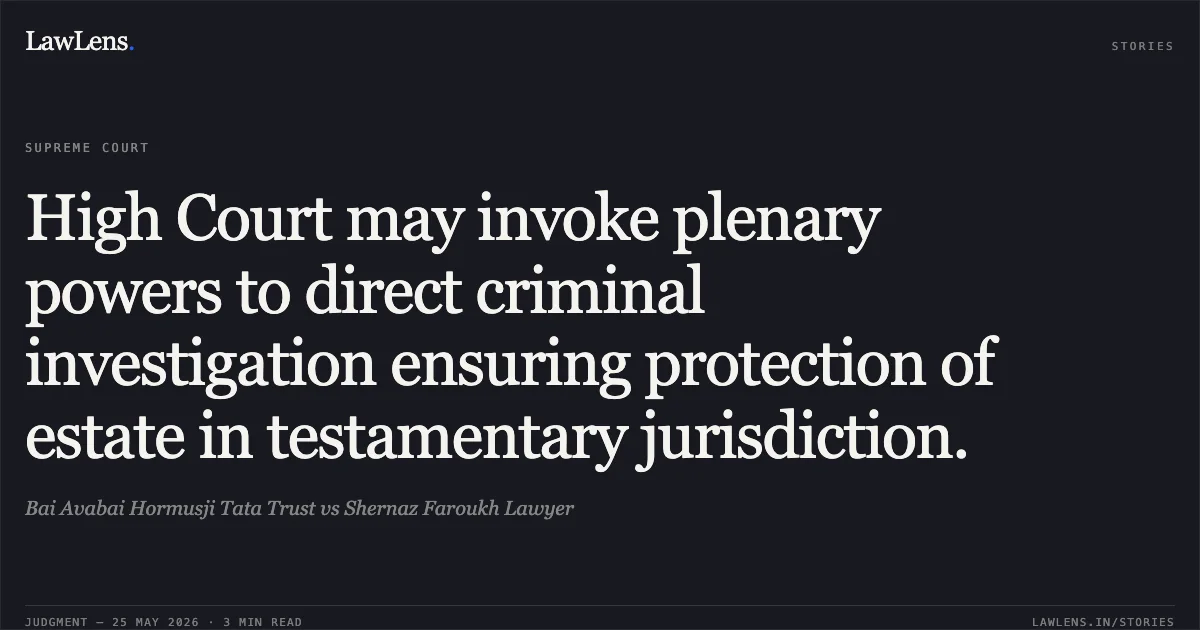
1. Whether a Testamentary Court has the jurisdiction to invoke plenary/inherent powers to direct a criminal investigation into the conduct of parties regarding the estate.
Source reference: para. 242. Whether the Indian Succession Act, 1925, as a self-contained code, precludes the High Court from bypassing statutory procedures under the CrPC (such as Section 340) to order an investigation.
Source reference: para. 17, 26.2Law Applied
Section 247 of the ISA, 1925 establishes that an Administrator pendente lite is an officer/hand of the Court under its immediate control.
Source reference: paras. 30-31Article 215 of the Constitution designates High Courts as Superior Courts of Record possessing inherent and plenary powers to prevent abuse of process and protect property in custodia legis.
Source reference: paras. 33, 35The decision in M.V. Elisabeth v. Harwan Investment Trading Pvt. Ltd. affirms the unlimited jurisdiction of High Courts to devise procedural rules where not prohibited.
Source reference: para. 33, 38Anthony C. Leo v. Nandlal Bal Krishnan regarding the obligation of court officers to seek legal action for property preservation.
Source reference: para. 31Sanjeev Kumar Mittal v. State regarding the Court’s power to use state agencies to investigate fraud.
Source reference: para. 37Reasoning
The Court reasoned that while the primary role of a Probate Court is to determine a Will's genuineness, it cannot remain a "silent spectator" when an estate in custodia legis is being plundered.
Source reference: para. 32The Court found that Section 269 of the ISA authorizes interference to protect property at risk of loss, and Section 300 grants the High Court concurrent jurisdiction with District Judges in this regard.
Source reference: paras. 34-35The Court rejected the "self-contained code" argument, stating that the ISA does not grant immunity for criminal breach of trust or forgery.
Source reference: para. 37It noted the suspicious "handshake" transactions and the revival of a dormant trust coincided with the disputed Will, justifying an investigation to trace assets that the Administrator could not recover due to "stonewalling" and deceit.
Source reference: paras. 39-40The Court clarified that Section 340 CrPC was not the sole source of power here; the High Court exercised its broader constitutional mandate to uphold the administration of justice.
Source reference: para. 41Holding
The Supreme Court held that a High Court exercising testamentary jurisdiction does not cease to be a Court of Record or a Court of Equity under Article 215.
The Court ruled that no substantive prejudice is caused to the Appellants as they will have a full opportunity to defend themselves during the criminal process.
Source reference: para. 42The Supreme Court dismissed the appeals and upheld the High Court's jurisdiction to direct a criminal investigation; the Prothonotary was directed to submit a report, and the investigation authorities were ordered to proceed expeditiously.
Source reference: para. 45-46Acts & Sections Cited
12 provisions across 2 statutes referred to in this judgment. Each provision opens on LawLens.
Indian Succession Act, 1925
Code of Criminal Procedure, 19733
Original Court PDF
Bai Avabai Hormusji Tata TrustvsShernaz Faroukh Lawyer
Click to open original judgment
Original judgment, available to read, download and summarize on LawLens.in