Facts
The complainant alleged that he had entered into agreements to sell, dated 7 May 2011 and 1 March 2012, concerning approximately 12 vighas of land situated at Motikishol village, Survey No. 461.
Source reference: pp. 1–3, paras. 2–2.1He claimed to have paid earnest money and further consideration, taken possession, commenced development, and engaged watchmen and gardeners.
Source reference: pp. 1–3, paras. 2–2.1According to the FIR, the petitioners subsequently harassed the persons working at the site, threatened them, and removed articles including lights, batteries, an inverter, solar panels, wires, a water tank, PVC pipes and water taps, allegedly worth ₹62,350.
Source reference: pp. 1–3, paras. 2–2.1The petitioners invoked Section 482 of the Code of Criminal Procedure, 1973 (“Cr.P.C.”), seeking quashing of FIR C.R. No. I-93 of 2014 registered at Viramgam Rural Police Station for offences under Sections 379, 507 and 114 of the Indian Penal Code, 1860 (“IPC”), together with consequential proceedings.
Source reference: pp. 3–6, paras. 3–3.5A chargesheet had been filed during the proceedings.
Source reference: p. 7, para. 4Issues
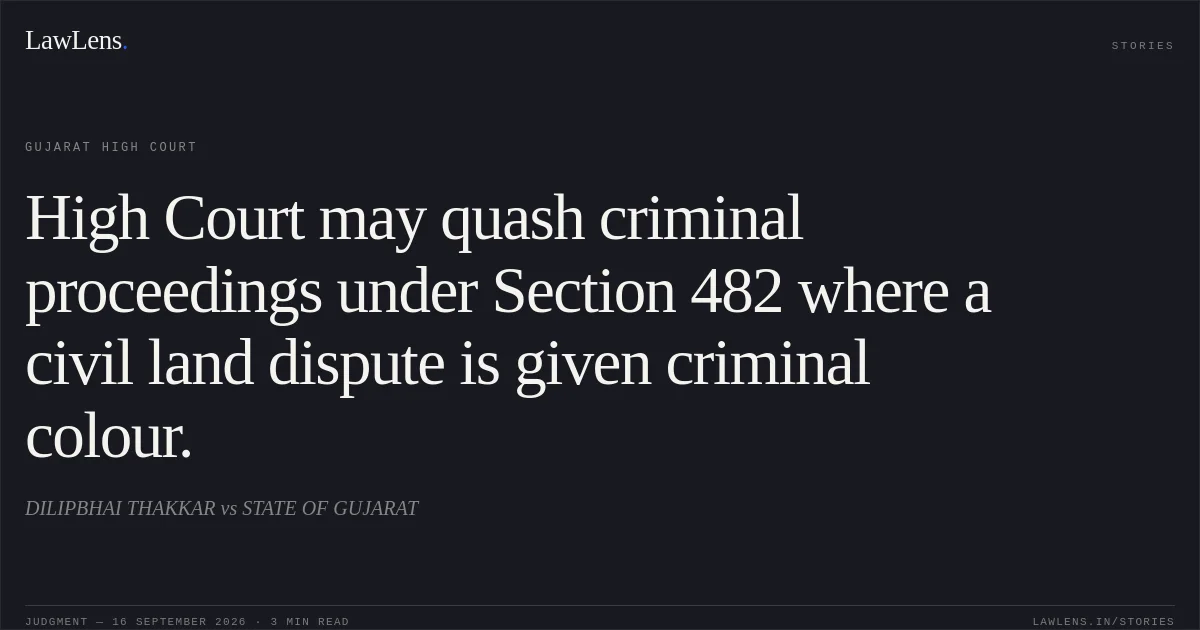
Whether the FIR, chargesheet and consequential proceedings disclosed genuine criminal offences under Sections 379, 507 and 114 IPC, or merely gave a criminal colour to a civil dispute arising from an agreement to sell and competing claims of title and possession.
Source reference: p. 7, para. 5; pp. 8–9, paras. 7 and 9Whether the High Court could exercise its inherent jurisdiction under Section 482 Cr.P.C. after filing of the chargesheet.
Source reference: p. 7, para. 5; p. 9, para. 8Law Applied
The Court applied Section 482 Cr.P.C., which preserves the High Court’s inherent power to prevent abuse of the process of any court and to secure the ends of justice.
Source reference: p. 8, para. 6It relied on State of Haryana v. Bhajan Lal, 1992 Supp (1) SCC 335, and Paramjeet Batra v. State of Uttarakhand, (2013) 11 SCC 673, for the principle that criminal proceedings may be quashed where they are manifestly mala fide or instituted with an ulterior motive to exert pressure or wreak vengeance.
Source reference: p. 8, para. 6The Court further relied on Indian Oil Corpn. v. NEPC India Ltd., (2006) 6 SCC 736, which cautions against converting purely civil disputes into criminal proceedings for recovery or pressure tactics.
Source reference: p. 8, para. 7Under Section 379 IPC, theft requires dishonest moving of movable property out of another person’s possession without consent; therefore, the complainant must establish possession of the articles allegedly removed.
Source reference: p. 8, para. 7Relying on Anand Kumar Mohatta v. State (NCT of Delhi), (2019) 11 SCC 706, the Court held that the filing of a chargesheet does not bar the High Court from exercising jurisdiction under Section 482 Cr.P.C.
Source reference: p. 9, para. 8Reasoning
The Court found that the parties’ relationship arose entirely from the agreements to sell and that the central dispute concerned non-performance or cancellation of the transaction, payment of consideration, title and possession.
Source reference: p. 8, para. 7The documentary material, which was not disputed by the complainant, did not record delivery of physical possession to him, while the revenue records continued to reflect the petitioners’ names.
Source reference: p. 8, para. 7In that context, the allegation that the petitioners had committed theft of articles installed by an allegedly unverified occupant on land claimed by the petitioners was considered inherently improbable and unsupported by documentary material.
Source reference: pp. 8–9, paras. 7–9The Court accordingly concluded that the criminal allegations were being used to create pressure in what was fundamentally a civil land and contractual dispute.
Source reference: pp. 8–9, paras. 7–9It also rejected the objection that the chargesheet prevented intervention under Section 482 Cr.P.C., holding that continuation of proceedings founded on a maliciously criminalised civil dispute would itself amount to abuse of process.
Source reference: p. 9, para. 8Holding
The Court answered both issues in favour of the petitioners.
It held that the FIR and chargesheet represented an attempt to give criminal colour to a civil dispute and that the filing of the chargesheet did not curtail the Court’s inherent jurisdiction under Section 482 Cr.P.C.
Source reference: p. 10, paras. 10 and 12The petition was allowed, and FIR C.R. No. I-93 of 2014, the chargesheet, and all consequential criminal proceedings against the petitioners for offences under Sections 379, 507 and 114 IPC were quashed and set aside.
Source reference: p. 10, paras. 10 and 12The Court clarified that the order would not prevent either party from pursuing appropriate civil remedies before the competent Civil Court.
Source reference: p. 10, para. 11Acts & Sections Cited
4 provisions across 2 statutes referred to in this judgment. Each provision opens on LawLens.
Code of Criminal Procedure, 19731
Indian Penal Code, 18603
Original Court PDF
DILIPBHAI THAKKARvsSTATE OF GUJARAT
Click to open original judgment
Original judgment, available to read, download and summarize on LawLens.in