Facts
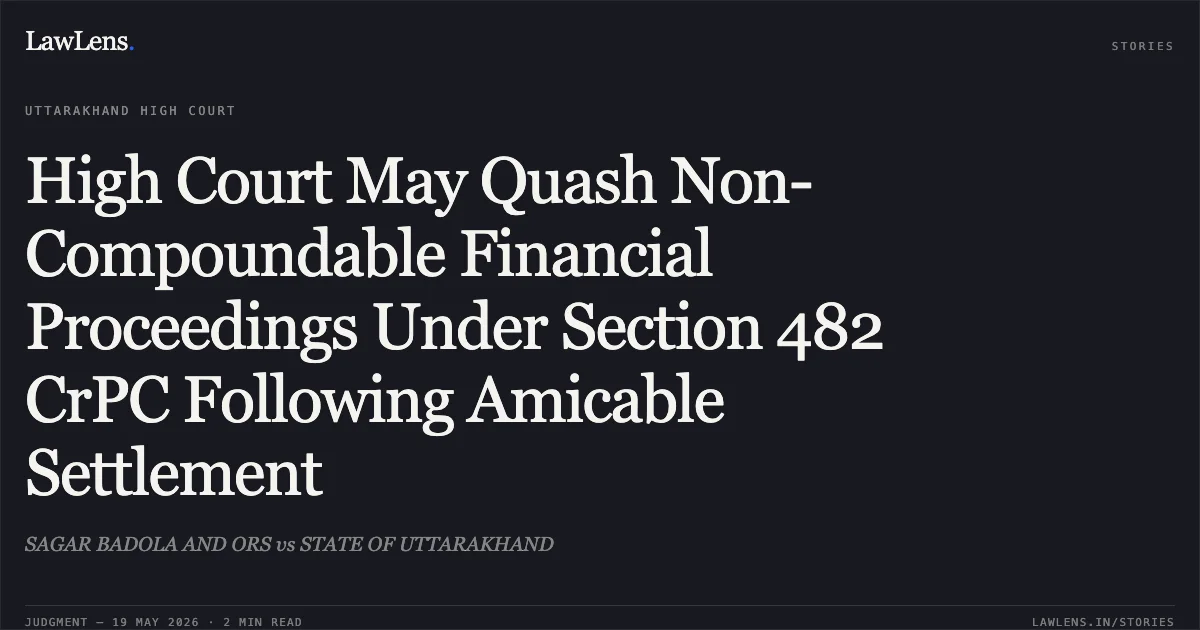
The applicants, former employees of Muthoot Finance Company (Branch In-charge and Relationship Managers), were accused of financial irregularities involving the misappropriation of gold jewellery pledged against loans and the preparation of forged documents.
Source reference: para. 5Following an audit and investigation, a charge-sheet was filed, and the Additional Chief Judicial Magistrate, Kotdwara, took cognizance on 12.03.2020 for offences under Sections 406, 420, 467, 468, and 120-B of the IPC.
Source reference: para. 4-5Parallelly, a civil recovery suit (O.S. No. 2 of 2020) was filed by the complainant-company, which was later settled via compromise in Lok Adalat on 08.03.2025 after full payment of the disputed amount.
Source reference: para. 5-6The parties subsequently filed a joint compounding application (I.A. No. 2 of 2026) to quash the criminal proceedings based on this settlement.
Source reference: para. 8Issues
1. Whether the High Court, in exercise of its inherent powers under Section 482 Cr.P.C., can quash criminal proceedings involving non-compoundable offences when the parties have reached an amicable settlement.
Source reference: para. 132. Whether the continuation of criminal proceedings in a dispute predominantly civil/financial in nature, which has been settled, would amount to an abuse of the process of the court.
Source reference: para. 15Law Applied
The Court primarily applied Section 482 of the Code of Criminal Procedure (Cr.P.C.) regarding the inherent powers of the High Court to prevent abuse of the process of law and secure the ends of justice.
Source reference: para. 13The Court relied on the landmark principles established in Gian Singh v. State of Punjab, which permits quashing of non-compoundable offences if the dispute is private/civil in character and settled.
Source reference: para. 14The Court applied the guidelines from Narinder Singh v. State of Punjab regarding the futility of trial post-settlement, and Parbatbhai Aahir v. State of Gujarat, emphasizing the use of inherent powers to secure justice.
Source reference: para. 14Reasoning
The Court observed that although the State Counsel opposed the application because Sections 467, 468, and 120-B IPC are non-compoundable, the underlying dispute was essentially financial and private in nature.
Source reference: para. 10, 15The Court verified that the parties had voluntarily entered into a compromise without coercion, the complainant had received the full settlement amount, and the complainant appeared in person to express unwillingness to proceed.
Source reference: para. 8, 9, 12Applying the Gian Singh doctrine, the Court reasoned that since the parties had settled the civil suit in Lok Adalat and the complainant no longer supported the prosecution, any further criminal proceedings would be futile and would not lead to conviction.
Source reference: para. 14-15Consequently, quashing was deemed necessary to prevent the abuse of the judicial process.
Source reference: para. 15Holding
The Court answered the issues in the affirmative, holding that the settlement rendered the continuation of the case unnecessary and an abuse of process.
The Court allowed the compounding application (I.A. No. 2 of 2026) and the Section 482 Cr.P.C. application.
Source reference: para. 16, 18The charge-sheet, the cognizance order dated 12.03.2020 in Criminal Case No. 413 of 2020, and the entire proceedings pending before the Additional Chief Judicial Magistrate, Kotdwara, were quashed.
Source reference: para. 17Acts & Sections Cited
5 provisions across 2 statutes referred to in this judgment. Each provision opens on LawLens.
Indian Penal Code, 18604
Code of Criminal Procedure, 19731
Original Court PDF
SAGAR BADOLA AND ORSvsSTATE OF UTTARAKHAND
Click to open original judgment
Original judgment, available to read, download and summarize on LawLens.in