Facts
The petitioners were accused in Madhuban P.S. Case No. 53 of 2023 for offenses involving rioting, attempted murder, outraging modesty, and house trespass under Sections 147, 148, 149, 341, 323, 307, 354, 427, 448, and 509 of the IPC, alongside Sections 3(1)(r) and 3(1)(s) of the SC/ST Act.
Source reference: p. 1-2During the pendency of the investigation, the petitioners and the informant (Opposite Party No. 2) settled their disputes through a compromise facilitated by common friends.
Source reference: p. 2The parties filed Interlocutory Application No. 4932 of 2026 supported by affidavits expressing the informant's desire not to proceed with the case.
Source reference: p. 2The petitioners contended that the dispute was private in nature and that the Section 307 IPC charge was an exaggeration as no sharp weapons or firearms were used.
Source reference: p. 2Issues
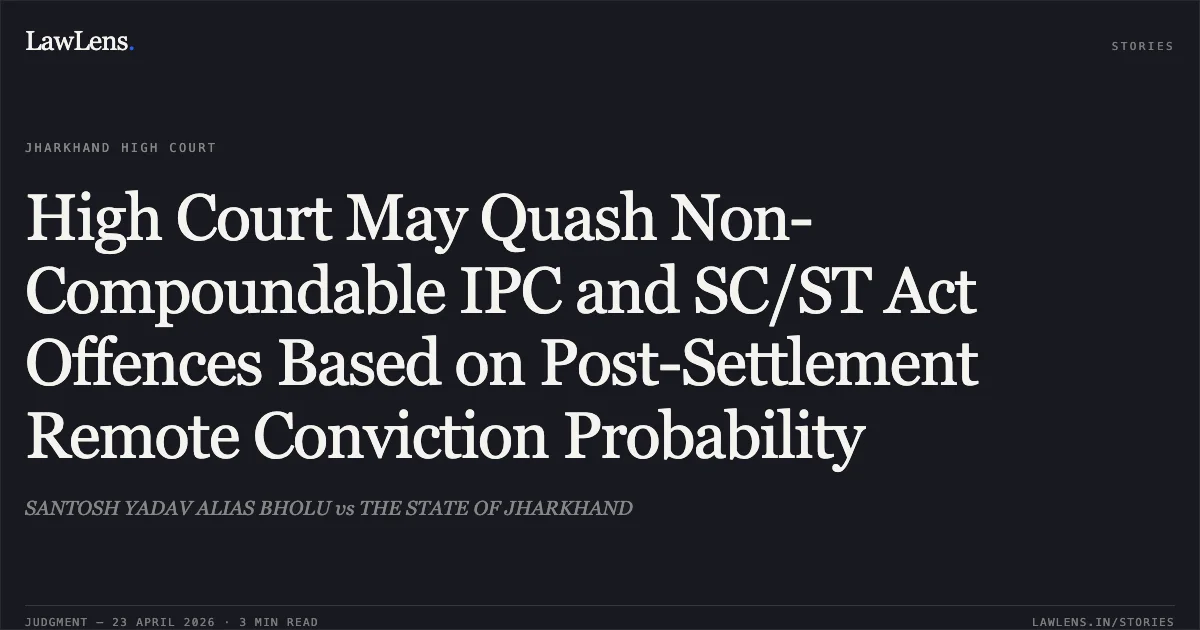
1. Whether the High Court can exercise its inherent power to quash a criminal proceeding involving non-compoundable offenses, including Section 307 IPC and the SC/ST Act, on the basis of a settlement between parties.
Source reference: para. 3-42. Whether the continuation of proceedings in the present case would amount to an abuse of the process of law given the bleak chances of conviction following the compromise.
Source reference: para. 3, 9Law Applied
Section 528 of the Bharatiya Nagarik Suraksha Sanhita (BNSS), 2023 (corresponding to Section 482 CrPC), regarding the inherent powers of the High Court to prevent abuse of process.
Source reference: p. 1, 6The principle established in Narinder Singh & Ors. v. State of Punjab & Anr. (2014) that even for Section 307 IPC, the court may quash proceedings if the injury is not serious and the settlement occurs during the investigation stage.
Source reference: para. 7The doctrine derived from Ramawatar v. State of Madhya Pradesh (2022), which permits quashing under the SC/ST Act if the offense is primarily private or civil in nature and not committed purely on the account of the victim's caste.
Source reference: para. 4Reasoning
The Court noted that although the FIR included Section 307 IPC (Attempt to Murder), there were no allegations of using sharp weapons or firearms, and the dispute appeared to be primarily private rather than a heinous crime against society.
Source reference: para. 3, 8The Court observed that the settlement was reached while the investigation was still ongoing, a stage where the High Court is encouraged to be more liberal in accepting compromises to ensure harmony.
Source reference: para. 7, 29.7Applying the Ramawatar precedent, the Court found that the underlying objectives of the SC/ST Act would not be contravened if the proceedings were quashed, as the dispute was private and no public policy was at stake.
Source reference: para. 4, 8The Court determined that the possibility of conviction was "remote and bleak" and forcing the parties to trial would cause "extreme injustice" and "oppression" to the petitioners.
Source reference: para. 9-10Holding
The Court answered the issues in the affirmative, holding that where a settlement is reached in a private dispute and the chances of conviction are minimal, the High Court must exercise its inherent power to quash the proceedings to serve the ends of justice.
The Court allowed Cr. M.P. No. 1028 of 2026 and quashed the entire criminal proceeding including the FIR in Madhuban P.S. Case no. 53 of 2023.
Source reference: para. 11-12Interlocutory Application No. 4932 of 2026 was also disposed of accordingly.
Source reference: para. 13Acts & Sections Cited
12 provisions across 3 statutes referred to in this judgment. Each provision opens on LawLens.
Bharatiya Nagarik Suraksha Sanhita, 20231
Indian Penal Code, 1860
Scheduled Castes and the Scheduled Tribes (Prevention of Atrocities) Act, 19891
Original Court PDF
SANTOSH YADAV ALIAS BHOLUvsTHE STATE OF JHARKHAND
Click to open original judgment
Original judgment, available to read, download and summarize on LawLens.in