Facts
The petitioner sought quashing of FIR No. 0170/2021 dated 19.08.2021, registered at Police Station R.S. Pura, Jammu, for offences under Sections 452, 498-A, 323, 504, 506 and 34 IPC.
Source reference: para. 1The petitioner was the mother-in-law of respondent No. 2, whose marriage with the petitioner’s son was solemnised in 2014. Following matrimonial disputes, respondent No. 2 left the matrimonial home and lodged the FIR against the petitioner and another accused.
Source reference: para. 2She subsequently initiated proceedings under the Protection of Women from Domestic Violence Act, 2005, in which interim monetary relief was granted.
Source reference: para. 3During the pendency of those proceedings, the parties amicably settled their matrimonial disputes and agreed to seek dissolution of the marriage by mutual consent. Respondent No. 2 filed an affidavit stating that she did not wish to pursue the FIR.
Source reference: para. 4The Registrar Judicial recorded the parties’ statements, confirming the voluntariness and genuineness of the settlement and respondent No. 2’s consent to quashing the FIR.
Source reference: para. 5Issues
Whether the High Court could exercise its inherent jurisdiction under Section 482 CrPC to quash non-compoundable offences on the basis of a settlement between the parties?
Source reference: para. 8Whether, in the circumstances of the matrimonial dispute, continuation of the criminal proceedings would amount to an abuse of the process of law and whether the proceedings should therefore be quashed?
Source reference: paras. 10–11Law Applied
The Court applied the inherent jurisdiction of the High Court under Section 482 CrPC, which is distinct from the statutory power of compounding under Section 320 CrPC and may extend to quashing non-compoundable offences to secure the ends of justice or prevent abuse of process.
Source reference: para. 8Relying on Gian Singh v. State of Punjab, (2012) 10 SCC 303, the Court held that criminal proceedings arising predominantly from matrimonial, family, commercial or other private disputes may be quashed where the parties have completely settled the matter and the likelihood of conviction is remote, provided the offences are not heinous crimes having a serious societal impact.
Source reference: para. 8The Court also relied on Narinder Singh v. State of Punjab, (2014) 6 SCC 466, which requires the power to be exercised sparingly and with caution, while permitting quashing in matrimonial and family disputes where settlement makes continuation of prosecution oppressive, unjust or an abuse of process.
Source reference: para. 9Reasoning
The Court treated the dispute as a private matrimonial conflict rather than an offence having a predominant public or societal character.
Source reference: paras. 10–11The settlement was supported by respondent No. 2’s affidavit and confirmed through statements recorded by the Registrar Judicial, establishing that it was voluntary and comprehensive.
Source reference: paras. 4–5Since respondent No. 2 no longer wished to pursue the prosecution and the matrimonial dispute had been resolved, the possibility of conviction was considered remote.
Source reference: para. 11The Court further observed that allowing the prosecution against the petitioner, who was the parent-in-law of respondent No. 2, to continue would defeat the settlement and serve no useful purpose. Accordingly, continuation of the proceedings would amount to abuse of the process of law and cause grave injustice.
Source reference: para. 11Holding
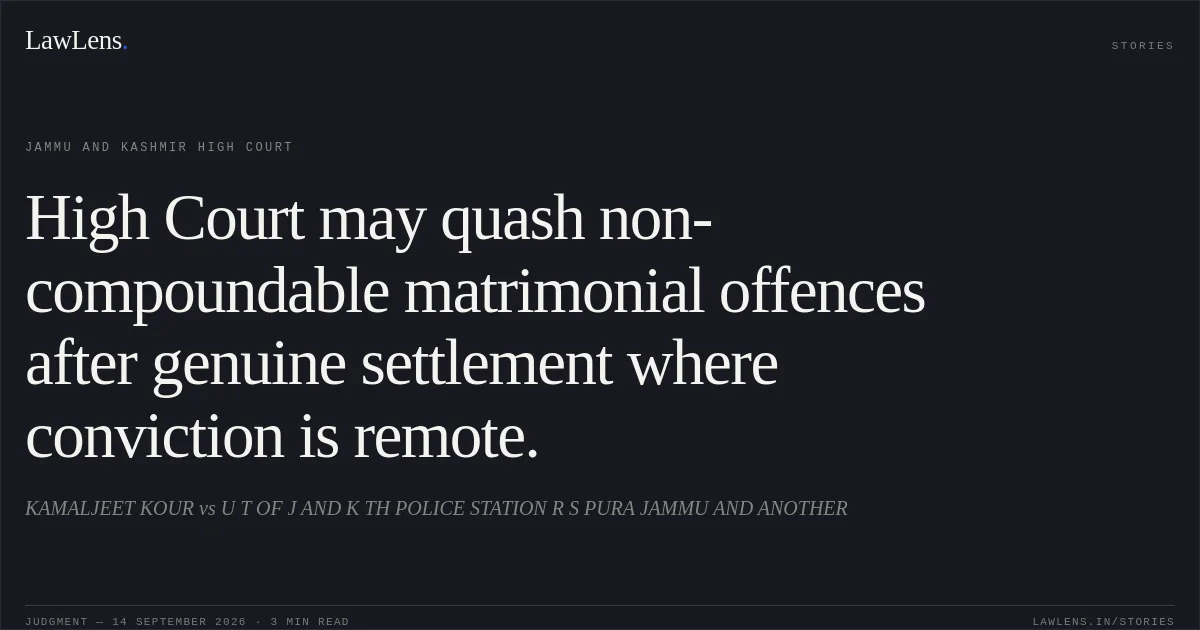
The Court answered the issues in favour of the petitioner and held that the FIR and consequential proceedings could be quashed notwithstanding the non-compoundable nature of some alleged offences.
The petition was allowed, and FIR No. 0170/2021 dated 19.08.2021, registered at Police Station R.S. Pura, Jammu, under Sections 452, 498-A, 323, 504, 506 and 34 IPC, along with all proceedings emanating from it, was quashed.
Source reference: para. 12A copy of the order was directed to be sent to the concerned police station for information and compliance.
Source reference: para. 13Acts & Sections Cited
8 provisions across 2 statutes referred to in this judgment. Each provision opens on LawLens.
Indian Penal Code, 18606
Code of Criminal Procedure, 19732
Original Court PDF
KAMALJEET KOURvsU T OF J AND K TH POLICE STATION R S PURA JAMMU AND ANOTHER
Click to open original judgment
Original judgment, available to read, download and summarize on LawLens.in