Facts
Respondent No. 2 lodged FIR No. 54 of 2022 at Police Station Sitarganj, Udham Singh Nagar, alleging matrimonial cruelty, dowry harassment, assault, insult, criminal intimidation, and ouster from the matrimonial home.
Source reference: pp. 1–2, paras. 1–3Following investigation, the police filed a charge sheet dated 25 July 2022 for offences under Sections 323, 498A, 504 and 506 IPC and Sections 3/4 of the Dowry Prohibition Act.
Source reference: pp. 1–2, paras. 1–3The Magistrate took cognizance and summoned the applicants by order dated 5 January 2023 in Criminal Case No. 40 of 2023.
Source reference: pp. 1–2, paras. 1–3The applicants invoked Section 482 CrPC seeking quashing of the charge sheet, summoning order, and criminal proceedings.
Source reference: pp. 1–2, paras. 1–3During the pendency of the application, the matrimonial parties entered into an amicable settlement before the Daily Lok Adalat on 7 August 2024, including settlement of the criminal proceedings and related disputes.
Source reference: pp. 2–4, para. 4Issues
1. Whether the High Court should exercise its inherent jurisdiction under Section 482 CrPC to quash proceedings involving Sections 323, 498A, 504 and 506 IPC and Sections 3/4 of the Dowry Prohibition Act, when the matrimonial dispute has been amicably settled between the parties.
Source reference: pp. 1–2, paras. 1–3; p. 5, para. 82. Whether continuation of the criminal proceedings would serve any useful purpose after the complainant and the accused have entered into a bona fide compromise.
Source reference: pp. 4–5, paras. 5–8Law Applied
The Court applied Section 482 CrPC, which preserves the High Court’s inherent power to prevent abuse of the process of any court and to secure the ends of justice.
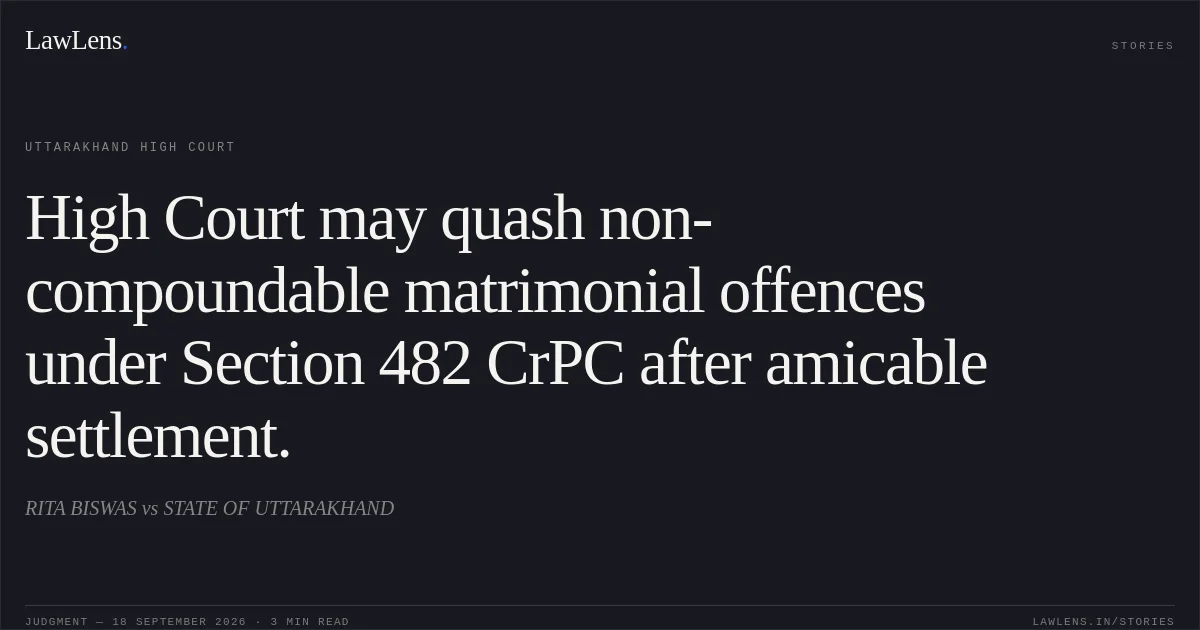
Source reference: pp. 5–7, para. 8It relied principally on B.S. Joshi v. State of Haryana, (2003) 4 SCC 675, holding that matrimonial criminal proceedings may be quashed on the basis of a genuine settlement even where the offences are technically non-compoundable, particularly when the complainant is unlikely to support the prosecution and continuation of the case would serve no useful purpose.
Source reference: pp. 5–7, para. 8The Court also relied on State of Karnataka v. L. Muniswamy, (1977) 2 SCC 699, for the principle that proceedings may be quashed where the interests of justice so require and the prosecution lacks a reasonable likelihood of resulting in conviction.
Source reference: pp. 5–6, para. 8Reasoning
The dispute arose from matrimonial discord and the parties had expressly settled their disputes through a written compromise recorded by the Daily Lok Adalat.
Source reference: p. 4, para. 4Respondent No. 2 supported the applicants’ request for quashing, and the State had no objection because the proceedings concerned a matrimonial dispute that had been amicably resolved.
Source reference: p. 5, paras. 5–7Applying B.S. Joshi and the broader ends-of-justice principle under Section 482 CrPC, the Court held that continuation of the prosecution would be purposeless after settlement, particularly since the complainant’s non-support would substantially undermine the likelihood of conviction.
Source reference: pp. 5–8, paras. 8–9The Court therefore treated the compromise as a sufficient basis for exercising its inherent jurisdiction notwithstanding the non-compoundable nature of some of the alleged offences.
Source reference: pp. 6–8, paras. 8–9Holding
The High Court allowed the application under Section 482 CrPC and quashed the charge sheet dated 25 July 2022, the summoning order dated 5 January 2023, and the entire proceedings in Criminal Case No. 40 of 2023 arising out of FIR No. 54 of 2022 for offences under Sections 323, 498A, 504 and 506 IPC and Sections 3/4 of the Dowry Prohibition Act.
Pending applications, if any, were also disposed of.
Source reference: p. 8, para. 11Acts & Sections Cited
7 provisions across 3 statutes referred to in this judgment. Each provision opens on LawLens.
Indian Penal Code, 18603
Code of Criminal Procedure, 19732
Original Court PDF
RITA BISWASvsSTATE OF UTTARAKHAND
Click to open original judgment
Original judgment, available to read, download and summarize on LawLens.in