Facts
The petitioners sought the quashing of FIR No. 307/2023 registered at PS Burari under Sections 354/323/509/506/427/34 of the IPC.
Source reference: para 3The complaint was filed by Respondent No. 2 following a physical altercation on November 11, 2022, arising from matrimonial disputes between the complainant’s brother-in-law (Dayanand) and the petitioners' relative (Nisha Rani).
Source reference: paras 4-5Chargesheets were filed, including Section 354(B) IPC against Petitioners 1 and 3.
Source reference: para 6Subsequently, the parties settled all disputes via a Memorandum of Understanding dated September 8, 2025, during which the complainant stated that the allegations were "exaggerated" due to matrimonial acrimony.
Source reference: paras 9-11Issues
Whether the High Court can exercise its inherent power to quash criminal proceedings involving non-compoundable offences, such as Section 354(B) IPC, on the basis of a private settlement.
Source reference: para 16Whether the continuance of the current proceedings would constitute an abuse of the process of the court given the matrimonial and familial nature of the dispute.
Source reference: para 19Law Applied
The Court applied Section 528 of the Bhartiya Nagarik Suraksha Sanhita, 2023 (BNSS), which preserves the inherent powers formerly under Section 482 of the CrPC.
Source reference: para 16It relied on the principles established in *Narinder Singh v. State of Punjab* (2014), which allows quashing of non-compoundable offences to secure the ends of justice, especially in matrimonial or family disputes.
Source reference: para 16It further cited *Parbatbhai Aahir v. State of Gujarat* (2017), affirming that while serious offences against society cannot be quashed, cases with a predominant civil or matrimonial flavor may be quashed if the possibility of conviction is remote and the settlement is voluntary.
Source reference: para 17Reasoning
The Court observed that although Section 354(B) IPC is non-compoundable, the dispute originated from matrimonial acrimony between two families.
Source reference: para 18The complainant appeared in person, stating she no longer wished to pursue the case and admitted the complaints were exaggerated.
Source reference: para 11The Court reasoned that since the primary parties (Dayanand and Nisha) had filed for annulment and resolved to end all litigations, the possibility of conviction was "remote and bleak".
Source reference: para 18Following the guidelines in *Narinder Singh*, the Court determined that the dispute was private in nature rather than a heinous crime against society, and forcing a trial would only cause "ill will to fester" and cause "extreme injustice" to the petitioners.
Source reference: paras 18-19Holding
The Court answered the issues in the affirmative, holding that it was a fit case to exercise discretionary jurisdiction to prevent the abuse of the process of the law.
The Court allowed the petition and ordered that FIR No. 307/2023 and all consequential proceedings arising therefrom be quashed.
Source reference: para 20The parties were directed to cooperate in ending other pending proceedings as per their settlement.
Source reference: para 14Original Court PDF
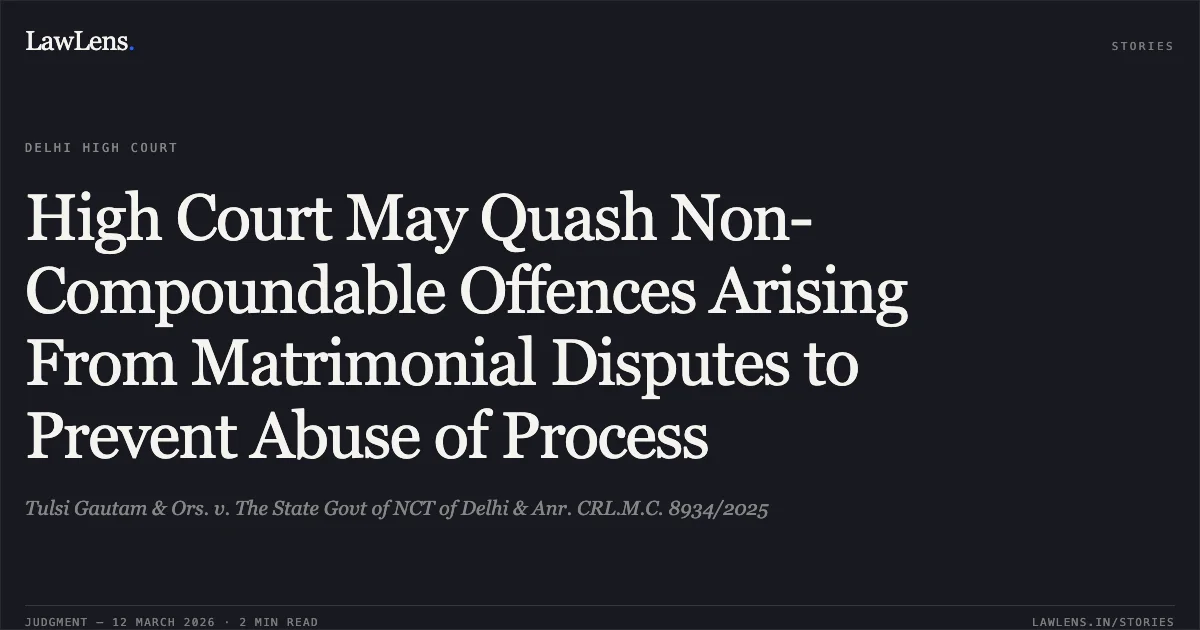
Tulsi Gautam & Ors. v. The State Govt of NCT of Delhi & Anr. CRL.M.C. 8934/2025
Click to open original judgment
Original judgment, available to read, download and summarize on LawLens.in