01Facts
The petitioners, the father-in-law (Petitioner No. 1) and husband (Petitioner No. 2) of the first informant (Respondent No. 2), sought quashing of FIR No. 15/2024 dated 08.04.2024 registered at Women Police Station Harda, the resulting charge-sheet, and all consequential proceedings under Section 528 BNSS, 2023 (Section 482 CrPC).
p. 1The parties entered into a compromise and moved the trial court for compounding. The trial court allowed compounding for the offence under Section 498-A IPC but declined to compound the offences under the Dowry Prohibition Act.
p. 1 · ¶ 2The State and Respondent No. 2 did not object to quashing and discharge.
¶ 3No other point was argued.
¶ 402Issues
i.1. Whether the High Court can quash criminal proceedings relating to non-compoundable offences (Section 498-A IPC and the Dowry Prohibition Act) on the basis of a settlement between the parties under its inherent power.
pp. 1–2 · ¶ 2, 6ii.2. Whether the nature of the offences, the complainant's consent, and the absence of any public-interest bar justify quashing despite the statutory bar on compounding.
pp. 3–6 · ¶ 9–1203Law Applied
The Court applied Section 320 CrPC, which confines compounding by a criminal court to listed offences, and Section 482 CrPC (now Section 528 BNSS), which preserves the High Court's inherent power to quash proceedings to secure the ends of justice, the two being distinct powers, citing Gian Singh v. State of Punjab (2012) 10 SCC 303.
pp. 2–3 · ¶ 6The Court followed Narinder Singh v. State of Punjab (Criminal Appeal No. 686/2014), which permitted compounding and quashing of a non-compoundable offence.
p. 3 · ¶ 7Daxaben v. State of Gujarat (SLP (Crl.) Nos. 1132–1155 of 2022) held that Section 482 CrPC may quash non-compoundable offences to prevent abuse of process or secure justice.
p. 3 · ¶ 8Under Yogendra Yadav v. State of Jharkhand (AIR 2015 SC (Crl.) 166), the High Court may quash non-compoundable offences where the dispute is amicably settled, the victim has no objection, and the offences are personal and do not affect public peace; offences involving moral turpitude or grave offences such as rape or murder are excluded.
pp. 3–4 · ¶ 9–10Ramgopal v. State of M.P. (Criminal Appeal No. 1489/2012, decided 29 September 2021) affirmed this power, requiring evaluation of the nature of the offence and the victim's consent.
pp. 4–5 · ¶ 11Ramawatar v. State of M.P. (2022) 13 SCC 635 held that the mere fact that an offence arises under a special statute does not bar quashing where the offence is primarily private or civil and the statute's objective would not be diminished.
pp. 5–6 · ¶ 12Provisions in the judgment · 9 · Linked ones open on LawLens
Bharatiya Nagarik Suraksha Sanhita, 2023 Section 528
Code of Criminal Procedure, 1973 Section 482Section 320
Indian Penal Code, 1860 Section 323Section 34Section 307Section 326
04Reasoning
The Court first noted that the trial court had compounded only the Section 498-A IPC offence, leaving the Dowry Prohibition Act offences unresolved.
¶ 2The Court treated the Gian Singh distinction between compounding under Section 320 and quashing under inherent powers as the basis for entertaining the petition despite the statutory bar.
¶ 6The Court examined the consistent line of Supreme Court authority culminating in Yogendra Yadav and Ramgopal, which requires the High Court to assess the nature of the offence, the parties' settlement, and the victim's position.
¶ 9–11Applying these tests, the Court relied on the compromise and the express no-objection of both the State and the complainant.
¶ 3, 13Although the offences arose under a special statute (the Dowry Prohibition Act), Ramawatar permitted quashing where the dispute was essentially domestic and private, and the Court implicitly found that the objectives of the dowry legislation would not be defeated by discharging the parties.
¶ 12–13The Court therefore concluded that continuing the prosecution would be a "lame prosecution" that serves no purpose and would frustrate the settlement.
¶ 905Holding
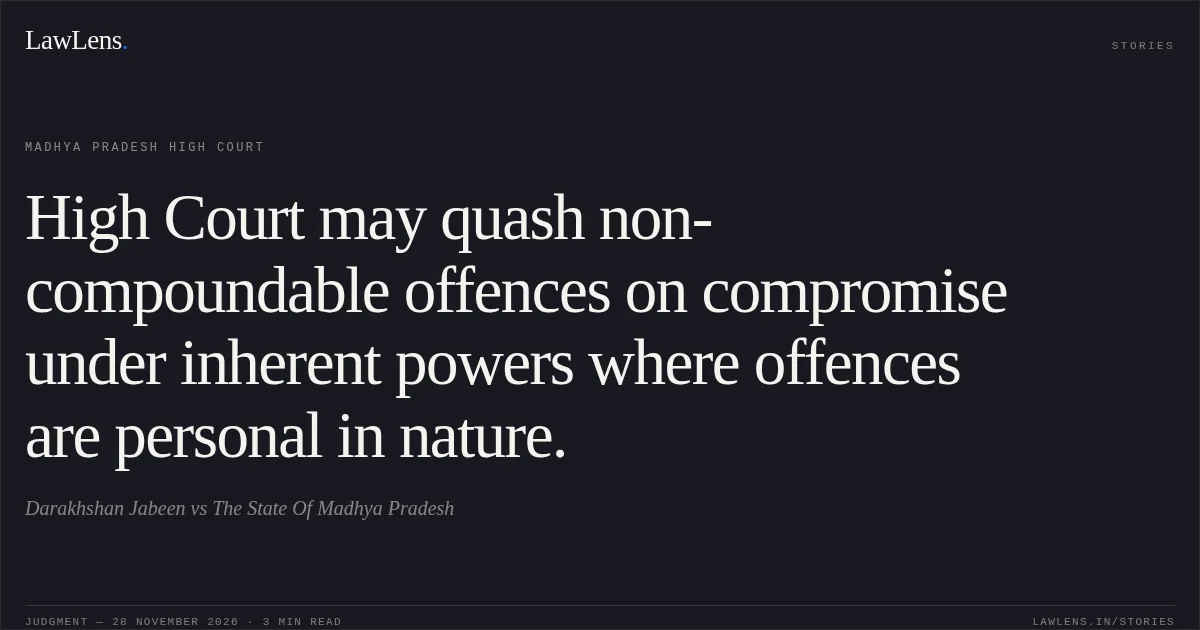
Relying on the compromise and the consent of the complainant and State, and on Yogendra Yadav, Ramgopal and Ramawatar, the Court held that the High Court may quash proceedings for non-compoundable offences arising from a private, settled matrimonial dispute.
¶ 9–13The petition is allowed. The Court quashed FIR No. 15/2024 dated 08.04.2024 at Women Police Station Harda, the charge-sheet, and all consequential proceedings for offences under Sections 498-A, 323 and 34 IPC and Section 3/4 of the M.P. Dowry Prohibition [Rules]. The petitioners were discharged and their bail bonds, if any, were discharged. Note: The operative paragraph refers to "M.P. Dowry Prohibition Rules," whereas the petition and the trial court's ruling refer to the Dowry Prohibition Act, 1961.
p. 6 · ¶ 13 · pp. 1–2 · ¶ 2, 13Original Court PDF
Darakhshan JabeenvsThe State Of Madhya Pradesh
Click to open original judgment
Original judgment, available to read, download and summarize on LawLens.in



