01Facts
The applicant sought quashment under Section 528 of the Bharatiya Nagarik Suraksha Sanhita, 2023, of Crime No. 0108/2020 registered at Police Station Mahila Thana, Bhopal, for offences under Section 498-A of the Indian Penal Code, 1860 and Sections 3 and 4 of the Dowry Prohibition Act, 1961, along with RCT No. 8489/2020 pending before the JMFC, Bhopal.
p. 1The charge-sheet was filed on 06.10.2020, and charges were framed on 18.04.2022.
¶ 2 · p. 2 · ¶ 4Eight prosecution witnesses were cited, but none had been examined despite repeated listings.
¶ 2 · ¶ 4The applicant contended that the adjournments lacked substantial progress and violated his right to speedy trial under Article 21 of the Constitution, and he sought directions to expedite the trial.
¶ 2The State opposed the petition.
¶ 3On perusal of the trial court's order sheet, the Court found that the trial court failed to verify whether process issued to witnesses had been served or returned, and did not ensure the witnesses' presence.
¶ 7 · p. 302Issues
i.1. Whether the prolonged pendency of the trial, with no prosecution witness examined after charges were framed, violates the applicant's right to speedy trial under Article 21 and warrants judicial intervention.
¶ 2 · ¶ 5 · pp. 2–3ii.2. Whether the FIR and consequential proceedings should be quashed under Section 528 BNSS, or whether the matter should be left to the trial court.
¶ 5 · p. 2iii.3. Whether, and on what conditions, the trial court may close prosecution evidence after repeated opportunities have been given to the prosecution.
¶ 8 · p. 303Law Applied
The Court relied on Article 21 of the Constitution, which it described as guaranteeing the right to a speedy trial, and held that the prosecution cannot indefinitely prolong a trial.
¶ 5The Court applied Section 528 BNSS as the procedural basis for the petition.
p. 1The trial court must ensure that summoned witnesses are present and that process is traced to service or return.
¶ 7 · ¶ 10A trial court may close prosecution evidence after repeated opportunities. Such closure is not automatic, must balance fair-trial rights against the interests of justice, and must consider whether the delay is attributable to the accused or to a court stay.
¶ 8The judgment cites no precedent; these principles are stated without authority.
Provisions in the judgment · 3 · Linked ones open on LawLens
Bharatiya Nagarik Suraksha Sanhita, 2023 Section 528
04Reasoning
The Court held that the material on record, namely the filing of the charge-sheet, framing of charges, and non-examination of any of eight witnesses over a considerable period, showed prolonged and unjustified delay.
¶ 4 · ¶ 6The Court treated this as engaging the speedy-trial right under Article 21.
¶ 5The Court declined to quash the FIR or proceedings, holding that the grounds urged were insufficient for quashment and that the allegations must be adjudicated by the trial court on evidence.
¶ 5The Court located the cause of delay in the trial court's failure to supervise process and secure witness attendance, which it described as a casual approach to the order sheet.
¶ 7The remedy was therefore procedural: a time-bound direction to the trial court, rather than termination of the proceedings.
¶ 6 · ¶ 8The Court left the accused free to object to adjournments and to seek closure of prosecution evidence, subject to the balancing test in para. 8.
¶ 805Holding
The Court did not quash the FIR or the proceedings in RCT No. 8489/2020, as the grounds were insufficient.
¶ 5The prolonged delay, with no prosecution witness examined despite repeated opportunities, warranted directions to expedite the trial.
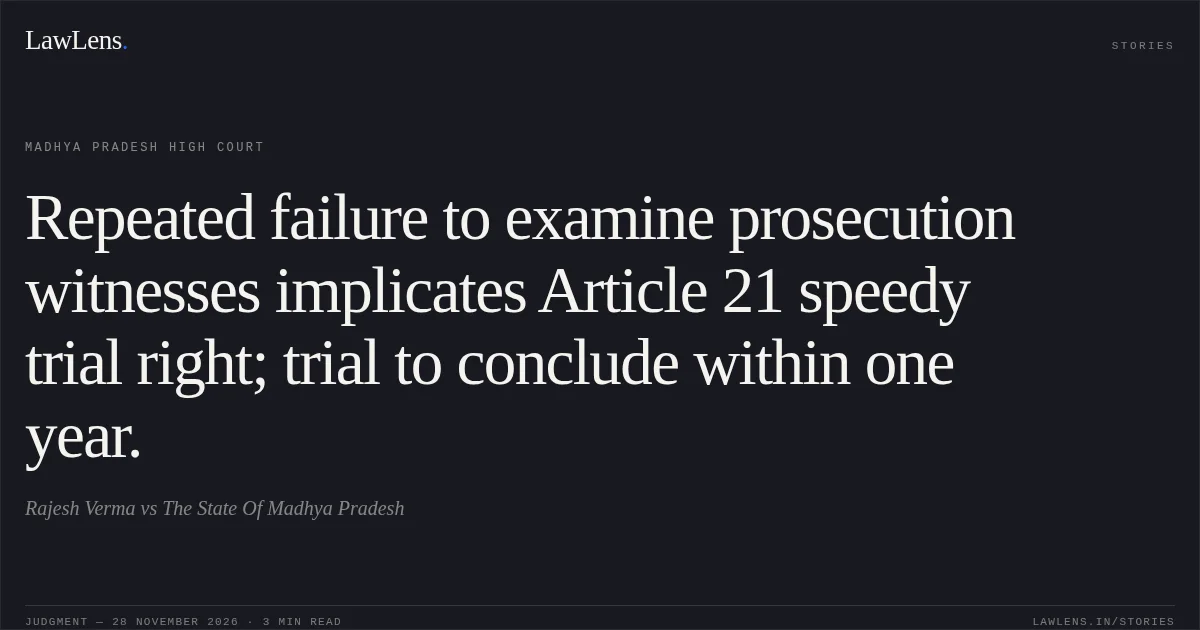
¶ 6The trial court was directed to make every endeavour to conclude the trial within one year of receipt of a certified copy of the order, to summon and examine witnesses without unnecessary delay, to avoid unwarranted adjournments, and to take lawful steps to secure the presence of any witness absent despite service of summons.
¶ 9 · ¶ 10Both parties were directed to cooperate.
¶ 9The Court expressly expressed no opinion on the merits, and the trial court is to decide the case independently.
¶ 11 · p. 4The order does not expressly state that the petition is disposed of, though the directions indicate that disposal was intended.
Original Court PDF
Rajesh VermavsThe State Of Madhya Pradesh
Click to open original judgment
Original judgment, available to read, download and summarize on LawLens.in



