Facts
Respondent No. 2 (complainant) filed an F.I.R. alleging that the applicant assaulted him with a khukri (sharp-edged weapon), causing a head injury.
Source reference: para. 5Following an investigation, the Civil Judge (Junior Division)/Judicial Magistrate, Doiwala, took cognizance and issued a summoning order on 25.04.2024 in Criminal Case No. 225 of 2025.
Source reference: para. 4During the pendency of the proceedings, the parties—who are residents of the same locality—amicably resolved the dispute through the intervention of society members.
Source reference: para. 6, 10The applicant subsequently filed the present C-482 application (titled C-528) seeking to quash the chargesheet and summoning order based on a joint compounding application (IA No. 1 of 2026).
Source reference: para. 4, 6Issues
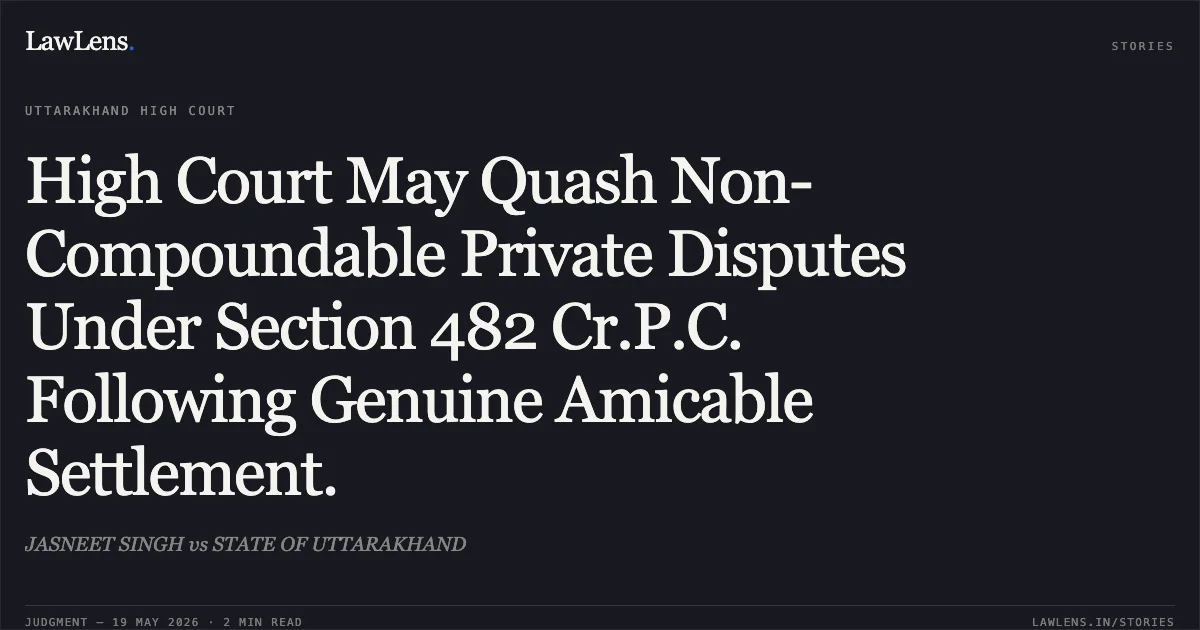
1. Whether the High Court, in the exercise of its inherent powers under Section 482 of the Cr.P.C., can quash criminal proceedings involving a non-compoundable offence (Section 324 IPC) on the basis of a private settlement between the parties.
Source reference: para. 8, 102. Whether the continuation of criminal proceedings in the present case would amount to an abuse of the process of law given the voluntary settlement between the parties.
Source reference: para. 12Law Applied
The Court primarily applied Section 482 of the Code of Criminal Procedure (Cr.P.C.), which grants the High Court inherent powers to prevent abuse of the process of any court or to secure the ends of justice.
Source reference: para. 10, 13It further relied on the legal principles established by the Hon’ble Supreme Court in Gian Singh vs. State of Punjab and Narinder Singh vs. State of Punjab, which held that the High Court may quash proceedings arising out of personal/private disputes even for non-compoundable offences if the settlement is genuine and quashing serves the ends of justice.
Source reference: para. 11The court also noted that Section 324 of the Indian Penal Code (IPC) is technically non-compoundable.
Source reference: para. 8Reasoning
The Court observed that although Section 324 IPC is non-compoundable, the dispute was essentially private and personal in nature, arising from a localized altercation.
Source reference: para. 10Upon interacting with the applicant and Respondent No. 2 via video conferencing, the Court verified that the compromise was bona fide, voluntary, and executed without coercion.
Source reference: para. 7, 12The Court reasoned that because the complainant no longer intended to prosecute and the parties had restored their relationship, the possibility of conviction was remote.
Source reference: para. 12Consequently, the Court determined that forcing the trial to continue would serve no "fruitful purpose" and would constitute an unwarranted burden on the judicial system.
Source reference: para. 12Holding
The Court answered the issues in the affirmative, holding that this was a fit case to exercise jurisdiction under Section 482 Cr.P.C. to secure the ends of justice.
The Court allowed the joint compounding application (IA No. 1 of 2026) and quashed the chargesheet, the cognizance/summoning order dated 25.04.2024, and all entire criminal proceedings in Case No. 225 of 2025.
Source reference: para. 13The application was allowed accordingly.
Source reference: para. 14Acts & Sections Cited
2 provisions across 2 statutes referred to in this judgment. Each provision opens on LawLens.
Indian Penal Code, 18601
Code of Criminal Procedure, 19731
Original Court PDF
JASNEET SINGHvsSTATE OF UTTARAKHAND
Click to open original judgment
Original judgment, available to read, download and summarize on LawLens.in