Facts
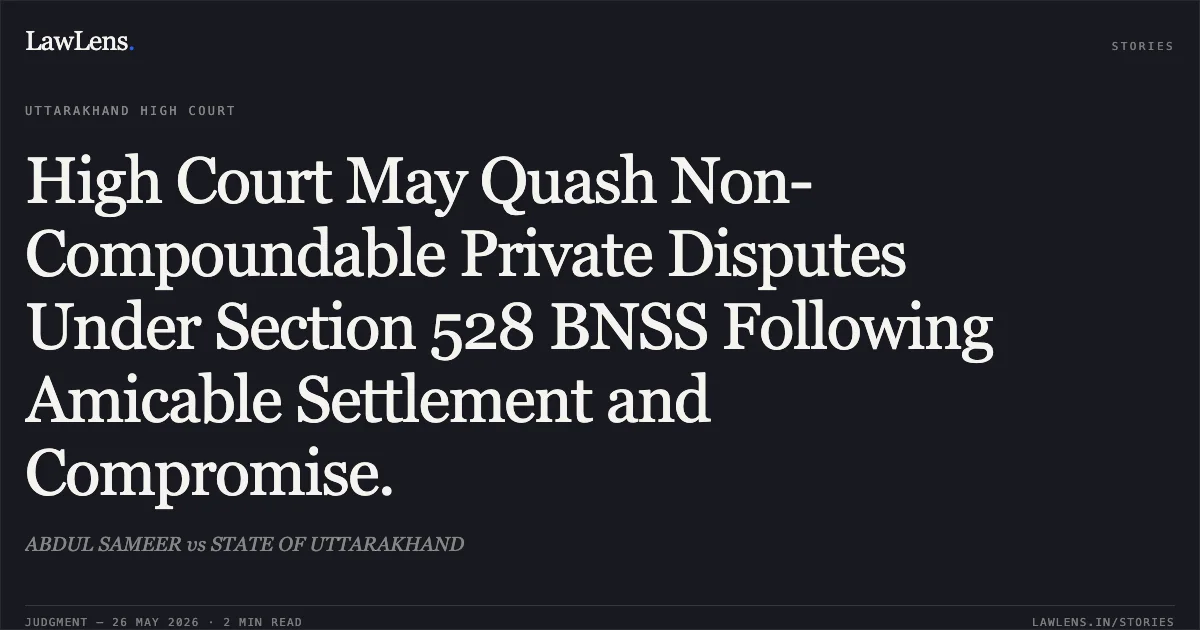
The applicant sought the quashing of a charge-sheet and summoning order dated April 15, 2025, arising from Criminal Case No. 358 of 2025
Source reference: para. 4The complainant (Respondent No. 2) filed an F.I.R. alleging that the applicant possessed personal photos/videos and was threatening to leak them to defame and harass her
Source reference: para. 5Charges were filed under Sections 376, 354, 354-C, 354-D, 323, 506 of the I.P.C. and Section 67-A of the Information Technology Act
Source reference: para. 4During the pendency of the proceedings, the parties amicably settled the dispute through the intervention of society members and filed a joint compounding application (I.A. No. 1 of 2026)
Source reference: para. 6Both parties appeared in person to confirm the voluntary nature of the settlement
Source reference: para. 7Issues
1. Whether the High Court can exercise its inherent jurisdiction to quash criminal proceedings for non-compoundable offences, including Section 376 I.P.C., based on a private settlement between parties
Source reference: para. 112. Whether the continuance of the criminal proceedings in the present case would amount to an abuse of the process of law given the lack of specific allegations of sexual assault in the F.I.R.
Source reference: para. 5, 12Law Applied
The Court applied Section 528 of the Bharatiya Nagarik Suraksha Sanhita (B.N.S.S.) / Section 482 of the Cr.P.C. regarding the inherent powers of the High Court
Source reference: para. 11It relied on the landmark precedents of Gian Singh v. State of Punjab, Narinder Singh v. State of Punjab, and Parbatbhai Aahir v. State of Gujarat, which establish that criminal proceedings of a predominantly private or personal nature may be quashed if the parties have settled, even if the offences are non-compoundable, to prevent the abuse of the process of the court and subserve the ends of justice
Source reference: para. 11Reasoning
The Court examined the material on record and noted that the F.I.R. lacked specific allegations of sexual assault, with the State counsel admitting that the allegations primarily concerned attempted sexual exploitation via digital media rather than physical rape
Source reference: para. 5, 8The Court observed that the dispute was essentially private, arising out of personal discord. Since the complainant stated unequivocally that she did not wish to prosecute and the settlement was found to be genuine and free from coercion, the Court reasoned that the prospect of conviction was remote. Consequently, the Court determined that forcing the trial to continue would serve no fruitful purpose and would be an inefficient use of judicial machinery
Source reference: para. 10, 6, 12Holding
The Court held that the settlement satisfied the parameters for quashing under inherent jurisdiction as the matter was personal and the ends of justice necessitated the termination of proceedings
The Court allowed the compounding application (I.A. No. 1 of 2026) and quashed the charge-sheet, the summoning order dated April 15, 2025, and all entire proceedings of Criminal Case No. 358 of 2025
Source reference: para. 13Acts & Sections Cited
6 provisions across 3 statutes referred to in this judgment. Each provision opens on LawLens.
Indian Penal Code, 18604
Code of Criminal Procedure, 19731
Bharatiya Nagarik Suraksha Sanhita, 20231
Original Court PDF
ABDUL SAMEERvsSTATE OF UTTARAKHAND
Click to open original judgment
Original judgment, available to read, download and summarize on LawLens.in