Facts
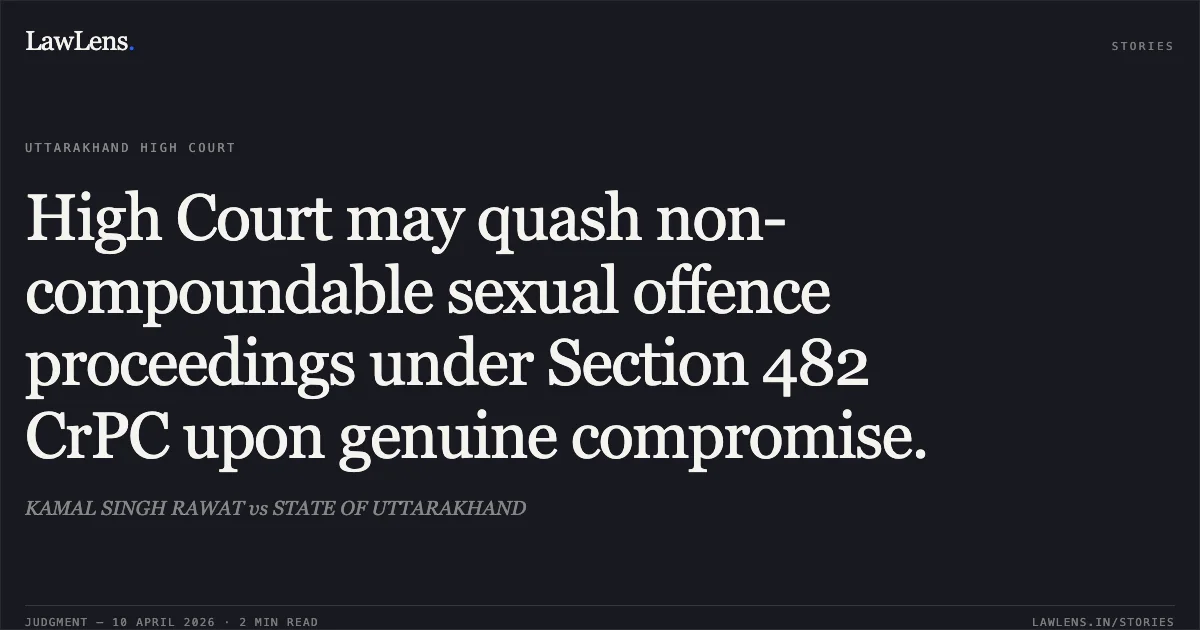
The applicant sought the quashing of a charge-sheet and proceedings in Special Sessions Trial No. 08 of 2024, arising from F.I.R. No. 76 of 2023.
Source reference: para. 4The F.I.R. alleged offenses under Sections 354, 363, 376, and 506 of the I.P.C., and Sections 5/6 of the POCSO Act, 2012.
Source reference: para. 4Following the investigation and filing of the charge-sheet, the victim recorded a statement under Section 164 Cr.P.C. denying the allegations, claiming a consensual relationship and a desire to marry the applicant, and stating that the F.I.R. was lodged under pressure from villagers.
Source reference: para. 6The victim, who was 16 at the time of the F.I.R., has since attained the age of majority.
Source reference: para. 6A joint compounding application (I.A. No. 1 of 2026) was filed, and the victim personally appeared before the Court to confirm the voluntary settlement.
Source reference: para. 7-8Issues
1. Whether the High Court, in the exercise of its inherent jurisdiction under Section 482 Cr.P.C., can quash criminal proceedings involving serious, non-compoundable offenses (including POCSO) based on a compromise between the parties.
Source reference: para. 12-132. Whether the continuation of criminal proceedings would amount to an abuse of the process of the Court when the victim retracts allegations and enters into a voluntary settlement.
Source reference: para. 15Law Applied
The Court primarily applied Section 482 of the Cr.P.C. (Inherent powers of High Court) to prevent the abuse of the process of law and secure the ends of justice.
Source reference: para. 12It relied on the principles established in Gian Singh v. State of Punjab, which permits quashing non-compoundable offenses if the dispute is private and settlement is reached.
Source reference: para. 13The Court further cited Narinder Singh v. State of Punjab regarding the futility of trial in compromise cases.
Source reference: para. 13Parbatbhai Aahir v. State of Gujarat, which affirmed the wide amplitude of the High Court's inherent power to quash proceedings based on the facts and circumstances of each case.
Source reference: para. 14Reasoning
The Court noted that despite the serious and non-compoundable nature of the offenses, the dispute was essentially private, arising from a personal relationship.
Source reference: para. 11-12The Court found the compromise to be genuine and voluntary, specifically noting the victim’s Section 164 Cr.P.C. statement and her personal testimony before the Court denying the alleged incidents.
Source reference: para. 8, 11The Court reasoned that since the victim had attained majority and refused to support the prosecution, any further trial would be a "futile purpose" and a waste of judicial resources.
Source reference: para. 15By applying the "ends of justice" test from Gian Singh and Narinder Singh, the Court concluded that the settlement rendered the likelihood of conviction remote, making quashing the most appropriate remedy.
Source reference: para. 15-16Holding
The Court answered that this was a fit case for exercising inherent jurisdiction under Section 482 Cr.P.C. to secure the ends of justice.
The Court allowed the compounding application (I.A. No. 1 of 2026) and quashed the charge-sheet and the entire proceedings of Special Sessions Trial No. 08 of 2024 pending in the Court of learned Special Sessions Judge, Champawat.
Source reference: para. 17-18The C-528 application was allowed accordingly.
Source reference: para. 19Acts & Sections Cited
6 provisions across 2 statutes referred to in this judgment. Each provision opens on LawLens.
Indian Penal Code, 18604
Original Court PDF
KAMAL SINGH RAWATvsSTATE OF UTTARAKHAND
Click to open original judgment
Original judgment, available to read, download and summarize on LawLens.in