01Facts
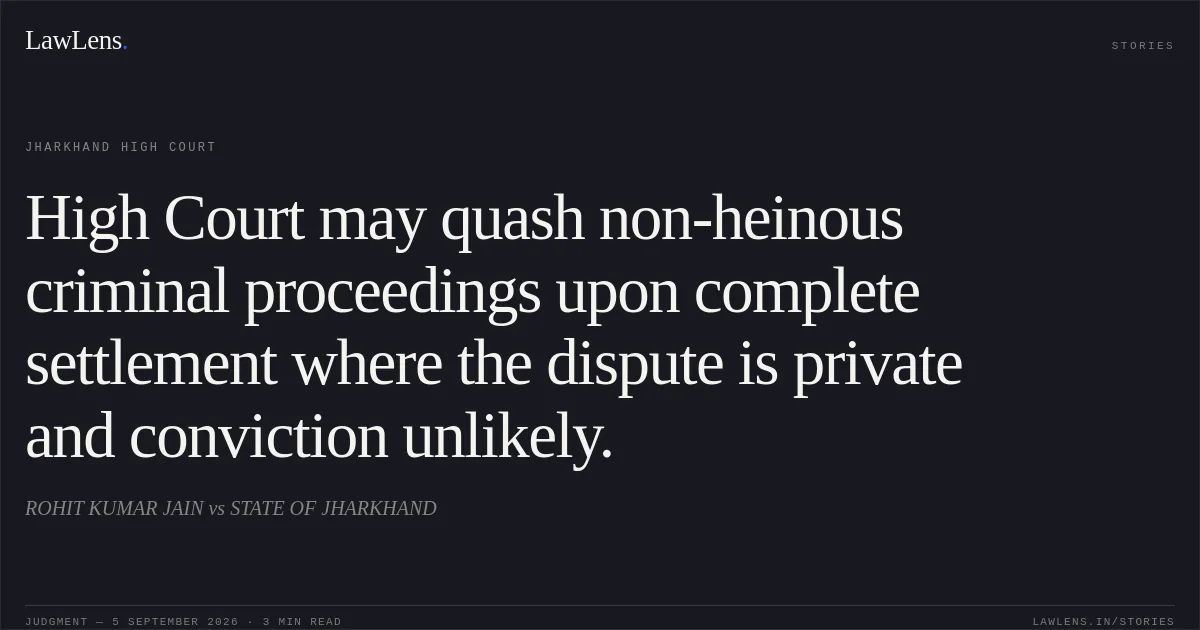
The petitioner invoked the inherent jurisdiction of the Jharkhand High Court under Section 528 of the Bharatiya Nagarik Suraksha Sanhita, 2023, seeking quashing of the order dated 29 July 2026 by which charges were framed against him under Sections 318(2), 318(4), 319(2), 336(2), 336(3), 338, 340(2) and 61(2) of the Bharatiya Nyaya Sanhita, 2023, and Sections 66-C and 66-D of the Information Technology Act, 2000, in C.I.D. Cyber P.S. Case No. 24 of 2026, corresponding to Cyber Case No. 44 of 2026.
¶ 2–3The petitioner and Opposite Party No. 2/informant filed affidavits stating that they had amicably settled the dispute and that the informant did not wish to proceed against the petitioner. The State expressed no objection to quashing the impugned order.
¶ 4–502Issues
i.Whether the High Court could exercise its inherent jurisdiction under Section 528 of the Bharatiya Nagarik Suraksha Sanhita, 2023, to quash the order framing charges after the parties had entered into a compromise.
¶ 2 · pp. 2–3ii.Whether continuation of the criminal proceeding, in view of the settlement and the private nature of the dispute, would amount to an abuse of the process of law.
¶ 4, 7–9 · pp. 2–503Law Applied
The Court applied Section 528 of the Bharatiya Nagarik Suraksha Sanhita, 2023, which preserves the High Court’s inherent jurisdiction to prevent abuse of the process of any court and to secure the ends of justice.
¶ 2Relying on Parbatbhai Aahir @ Parbatbhai Bhimsinhbhai Karmur v. State of Gujarat, (2017) 9 SCC 641, and the principles stated in Gian Singh v. State of Punjab, (2012) 10 SCC 303, the Court held that inherent powers are distinct from statutory compounding under Section 320 of the Code of Criminal Procedure and may be exercised where the dispute is predominantly civil, commercial, financial, personal or private in nature, the parties have completely settled their dispute, and the possibility of conviction is remote and continuation of the proceeding would cause oppression, prejudice or injustice. However, heinous offences, offences involving mental depravity, offences having serious societal impact, and offences under special statutes such as corruption laws ordinarily cannot be quashed merely on the basis of compromise.
¶ 6 · pp. 3–5Provisions in the judgment · 9 · Linked ones open on LawLens
Bharatiya Nagarik Suraksha Sanhita, 2023 Section 528
Bharatiya Nyaya Sanhita, 2023 Section 318Section 319Section 336Section 338Section 340Section 61
Code of Criminal Procedure, 1973 Section 482Section 320
04Reasoning
The Court found that the offences involved were neither heinous nor indicative of serious mental depravity and that the dispute was essentially private between the petitioner and the informant.
¶ 7The compromise was supported by separate affidavits, the informant no longer wished to pursue the case, and the State had no objection to the requested relief.
¶ 4–5Applying the principles in Parbatbhai Aahir and Gian Singh, the Court concluded that the complete settlement materially weakened the possibility of conviction and that continuation of the prosecution would subject the petitioner to oppression and prejudice, thereby amounting to an abuse of the process of law.
¶ 8The matter was therefore considered a fit case for exercise of the High Court’s inherent jurisdiction.
¶ 905Holding
The High Court answered the issues in favour of the petitioner.
¶ 9–10It quashed and set aside the order dated 29 July 2026 framing charges against Rohit Kumar Jain in C.I.D. Cyber P.S. Case No. 24 of 2026, corresponding to Cyber Case No. 44 of 2026, pending before the Additional Judicial Commissioner-II-cum-Special Judge, Cyber Crime, Ranchi.
¶ 9–10The Criminal Miscellaneous Petition was allowed, and Interlocutory Application No. 11756 of 2026 was disposed of accordingly.
¶ 11–12Original Court PDF
ROHIT KUMAR JAINvsSTATE OF JHARKHAND
Click to open original judgment
Original judgment, available to read, download and summarize on LawLens.in