Facts
Applicant No. 1 and Respondent No. 2 were married on 27.11.2022. Following matrimonial discord, Respondent No. 2 left the matrimonial home on 10.10.2023
Source reference: para. 2On 10.06.2024, she lodged FIR No. 416/2024 at P.S. Kotwali, Sehore, alleging offences under Sections 498-A, 294, 323, 506, and 34 of the IPC and Sections 3 and 4 of the Dowry Prohibition Act
Source reference: para. 2During the pendency of the resulting criminal case (R.C.T. No. 1491/2024), the parties settled all disputes before a Mediation Centre on 02.08.2025 and instituted divorce proceedings by mutual consent under Section 13-B of the Hindu Marriage Act
Source reference: para. 3The applicants moved the High Court seeking quashment of the criminal proceedings based on this compromise
Source reference: para. 1Issues
Whether the High Court should exercise its inherent powers to quash criminal proceedings involving non-compoundable offences when the parties have reached a voluntary settlement in a matrimonial dispute.
Source reference: para. 5-7Law Applied
Section 528 of the Bharatiya Nagarik Suraksha Sanhita (BNSS), 2023 (formerly Section 482 CrPC), regarding the inherent powers of the High Court
Source reference: para. 1, 5landmark precedents of Gian Singh v. State of Punjab (2012) and Narinder Singh v. State of Punjab (2014), which establish that criminal cases arising from matrimonial or personal disputes with an "overwhelmingly civil flavour" may be quashed if a genuine settlement is reached.
Source reference: para. 6, 7Jitendra Raghuvanshi v. Babita Raghuvanshi (2013) regarding the encouragement of settlements in matrimonial matters and State of M.P. v. Laxmi Narayan (2019), which mandates that private disputes not involving heinous crimes can be quashed upon compromise
Source reference: para. 7Reasoning
The Court examined the report of the Principal Registrar dated 03.07.2026, which verified that the compromise was voluntary, genuine, and free from coercion
Source reference: para. 8The Court observed that the dispute was "purely matrimonial in nature" and did not possess any "overriding societal impact" or involve heinous crimes
Source reference: para. 9Applying the principles from Gian Singh and Laxmi Narayan, the Court reasoned that since the complainant (Respondent No. 2) no longer wished to prosecute, the possibility of conviction was "extremely remote"
Source reference: para. 9Consequently, continuing the criminal trial would result in unnecessary harassment and an abuse of the process of law, frustrating the objective of the amicable settlement already acted upon in the Family Court
Source reference: para. 9-10Holding
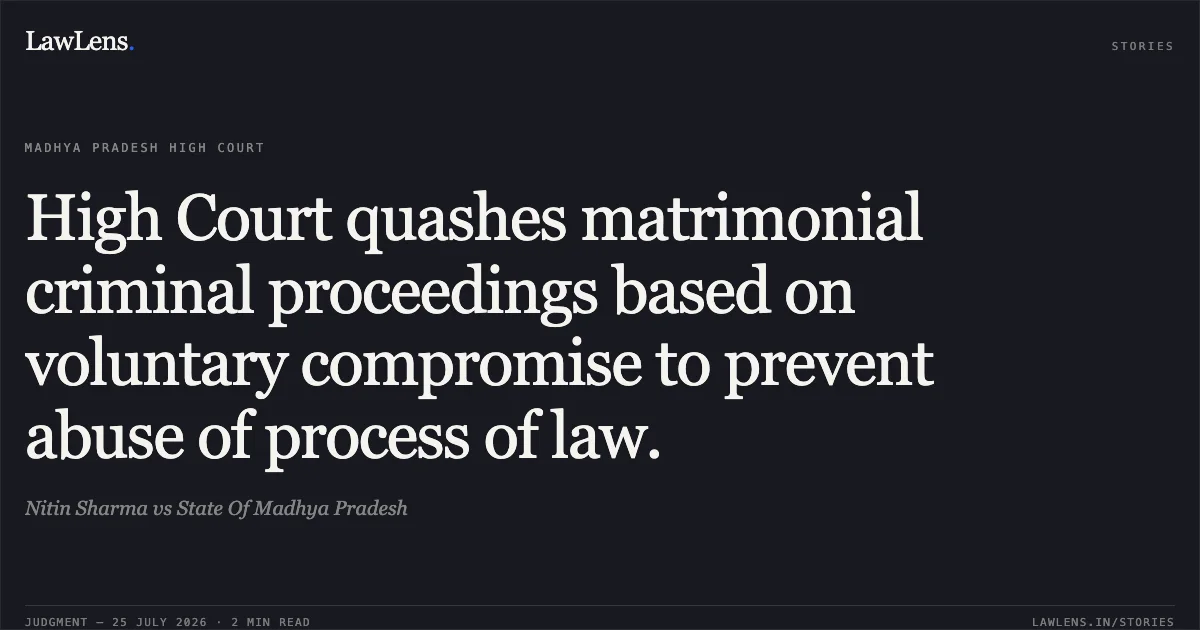
The Court answered the issue in the affirmative, holding that this was a fit case to secure the ends of justice through exercise of inherent jurisdiction
The Court allowed I.A. No. 15215/2026 (for compounding) and the main application under Section 528 BNSS. It ordered the quashment of FIR No. 416/2024 and all consequential proceedings in R.C.T. No. 1491/2024 pending before the IV Civil Judge, Junior Division, Sehore, against all applicants
Source reference: para. 11Acts & Sections Cited
7 provisions across 3 statutes referred to in this judgment. Each provision opens on LawLens.
Bharatiya Nagarik Suraksha Sanhita, 20231
Indian Penal Code, 18604
Original Court PDF
Nitin SharmavsState Of Madhya Pradesh
Click to open original judgment
Original judgment, available to read, download and summarize on LawLens.in


