Facts
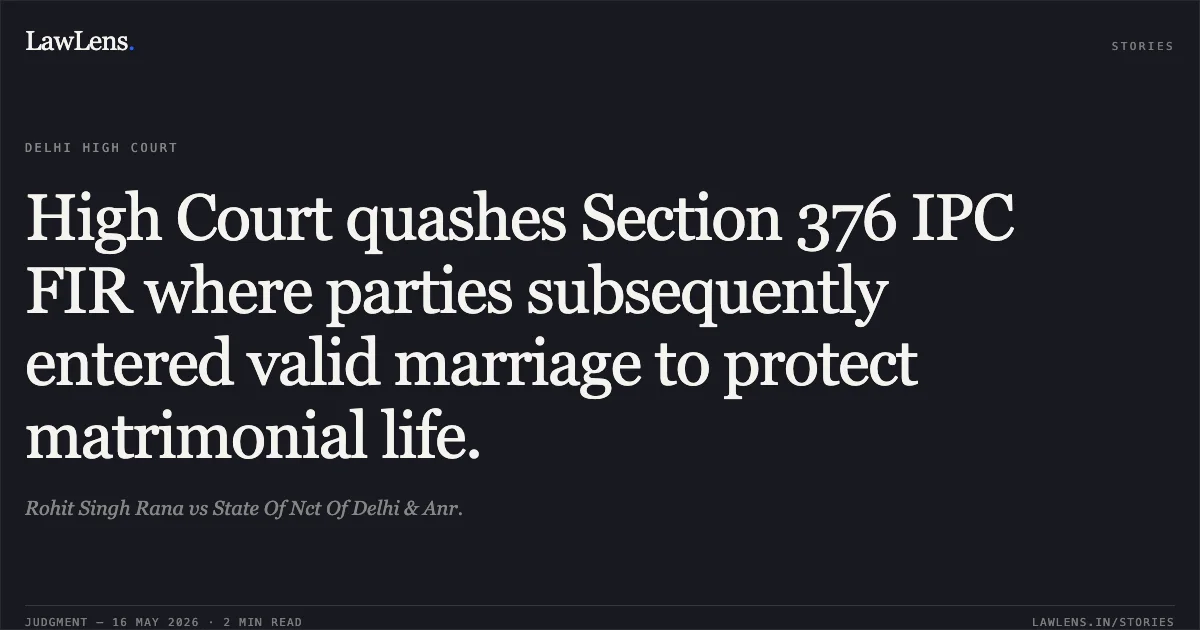
The Petitioner, a Sepoy in the Indian Army, sought the quashing of FIR No. 0180/2025 registered at P.S. Pahar Ganj under Section 376 of the IPC.
Source reference: p.1, 2The Complainant (Respondent No. 2) initially alleged that the Petitioner forcibly established physical relations on 11.06.2023 under a false promise of marriage.
Source reference: p.1, 2In her statement under Section 183 BNSS (Section 164 Cr.P.C.), she clarified the relationship was consensual and that she would withdraw the complaint if they married.
Source reference: p.2During the proceedings, it was verified that the parties had solemnized a marriage with family consent at Arya Samaj Mandir.
Source reference: p.2The Respondent No. 2 stated the FIR was a result of a "misunderstanding".
Source reference: p.3Issues
1. Whether the High Court, exercising its inherent powers, can quash criminal proceedings for a non-compoundable and heinous offence like Section 376 IPC on the basis of a settlement/marriage between the parties.
Source reference: p.3 / para. 11-12Law Applied
The Court applied Section 528 of the Bharatiya Nagrik Suraksha Sanhita (BNSS), corresponding to Section 482 of the Cr.P.C., regarding the inherent power of the High Court to secure the ends of justice.
Source reference: p.3, 4The Court relied on Narinder Singh & Ors. v. State of Punjab & Anr., which allows quashing non-compoundable cases if the conviction is remote and quashing serves a meaningful purpose.
Source reference: p.3The Court integrated the principle from Madhukar & Anr. v. State of Maharashtra, which held that while Section 376 IPC is grave, the Court’s power is not constrained by rigid formulas and can be exercised to prevent the disruption of personal stability and peace.
Source reference: p.3Reasoning
The Court observed that while rape is a heinous crime where settlement is usually discouraged, the specific facts of this case—the parties entering a valid marriage verified by the State—warranted an exception.
Source reference: p.2, 3The Court noted the Complainant's consistent stance that the FIR arose from a misunderstanding and her desire to maintain her matrimonial life.
Source reference: p.3Following the precedent in Abu Bakar v. State NCT of Delhi, the Court reasoned that continuing the trial would be an exercise in futility, as the likelihood of conviction was "remote and bleak" given the settlement.
Source reference: p.3, 4The Court concluded that the "hanging sword" of criminal proceedings would only serve to destroy the parties' stable family life and matrimonial harmony.
Source reference: p.2, 4Holding
The Court answered the issue in the affirmative, holding that quashing was necessary to secure the ends of justice and protect the matrimonial life of the parties.
The Court allowed the petition and quashed FIR No. 0180/2025 and all consequential proceedings.
Source reference: p.4, 5The parties were directed to submit original affidavits to the Trial Court within two weeks.
Source reference: p.5Acts & Sections Cited
1 provisions across 1 statute referred to in this judgment. Each provision opens on LawLens.
Indian Penal Code, 18601
Original Court PDF
Rohit Singh RanavsState Of Nct Of Delhi & Anr.
Click to open original judgment
Original judgment, available to read, download and summarize on LawLens.in