Facts
The petitioners, the informant’s sister-in-law and her husband, sought to quash the criminal proceedings arising from Balidih P.S. Case No. 72 of 2023, including the order dated 13 November 2024 taking cognizance of offences under Sections 341, 323, 354, 498A, 504, 506/34 IPC and Sections 3 and 4 of the Dowry Prohibition Act.
Source reference: p. 1–2, para. 2The informant alleged that the petitioners demanded ₹15,00,000 from her widow mother as dowry and harassed and assaulted her.
Source reference: p. 2–3, para. 5Following investigation, the police submitted a charge sheet finding the allegations true.
Source reference: p. 2–3, para. 5The petitioners argued that the allegations were general and that they lived in Muzaffarpur, Bihar; the State and the informant relied on witness statements said to describe each petitioner’s role specifically.
Source reference: p. 3–5, paras. 6–7Issues
1. Whether the criminal proceedings and cognizance order should be quashed under Section 528 of the Bharatiya Nagarik Suraksha Sanhita, 2023, on the ground that the allegations against the petitioners were general and omnibus.
Source reference: p. 1–2, para. 2; p. 3, para. 62. Whether the petitioners’ claim that they lived far from the matrimonial home could be determined in a quashing petition.
Source reference: p. 4–5, paras. 7–8Law Applied
Section 528 of the Bharatiya Nagarik Suraksha Sanhita, 2023, which corresponds to Section 482 of the Code of Criminal Procedure, preserves the High Court’s inherent power to prevent abuse of process and secure the ends of justice.
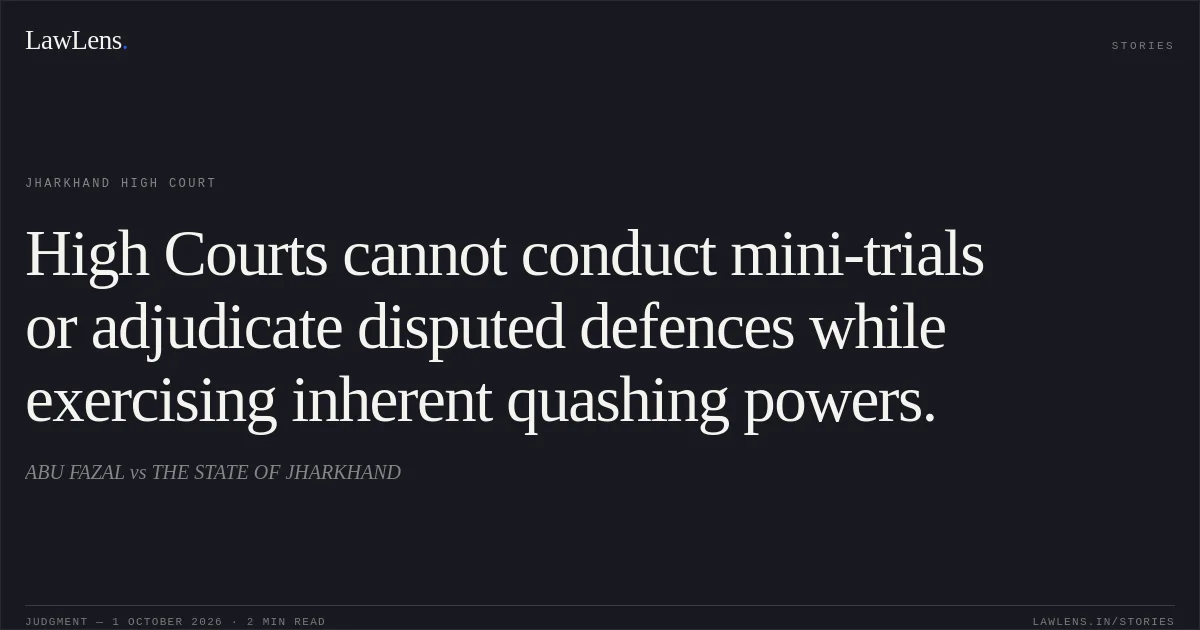
Source reference: p. 5–6, para. 8In exercising that power, the High Court must not conduct a mini-trial or assess the evidence in the case; the judgment relied on State of Uttar Pradesh v. Akhil Sharda, 2022 LiveLaw SC 594, for this principle.
Source reference: p. 6, para. 8The alleged offences were under Sections 341, 323, 354, 498A, 504, 506/34 IPC and Sections 3 and 4 of the Dowry Prohibition Act.
Source reference: p. 2, para. 2The petitioners cited Kahkashan Kausar @ Sonam v. State of Bihar, (2022) 6 SCC 599, in support of their challenge, but the court did not find it a basis to quash these proceedings on the record before it.
Source reference: p. 3, para. 6Reasoning
The court found that the record contained direct and specific allegations that the petitioners demanded ₹15,00,000 as dowry and harassed the informant, including by assaulting and restraining her; the police had also found the allegations true during investigation.
Source reference: p. 5, para. 8The petitioners’ assertion that they lived in Muzaffarpur was a disputed defence that could not be resolved by weighing evidence in a Section 528 proceeding. In light of the prohibition on conducting a mini-trial, the court declined to assess that defence or otherwise re-evaluate the evidence at this stage.
Source reference: p. 5–6, para. 8Holding
The court held that the case was not fit for quashing under Section 528 BNSS and dismissed the criminal miscellaneous petition as without merit.
The cognizance order and criminal proceedings therefore remained undisturbed.
Source reference: p. 6, paras. 9–10Acts & Sections Cited
11 provisions across 4 statutes referred to in this judgment. Each provision opens on LawLens.
Bharatiya Nagarik Suraksha Sanhita, 20231
Indian Penal Code, 18606
Code of Criminal Procedure, 19732
Original Court PDF
ABU FAZALvsTHE STATE OF JHARKHAND
Click to open original judgment
Original judgment, available to read, download and summarize on LawLens.in