Facts
RailTel Corporation of India Ltd. and Primatel Fibcom Limited entered into an agreement dated 27 February 2018 concerning the Raj Net Wi-Fi Project.
Source reference: no citationDisputes arose, and arbitration was invoked by Primatel. RailTel’s counter-claim was initially dismissed, following which, in ARB.P. 2075/2024, the High Court directed that the counter-claim be adjudicated by the same Sole Arbitrator as a fresh and independent reference.
Source reference: p.2RailTel subsequently challenged an order precluding oral evidence and cross-examination; the writ petition was dismissed with liberty to renew the request before the Arbitrator after completion of pleadings.
Source reference: pp.2–3, 11–12After filing its Statement of Claim, RailTel moved an application under Sections 18, 19 and 24 of the Arbitration and Conciliation Act, 1996, seeking determination of the arbitral procedure and permission to lead oral evidence.
Source reference: p.3By order dated 22 May 2026, the Sole Arbitrator rejected the application and directed that the dispute be decided on the basis of the pleadings and documents on record.
Source reference: pp.3, 5–6RailTel challenged that procedural order under Articles 226 and 227 of the Constitution.
Source reference: p.1Issues
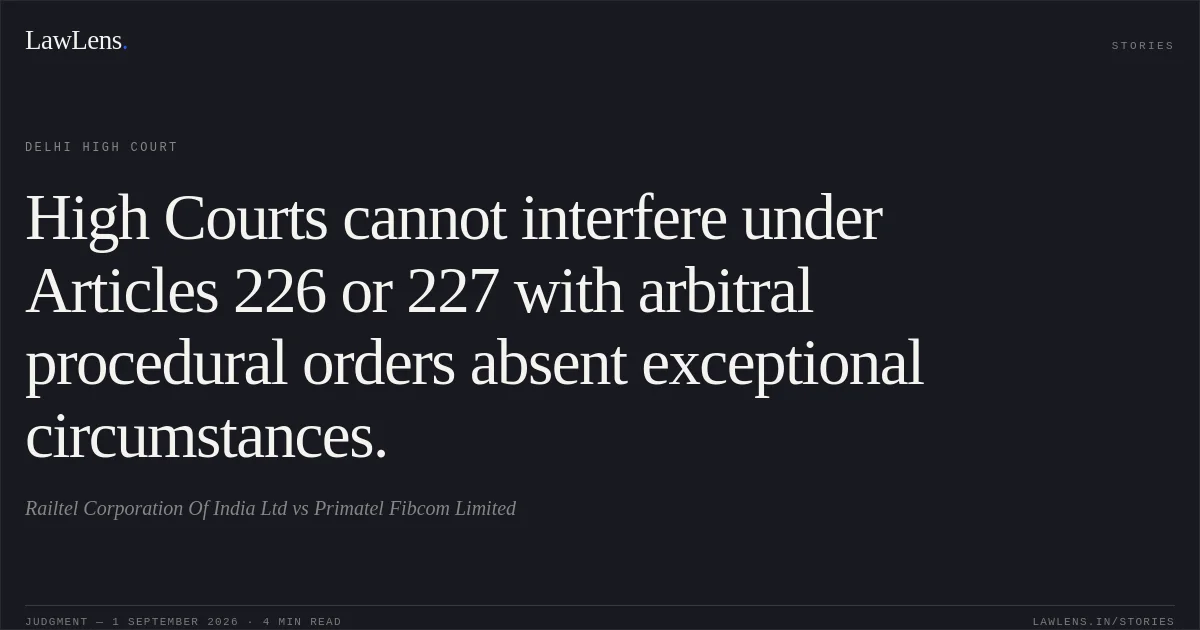
Whether a writ petition under Articles 226 and 227 of the Constitution is maintainable against an interlocutory procedural order of an Arbitral Tribunal during the pendency of arbitration, particularly an order declining oral evidence and cross-examination.
Source reference: paras. 9, 12–15Whether the Sole Arbitrator’s decision to adjudicate the counter-claim on the basis of the pleadings and documents, despite the direction that it be treated as a fresh and independent reference, disclosed any exceptional circumstance, patent lack of jurisdiction, perversity, or fundamental procedural illegality warranting interference.
Source reference: paras. 14–21Law Applied
The Court applied Sections 19(3) and 24(1) of the Arbitration and Conciliation Act, 1996, which confer procedural autonomy on the Arbitral Tribunal, including discretion to determine the procedure and whether oral hearings are necessary for the presentation of evidence.
Source reference: pp. 4–5, 13–14Section 18 requires equal treatment and a full and fair opportunity to present one’s case, but does not make oral evidence or cross-examination mandatory in every arbitration.
Source reference: p.2; pp. 13–14The Court relied on S.B.P. & Co. v. Patel Engineering Ltd., (2005) 8 SCC 618, holding that parties ordinarily must await the arbitral award unless a statutory appeal under Section 37 is available.
Source reference: pp. 7–8The Court relied on Deep Industries Ltd. v. Oil & Natural Gas Corporation Ltd., (2020) 15 SCC 706, limiting Articles 226/227 intervention to cases such as patent lack of inherent jurisdiction.
Source reference: pp. 8–9The Court relied on Bhaven Construction v. Executive Engineer, Sardar Sarovar Narmada Nigam Ltd., (2022) 1 SCC 75, restricting constitutional intervention to exceptional cases, including situations where the statutory framework leaves a party remediless or there is clear bad faith.
Source reference: p.9The Court also followed Future Coupons Pvt. Ltd. v. Amazon.com NV Investment Holdings LLC, 2022 SCC OnLine Del 3890, and Telecommunication Consultants India Ltd. v. B.R. Sukale Construction, 2021 SCC OnLine Del 4863, recognising that procedural decisions regarding oral evidence are ordinarily within the Tribunal’s domain.
Source reference: pp.9–10, 13–14Reasoning
The Court characterised the impugned order as an interlocutory procedural determination concerning the mode of evidentiary presentation, not an order deciding substantive rights or terminating the arbitration.
Source reference: paras. 12, 15Since there was no agreement prescribing a particular evidentiary procedure, Sections 19(3) and 24(1) empowered the Sole Arbitrator to determine whether the dispute could effectively be adjudicated on the existing pleadings and documents.
Source reference: paras. 15, 18The refusal to permit oral evidence and cross-examination, by itself, did not establish denial of a reasonable opportunity to present RailTel’s case, particularly as the Arbitrator had granted multiple hearings and opportunities for oral submissions.
Source reference: paras. 6, 15The Court further held that the direction to treat the counter-claim as a fresh and independent reference did not necessarily require the entire evidentiary procedure of the earlier arbitration to be reopened; that question remained part of the Tribunal’s procedural discretion.
Source reference: para. 19No patent lack of jurisdiction, bad faith, perversity, or fundamental procedural illegality was demonstrated. Accordingly, the case did not meet the narrow threshold for constitutional intervention during ongoing arbitration.
Source reference: paras. 20–21Holding
The High Court held that the writ petition was not maintainable as an ordinary challenge to the Arbitrator’s procedural order and that no exceptional circumstance justified interference under Articles 226 or 227.
The petition challenging the order dated 22 May 2026, along with the pending application, was dismissed.
Source reference: para. 22The Court clarified that it had expressed no opinion on the merits of the parties’ claims or defences, or on the ultimate procedure to be followed by the Arbitral Tribunal; those contentions remained open to be raised at the appropriate stage and before the appropriate forum.
Source reference: para. 23Acts & Sections Cited
7 provisions across 1 statute referred to in this judgment. Each provision opens on LawLens.
Arbitration and Conciliation Act, 19967
Original Court PDF
Railtel Corporation Of India LtdvsPrimatel Fibcom Limited
Click to open original judgment
Original judgment, available to read, download and summarize on LawLens.in