Facts
The petitioners sought quashing of FIR No. 131/2024, the charge-sheet, and the cognizance order dated 11 June 2026 in Depositor Interest Act/1/2024.
Source reference: para. 2They were prosecuted for offences under Sections 406, 420, 409, 120B and 34 of the IPC and Sections 6 and 10 of the Chhattisgarh Protection of Depositors’ Interests Act, 2005.
Source reference: para. 2The prosecution alleged that the petitioners, along with other accused persons, induced the complainants to invest money in a scheme promoted by co-accused Shiva Sahu, involving promises of doubling the deposits within eight months and paying monthly returns of 30%.
Source reference: para. 3The complainants allegedly paid approximately ₹2 crores in cash to Jhagesh Sahu pursuant to such representations and WhatsApp communications.
Source reference: para. 3The petitioners contended that there was no specific allegation that they had induced the complainants, received or dealt with the money, or possessed any proceeds of the alleged offence.
Source reference: para. 4The articles seized from Petitioner Nos. 1 and 2 consisted of mobile phones and passbooks, while those seized from Petitioner No. 3 consisted of a motorcycle and a mobile phone.
Source reference: para. 4The State opposed the petition, submitting that the FIR, witness statements and investigation material disclosed the petitioners’ involvement and that the issues raised concerned appreciation of evidence, which could not be undertaken in proceedings under Section 528 of the BNSS.
Source reference: para. 7Issues
Whether the FIR, charge-sheet and cognizance order disclosed a prima facie case against the petitioners for offences under Sections 406, 420, 409, 120B and 34 of the IPC and Sections 6 and 10 of the Chhattisgarh Protection of Depositors’ Interests Act, 2005?
Source reference: paras. 2–5, 13–17Whether the High Court should exercise its inherent jurisdiction under Section 528 of the BNSS to quash the criminal proceedings on the grounds that there was no recovery of the alleged cheated amount from the petitioners, the seized articles were ordinary personal belongings, and the petitioners’ individual roles were disputed or insufficiently established?
Source reference: paras. 4–6, 14–17Law Applied
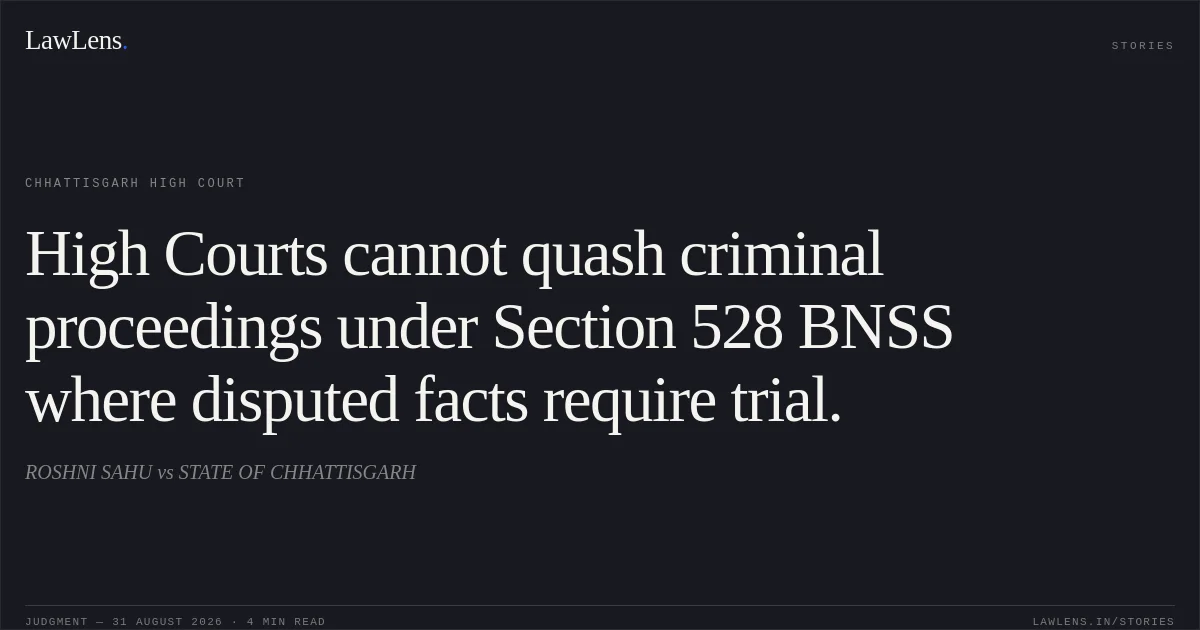
The Court applied Section 528 of the Bharatiya Nagarik Suraksha Sanhita, corresponding to the inherent jurisdiction formerly exercised under Section 482 of the CrPC, under which criminal proceedings may be quashed sparingly and only in exceptional cases where the allegations, taken at face value, do not disclose any offence or where continuation of proceedings would constitute an abuse of process.
Source reference: paras. 9, 11Relying on Rupan Deol Bajaj v. K.P.S. Gill, Rajesh Bajaj v. State of NCT of Delhi and Medchl Chemicals & Pharma (P) Ltd. v. Biological E Ltd., the Court held that proceedings should not be quashed where the allegations prima facie disclose the ingredients of an offence, though patently absurd or inherently improbable allegations may be quashed.
Source reference: para. 10Under Neeharika Infrastructure Pvt. Ltd. v. State of Maharashtra, the High Court cannot assess the reliability or genuineness of the allegations, appreciate evidence, or conduct a mini-trial while exercising inherent jurisdiction.
Source reference: para. 11The Court also relied on Pradeep Kumar Kesharwani v. State of Uttar Pradesh, applying the principle that quashing at the threshold is justified only where the accused relies on material of sterling and impeccable quality that completely demolishes the prosecution case and is incapable of being refuted.
Source reference: para. 12Reasoning
The Court held that the allegations in the FIR, read with the investigation material, could not be regarded as inherently improbable or patently absurd at the threshold.
Source reference: para. 13The absence of recovery of the alleged ₹2 crores from the petitioners and the seizure of mobile phones, passbooks and a motorcycle did not conclusively establish their innocence, because the relevance of those articles, the petitioners’ alleged role in inducing or facilitating the transaction, and the sufficiency of the investigation material required appreciation of evidence.
Source reference: para. 14The alleged delay in implicating Petitioner Nos. 1 and 2 and the defence allegation of false implication likewise raised factual matters for consideration by the trial court, rather than grounds for quashing under Section 528 of the BNSS.
Source reference: paras. 15–16Since the petitioners’ material did not completely demolish the prosecution case and the disputed questions required adjudication on evidence, the exceptional threshold for interference was not satisfied.
Source reference: para. 17Holding
The High Court answered the issues against the petitioners.
It held that the prosecution material disclosed matters requiring trial and that the case did not fall within the exceptional category warranting exercise of inherent jurisdiction under Section 528 of the BNSS.
Source reference: paras. 17–19The petition seeking quashing of the FIR, charge-sheet and cognizance order was accordingly dismissed.
Source reference: paras. 17–19The Court clarified that its observations were confined to the question of quashing and would not influence the trial court’s independent determination of the case on merits.
Source reference: para. 20Acts & Sections Cited
6 provisions across 3 statutes referred to in this judgment. Each provision opens on LawLens.
Bharatiya Nagarik Suraksha Sanhita, 20231
Indian Penal Code, 18604
Code of Criminal Procedure, 19731
Original Court PDF
ROSHNI SAHUvsSTATE OF CHHATTISGARH
Click to open original judgment
Original judgment, available to read, download and summarize on LawLens.in